
Dezincification of the P bracket

iamtjc

Well-Known Member
Joined
21 Sep 2018
Messages
85
Visit site
Boat is out of the water for the first time in my ownership.
Having removed the antifouling, the P bracket has quite a lot of dezincification.
I have fixed the corroded earthing connection (inside the boat) between the bracket and the anode , but the damage has been done.
My newbie guess is that the bracket has enough bronze left to be good for another year or so if it doesn't corrode to much further but I would value opinions of those with more experience that I.
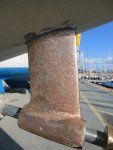
IMG_5451small.jpg
 
Boat is out of the water for the first time in my ownership.
Having removed the antifouling, the P bracket has quite a lot of dezincification.
I have fixed the corroded earthing connection (inside the boat) between the bracket and the anode , but the damage has been done.
My newbie guess is that the bracket has enough bronze left to be good for another year or so if it doesn't corrode to much further but I would value opinions of those with more experience that I.
If it is bronze it cannot dezincify ......... bronze is a copper / tin alloy.

If what you see really is dezincification it means it must be made of brass, which is a copper / zinc alloy., but see what Vyv Cox' says in the above link about the liklihood that it is manganese bronze

According to Vyv you cannot prevent dezinicification of brass with an anode.

.
 
Last edited:
When tapped with something metal does it chime or does it go thud and sound dead? If the former it's fine, if the latter it may need a closer look at.
 
If it is bronze, has the alloy reacted with the antifoul?
Should it have been epoxied or some other barrier coat?
 
As VicS says if it is indeed bronze then it should not dezincify.. Tap it with a small hammer and see if it rings and grind it lightly. There does not seem to be any pitting and suspect that is just surface discolouring. There is normally need to bond a P bracket to an anode as it is not in contact with any other metal underwater, except sometimes when stainless bolts are used for through hull bolting. In your case the bracket is attached internally probably side bolted through a web and glassed over.

However if it is indeed made of manganese bronze (effectively brass) as Vyv suggests in the link in post#2 then the dezincification will not be stopped by an anode as it occurs within the metal rather than between metals as in in a prop attached to a stainless shaft IN WATER. The only solution if it has really dezincified to the point that it has lost its strength (effectively copper because the zinc has gone) is to replace it with a proper bronze one.

Not sure it is anywhere near this stage, so if it rings, clean it up and coat it with primer and antifoul so that it is protected from water.
 
Last edited:
Painting a manganese bronze P bracket is by far the best way to protect it. A nickel aluminium bronze bracket needs no protection. A zinc anode cannot protect brass from dezincification, as it is zinc that is being lost, both at the same potential.

As usual, Hammerite special metals primer followed by whatever antifouling you prefer seems to be a good solution. My prop and P-bracket are treated like this.
 
Many thanks for all the help and advice.
The bracket didn't ring like a bell when struck but then it is constrained at the top and in a rubber mount at the bottom. It did sound like I would expect a solid block of metal to sound like though - definitely not just a dull thud.
I'll go the Hammerite special metals primer + antifoul route and turn worry mode off for another year.
 
What abotu a magnesium anode? I read that they are considered suitable for fresh and salt water use now.
I think it would be too reactive and not last long bonded to a brass or bronze item.

Where did you learn that they are now considered suitable for salt water use
 
How about an aluminium anode? More reactive than zinc but not so much as magnesium.
If I have understood my table of potentials correctly it is 0.91v between aluminium and zinc rather than 1.61v between magnesium and zinc.
What sort of voltage difference is considered ideal? (Not that we have many candidates to choose from to select an ideal anode).
 
How about an aluminium anode? More reactive than zinc but not so much as magnesium.
If I have understood my table of potentials correctly it is 0.91v between aluminium and zinc rather than 1.61v between magnesium and zinc.
What sort of voltage difference is considered ideal? (Not that we have many candidates to choose from to select an ideal anode).
Anodes are not the pure metal, but a complex alloy of three or four metals. Modern aluminium and zinc anodes have almost exactly the same potential. It sounds counter-intuitive that an aluminium anode can protect an aluminium saildrive but it is the case. There is a small potential between a zinc anode and the zinc-copper phase that is lost in dezincification but not enough to be significant.
 
Top