Describe your setup - Boom based mainsail reefing based on :

If my sail was loose-footed - I can see the point of the clew outhaul slider ... but being a 'tracked' sail - it has little use. Therefore it may be better to just tension and make fast clew at aft end of boom.
Even with a laminate sail one can still affect sail shape with an adjustable clew. ( Well I can anyway). So i would definitely leave the clew outhaul in use. I get 4 inches of movement at least
Is it me, or am I the only one who does not leave sails under tension when not in use?
I also have my boat rigged so that the clew outhaul can be used as 2 line reefing in an emergency.
 
Last edited:
Even with a laminate sail one can still affect sail shape with an adjustable clew. ( Well I can anyway). So i would definitely leave the clew outhaul in use. I also have my boat rigged so that the clew outhaul can be used as 2 line reefing in an emergency.

Fine if slugged ot loose footed ... but mine has full boltrope in track ...

Its a crap sail anyway ... its about 5cms too long on luff ... so I cannot get luff tensioned properly - the wire to rope halyard joint hits mast base sheeve just before full luff tension comes on ...

20250726_074055.jpg

I keep meaning to use a tack-line to the ramshorn to pull it down tight.
 
Sorry , I was not trying to be rude. But it does not look in proportion to the sail. But as you say, the picture may distort somewhat.
I blame the photographer :unsure: :cry:
Is it me, or am I the only one who does not leave sails under tension when not in use?

Never thought you were being rude ..... makes a change !! :eek::eek:

The light on the boom gives impression of only a small amount above those lazyjack handles ... but they are in fact halfway down the side ..
 
My boat has Selden mast / Boom combo which previous owner and yard have messed about with and now its not easy setup to reef the main. PLus its not obvious how the original was setup before they pulled it apart !

Description :

Goosenech end has sheeve either side of gooseneck. These receive the port and stbd reefing lines (they go back to clutches on aft coachroof).
There are two jamming clutches underneath the gooseneck end of the boom - but seems nothing is controlled by them.
Either side of gooseneck are ramshorns for luff cringle eyes.
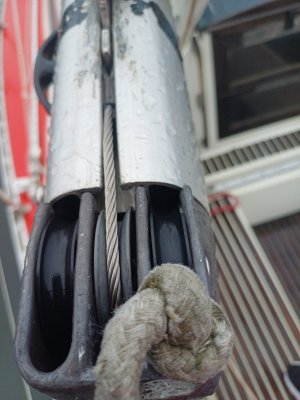
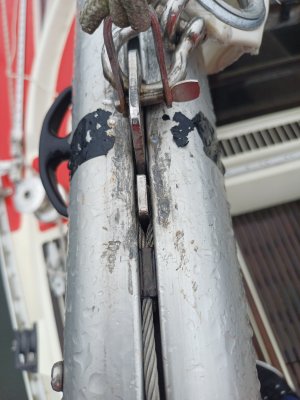
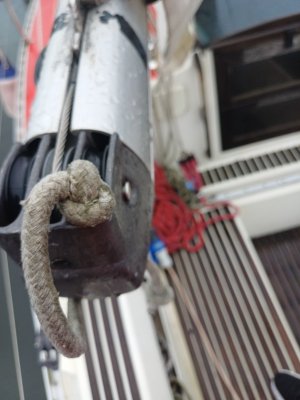
Aft end of boom has three sheeves ... centre one has the clew outhaul slider that runs in the boom track. The stbd sheeve has a reefing line exiting - but not fastened to sail .. its just hanging out end !
I assumed from the little seller said about it - he would just make it fast to which ever cringle eye he decided to reef to ...


The port reefing line has been used to connect to the wire cable based outhaul slider via centre sheeve, that is supposed to slide in the boom track. It is very hard to get it to move ! Mainsail is bolt-roped in the track.
The stbd reefing line has been led through to other aft end sheeve and just dangles free. Port sheeve is empty.

I have checked on Seldens site and they concentrate on the single line system ... with nothing about the jamming cleats / three sheeves boom end etc. The single line system having a 'traveller inside the boom that allows luff and leech reefing pendants to be pulled as one ... meaning operator reefs from the coachroof clutch without need to go the mast. I wonder if this was system in my boom - as it has a terrible harmonic buzz when no sail hoisted - giving impression something metal is inside ..
But if this is the case - why the two jammers at gooseneck end etc.
(Note I have Selden details of the internal boom reef system .... ).

What I'm hoping is that someone may have similar setup and can lead me to install similar working reef. At present - if I want to reef, I am basically stuck with doing it when first hoisting sail - I would not like to try when conditions are bad to try and reef a full sail ..

Ignore the following I missed half of this thread....... :censored:


I may be missing the point here but -

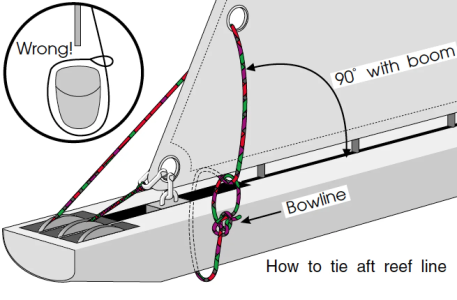
I had a similar set up I think. They provide for only two reefs and the centre one controls the outhaul, as you say. This is it in essence:

1753807603820.png

Though you won't need the bowline because you will, in all probability, have a lacing eye on the boom. At the mast end of the boom there will be three cam cleats to fix the end of the reefing lines and outhaul, except they often don't which might explain the two jammers at the gooseneck end.

To operate take tension off the sail, pull the boom end of the reefing line (hopefully you will have a small winch on the mast) till the leach of the sail comes down to the boom, cleat. Put the appropriate cringle over the rams horn. Re-tension the main, and away you go.

I should get this working slickly at the mast before thinking about stuff going back to the cockpit. Personally I prefer to do everything at the mast anyway.

.
 
Fine if slugged ot loose footed ... but mine has full boltrope in track ...
My laminate sail has a bolt rope foot as well but it still moves in the track
It sounds as if you need to change the halyard to dynema. It may well sit in the existing wire pulley if you get a small diameter high qua;lity halyard. My one has 4 tonne plus SWL & will lift the boat & is less than 8mm diameter. If your sail is too long then it does not cost much to have 6 inches cut off the head which is what I did with my first stock sail delivered with the boat when I wanted to get more luff tension on it. A rope halyard will enable you to do away with shackles at the head & bowlines etc & that will allow an extra lift at the head. Just loop the sail through the cringle then the tail through the loop & knot the tail
 
My boat has Selden mast / Boom combo which previous owner and yard have messed about with and now its not easy setup to reef the main. PLus its not obvious how the original was setup before they pulled it apart !
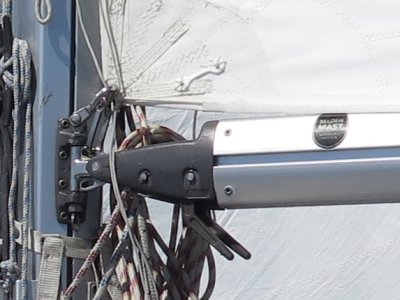
My Seldén boom might be similar to yours, though probably one size smaller. Does it look like that in the attached photo?
If so, it seems to me that the previous owner has lost or removed the outhaul control line and then used the port reef line for the outhaul.
There should originally have been three sheaves at the goose neck, and also three jammer levers. The ones at the centre for the outhaul and the SB and port ones for 1st and 2nd reef respectively.
I think it might be a good idea to try and restore the outhaul, so that you can have two functional reefing lines (provided that the sail has two reefs). The outhaul should have a tackle (4 part in the case of my boom) in the forward section of the boom, so that the outhaul car can be moved with greater force.
The casting at the mast end of the boom will come off the extrusion once you drill out the four rivets.

seldenboom.jpeg
 
Hi Nigel. I did watch your video and commented a bit on mainsail arrangement.
Firstly the outhaul should be considered separate to reefing. The wire connected to rope inside the boom should be ok. It might even have a sheave on the wire to give a 2 purchase. But essentially the outhaul should end up on cabin top where it can be winched to get tension.
As I said I would consider using the outhaul tackle to go to the flattening reef and just lash the bottom outhaul to suit mild conditions. Yes a cunninngham or tackle from eyelet in luff down to deck can give a full flattening reef (like a half reef) . Will also help luff too long.
The slider on clew to boom will be difficult to move under load and yes you cna get some movement of foot of sail with outhaul it obviously won't be a lot. Or at least you won't be able to release the foot much. Yes I like the velcro or even just a few turns of rope around the boom.
One trick re luff too long I used was to take the eyelet in the wire down to a point where a bolt fitted through with the eyelet on the side of the head board. I made a little bit of ss metal with a slot in it so that the wire eyelet and swage went through it. On the other end was a hole to suit the bolt. So the bit of metal took load on one side and wire eyelet the other. Took away the gap between the head of sail and mast top caused by using a shackle.
I have recently replaced my wire and rope main halyard with dyneema and rope. The splice was easy enough and seems to pass out through the hole in the mast near the bottom easily. (winte rhere so haven't actually tested it in anger.
Now reefing. Doug 748 system should be ok You would need to fit a saddle on side of boom to attach rope rather than bowline around the boom. Just make it a strong saddle as this will take all the load of the main sheet when boom pulled down. (beating) You can just tie the reefing line to the eyelet but this way gives 2 purchase albeit with risk of chafe at eyelet. Keep an eye on condition of rope here or even fit a sheave block on sail. If you have 3 sheaves at end of boom then you can thread up a second reef with another saddler further forward to suit the reef eyelet position when reefed.
I have never liked single line reefing. The use of rams horns for tack is ok but does require a man to attach tack to the rams horn in any way you have. VBastly better in opinion is to take another line from tack down to a turning block on deck and back to a winch and or jamber. This line should start at a sdaddle on the side of the mast below the goosenecik and as far forward as possible such that the line runs at 45 degrees to boom and mast to the tack eyelet. From the tack eyelet it shoukld run forward and down to a turning block or in my case just a saddle to turn the line from 45 degrees to straight down then turn on deck back to winch.
Yes for 2 reefs that is extra lines lieing around. A front reefing line and clew reefing line for each reef.
But it does mean you can pull a reef in from cockpit. No need for gaskets around the bunt unless you want tidiness.
The clew reefing lines will go down through the boom and will need a sheave box in the under side of front of boom to allow lines to turn down ward then turning block again and back to winches.
So on my little boat I have 4 (small) winches on cabin top. One for jib halyard one for clew reefing line. On other side one for out haul and one for main halyard. The outhaul winch becomes tack reefing line winch as outhaul becomes redundant. Lines stay on the winches with simple horn cleats after winch. (winches at the time were comparable in cost to a jamber) I can pull a reef in seconds without use of topping lift provided boat is beating to windward. (whenreef need becomes apparent.)
Yes I actually only use one reef but can onvert to second reef before departure. ol'will
 
OK ... here we go with some piccies .... not ignoring you Will .. DB ... BY etc ... all read and appreciated ..

20250730_115401.jpg

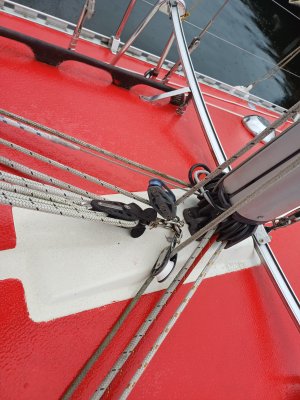
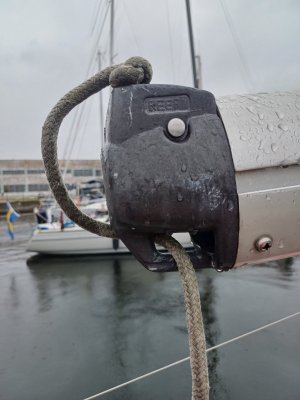
Here you see the two 'reef lines point vertical to boom end where they enter boom sheeves

20250730_115416.jpg

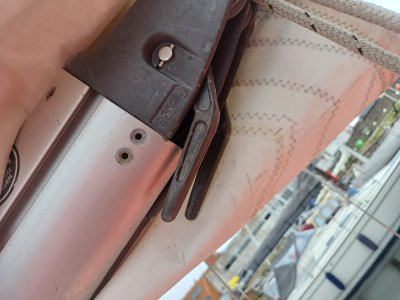
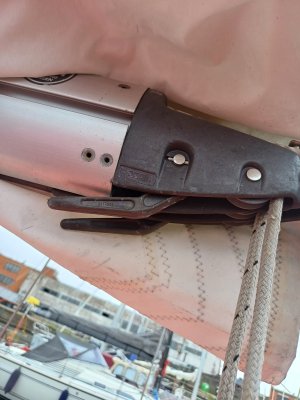
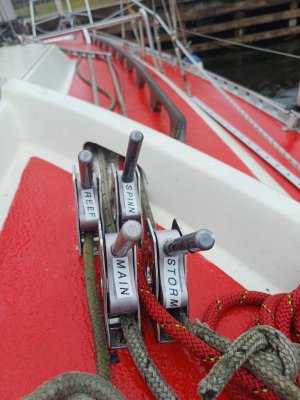
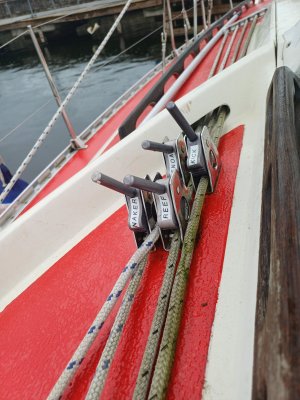
Here you see two jammers at gooseneck end ... not 3.

20250730_115418.jpg

Here you see - if you look carefully in front of jammers ... 3 sheaves, but jammers only on the outer 2.

The port reef line has been moved to the central sheeve for the outhaul.

20250730_115509.jpg

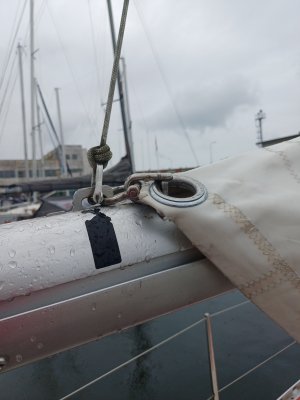
Boom aft end ... you see stbd reef line with stopper ... cable from port reef line to sail clew slider.

20250730_115517.jpg

For Regatta reg'n - the mast and boom max points are marked ... gooseneck to mast ... clew outhaul on boom.

20250730_115528.jpg

20250730_115524.jpg

20250730_115607.jpg

Stbd clutches

20250730_115611.jpg

Port clutches.

Marvelous tool - Brother Label maker !

So ... as we can see - guy has moved port reef line to central gooseneck sheeve instead of its correct place at port sheeve. The outhaul line has obviously been removed or lost. To sort this outhaul - I think it may need a small cleat under boom - cut the reef line and then make fast to boom cleat. Then run a new port reef line to exit that spare sheeve at aft end similar to the existing stbd one. This will then give me the two reef lines I need ...
At gooseneck - I would like to be able to run reef lines back to cockpit - but I don't think it will be so easy as all clutches are in use .. so looks like a tack line to the ramshorn at gooseneck ... simple and quick.

Sail tidy's can be added to the small horizontal eyes in sail - as it has slab reef points.... but no lanyards in. Lashing round boom I prefer instead of using the lazy jack fixings.
 

Attachments

  • 20250730_115512.jpg
    20250730_115512.jpg
    1,005.2 KB · Views: 4
Hi Nigel. I did watch your video and commented a bit on mainsail arrangement.
Firstly the outhaul should be considered separate to reefing. The wire connected to rope inside the boom should be ok. It might even have a sheave on the wire to give a 2 purchase. But essentially the outhaul should end up on cabin top where it can be winched to get tension.
[/QUOTE]

Ideally - but no spare clutch and I am not goping to add anymore.

As I said I would consider using the outhaul tackle to go to the flattening reef and just lash the bottom outhaul to suit mild conditions. Yes a cunninngham or tackle from eyelet in luff down to deck can give a full flattening reef (like a half reef) . Will also help luff too long.
[/QUOTE]

Clew can be sorted by using the existing cut short and cleated under boom. The luff can be sorted by tackline to ramshorn one side as I have the dual arrangement..... one each side.
The slider on clew to boom will be difficult to move under load and yes you cna get some movement of foot of sail with outhaul it obviously won't be a lot. Or at least you won't be able to release the foot much. Yes I like the velcro or even just a few turns of rope around the boom.
One trick re luff too long I used was to take the eyelet in the wire down to a point where a bolt fitted through with the eyelet on the side of the head board. I made a little bit of ss metal with a slot in it so that the wire eyelet and swage went through it. On the other end was a hole to suit the bolt. So the bit of metal took load on one side and wire eyelet the other. Took away the gap between the head of sail and mast top caused by using a shackle.
[/QUOTE]

Head is by small shackle to wire halyard. I understand your idea - but think easier just to pull down at gooseneck.

I have recently replaced my wire and rope main halyard with dyneema and rope. The splice was easy enough and seems to pass out through the hole in the mast near the bottom easily. (winte rhere so haven't actually tested it in anger.
[/QUOTE]

I am not a great supporter of wire to rope halyards ... much prefer all rope - even though you can get stretch etc. I am thinking that end of year - mast will come down to sort out MHU / Windex / flag halyards / service head sheeves etc ... may take opportunity to swap out halyards for new.

Now reefing. Doug 748 system should be ok You would need to fit a saddle on side of boom to attach rope rather than bowline around the boom. Just make it a strong saddle as this will take all the load of the main sheet when boom pulled down. (beating) You can just tie the reefing line to the eyelet but this way gives 2 purchase albeit with risk of chafe at eyelet. Keep an eye on condition of rope here or even fit a sheave block on sail. If you have 3 sheaves at end of boom then you can thread up a second reef with another saddler further forward to suit the reef eyelet position when reefed.
I have never liked single line reefing. The use of rams horns for tack is ok but does require a man to attach tack to the rams horn in any way you have. VBastly better in opinion is to take another line from tack down to a turning block on deck and back to a winch and or jamber. This line should start at a sdaddle on the side of the mast below the goosenecik and as far forward as possible such that the line runs at 45 degrees to boom and mast to the tack eyelet. From the tack eyelet it shoukld run forward and down to a turning block or in my case just a saddle to turn the line from 45 degrees to straight down then turn on deck back to winch.
Yes for 2 reefs that is extra lines lieing around. A front reefing line and clew reefing line for each reef.
But it does mean you can pull a reef in from cockpit. No need for gaskets around the bunt unless you want tidiness.
The clew reefing lines will go down through the boom and will need a sheave box in the under side of front of boom to allow lines to turn down ward then turning block again and back to winches.
So on my little boat I have 4 (small) winches on cabin top. One for jib halyard one for clew reefing line. On other side one for out haul and one for main halyard. The outhaul winch becomes tack reefing line winch as outhaul becomes redundant. Lines stay on the winches with simple horn cleats after winch. (winches at the time were comparable in cost to a jamber) I can pull a reef in seconds without use of topping lift provided boat is beating to windward. (whenreef need becomes apparent.)
Yes I actually only use one reef but can onvert to second reef before departure. ol'will

Last bit - understood ... but want to keep additional fittings to a mininum ... try to sort with existing.
 
One of the three sheaves at the gooseneck, the one without the jammer, is for the clew out haul, which likely was designed to be lead aft for control at cockpit, hence no jammer. They were also fitted with jammers at gooseneck to be used with pendant winch on aft part of mast, below gooseneck.

Your boom is a fairly standard set up, 2 reefs, clew outhaul, jammers at gooseneck end for reefs, cockpit control. With a bit of thought, blocks, jammers in cockpit, lines, the reefing tacks could be set up for cockpit control as well. If topping lift is lead back to cockpit, mainsail reefing could all be done from there (assume main halyard is in cockpit).

My own opinion is all mast or all cockpit, splitting controls between mast and cockpit is more awkward if short handed.

Should be simple to sort out. If you get a new main, go for loose footed and eliminate the flattener and cuningham.

With your current main, hoist restricted, you need a cuningham to get luff tension to manage camber position. This was likely always the case if racing, and you hoisted to the black band at the top of the mast.
 
One of the three sheaves at the gooseneck, the one without the jammer, is for the clew out haul, which likely was designed to be lead aft for control at cockpit, hence no jammer. They were also fitted with jammers at gooseneck to be used with pendant winch on aft part of mast, below gooseneck.
If you look at the picture in post 23, there are rivet holes on the aft face of the mast. These are for the mounting plate of the winch that used to serve the reefing lines and outhaul line when reefing and outhaul control all was done at the mast. So originally there wound have been a jammer at the gooseneck also for the outhaul.
The winch on the mast was probably removed when the reefing lines were rerouted to the cockpit. Difficult to know what happened to the outhaul, the jammer might well have remained at the gooseneck, but then a winch is handy if you want to stretch the foot while sailing.
I agree with the rest of your post.
 
Top