Deliberately starting an anchor thread.

Simple question.

Does your anchor hold when its windy.

1. No. Get bigger anchor.

2. Yes. No further action required.

:)

Please don’t confuse people with technical mumbo jumbo.


Ps... your wrong about the first bit.

If it’s not holding.... let out more chain.
 
Simple question.

Does your anchor hold when its windy.

1. No. Get bigger anchor.

2. Yes. No further action required.

:)

But yes is really annoying as there’s no excuse to go up to the brilliance of a much larger NG anchor. Even if you want one it can’t be logically justified against the items you actually need.

I want to find out what people do to get a Delta or CQR to drag.
 
But yes is really annoying as there’s no excuse to go up to the brilliance of a much larger NG anchor. Even if you want one it can’t be logically justified against the items you actually need.

I want to find out what people do to get a Delta or CQR to drag.

I have found that anchoring on a short scope in about two metres on the edge of a deep hole (see post 1.) works well. This works particularly well on glacier terminal moraines in fjords. These tend to be thick blue clay, which anchors just slide off, but if you would like to practice, there’s quite a good place at Stone Point, in Walton Backwaters. Don’t ask me how I know this.

I am told that poking the sharp end into a tin can can work, too.
 
Last edited:
I'll try again. Yes, manufacturers link displacement and size, but it's not a linear relationship. They normally recommend a 20% increase in size for a 100% increase in displacement.
Maybe that’s for one particular size step up, but the relationship between anchor weight and displacement is very different from what you are suggesting. It may be explained by models being slightly modified to cover different displacements and that one goes over the step to the next anchor model range.

Look here and with a large size range the relationship is fairly clear. Boat displacement is very roughly proportional to anchor weight and the square of the anchor surface area:

https://www.mantusmarine.com/mantus-anchor-knowledgebase/anchor-sizing/

The size guide really needs to take account of windage and displacement and the degree a boat sails at anchor. Boat length is a rough analogy of windage and no consideration of sailing at anchor is given. It can only be a very rough guide.
 
The size guide really needs to take account of windage and displacement and the degree a boat sails at anchor. Boat length is a rough analogy of windage and no consideration of sailing at anchor is given. It can only be a very rough guide.

The sizing guides have been honed over decades and in general have not been found wanting. One thing that has happened is that for a given size, length of yacht, they now carry more windage and are lighter.

One would have thought that the spreadsheets are cautious -erring on the side of safety and not erring to encourage people to buy a cheaper (smaller) anchor.

Sadly - we don't know in must cases why an anchor drags and is possibly due to a number of characteristics of yacht, how the rode and anchor was laid, the seabed and weather. Unless people document with as much data as possible instances where they dragged our information base is - negligible.

I can pontificate, as can others, but we have no certainty - just educated guesses.

There are attempts to quantify conditions that could lead to dragging - but testing is tough and one test is only part of the rather muddled combination of factors.

It is well known, and thoroughly documented, that very short scope reduces holding capacity - but that the 2nd Gen anchors have better hold at short scope than the 1st gen anchors. How yawing and hobby horsing impact hold - there are strong suspicions, - but quantification has been limited, till recently. The effects of constant tugging by the chain on shear strength of the substrate has been documented - but what it means is more difficult to interpret. Larger anchors are held up as a panacea - but actually defining why they might be safer - is currently explained by - its common sense.

We have a way to go

Jonathan
 
Last edited:
The sizing guides have been honed over decades and in general have not been found wanting. One thing that has happened is that for a given size, length of yacht, they now carry more windage and are lighter.

One would have thought that the spreadsheets are cautious -erring on the side of safety and not erring to encourage people to buy a cheaper (smaller) anchor.

Sadly - we don't know in must cases why an anchor drags and is possibly due to a number of characteristics of yacht, how the rode and anchor was laid, the seabed and weather. Unless people document with as much data as possible instances where they dragged our information base is - negligible.

I can pontificate, as can others, but we have no certainty - just educated guesses.

There are attempts to quantify conditions that could lead to dragging - but testing is tough and one test is only part of the rather muddled combination of factors.

It is well known, and thoroughly documented, that very short scope reduces holding capacity - but that the 2nd Gen anchors have better hold at short scope than the 1st gen anchors. How yawing and hobby horsing impact hold - there are strong suspicions, - but quantification has been limited, till recently. The effects of constant tugging by the chain on shear strength of the substrate has been documented - but what it means is more difficult to interpret. Larger anchors are held up as a panacea - but actually defining why they might be safer - is currently explained by - its common sense.

We have a way to go

Jonathan
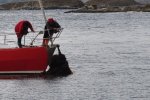
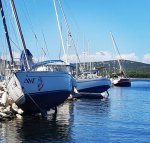
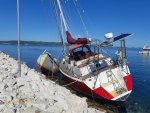
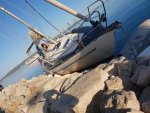
Maybe you could ask these guy Jonathan why he drag?
 

Attachments

  • IMG_0339.JPG
    IMG_0339.JPG
    208.9 KB · Views: 0
I have hundreds of these photos , people talk here as if it happen now and then and when it does , the end result is no big deal , I seen other wise time and time again ,
Get your self a good anchor and good chain and learn how to use it .
 
I want to find out what people do to get a Delta or CQR to drag.

CQRs can do it without assistance from people. I have dived on very many anchors in the Mediterranean, included in which were a good few CQRs. I have never seen a single one that had behaved as it was designed to do, i.e. roll through 90 degrees with the tip down. The photo shows a typical one, this in winds around force 4 I think. It may be that the relatively hard seabed of the Aegean is a contributory factor.


So far as Delta is concerned I used them for many years on three different boats and was always very happy with them. But in Vliho Bay, fairly soft mud, in combination with winds gusting to 50 knots in a microburst storm ours dragged three times within a short period of time. That was when I resolved to buy a Rocna.
 
I walked along a pontoon on Saturday counting anchors:

The stand out was Arthur Ransome’s 1930s Hillyard cutter “Nancy Blackett” with her CQR on the foredeck and her Wykeham Martin furler. She was the only wooden boat and the smallest. All other boats carried their anchor in the bow roller

Five Bruces, one was stainless steel - this may include some Lewmar Claws).

Four more CQRs not counting Nancy. Two genuine, two fake.

Eight Deltas

Two Spades, one extremely rusty all over, one still with some yellow paint on it.

Two Rocnas, one 15 and one 33 - on similar boats.

One Danforth- ish.

One Manson Supreme

No Mantus, no Vulcan, no Guardian, no Fortress.
 
I walked along a pontoon on Saturday counting anchors:

The stand out was Arthur Ransome’s 1930s Hillyard cutter “Nancy Blackett” with her CQR on the foredeck and her Wykeham Martin furler. She was the only wooden boat and the smallest. All other boats carried their anchor in the bow roller

Five Bruces, one was stainless steel - this may include some Lewmar Claws).

Four more CQRs not counting Nancy. Two genuine, two fake.

Eight Deltas

Two Spades, one extremely rusty all over, one still with some yellow paint on it.

Two Rocnas, one 15 and one 33 - on similar boats.

One Danforth- ish.

One Manson Supreme

No Mantus, no Vulcan, no Guardian, no Fortress.

I don't think I ever seen a fortress on a bow , but many including ourself Carry one on the boat .
On the cruising scene we very rearly see a CQR , most common is the Delta , I guess the reason is there many newest boats about and most come with a Delta , that's followed by Rocna , Manson and Mantus and the Bugel .
If you talk to anyone who just up graded his anchor many will say their old anchor was a Delta but they lost confronted in it when it drag , that not to say it was the Anchor fault when you see how they anchor .
 
I walked along a pontoon on Saturday counting anchors:

The stand out was Arthur Ransome’s 1930s Hillyard cutter “Nancy Blackett” with her CQR on the foredeck and her Wykeham Martin furler. She was the only wooden boat and the smallest. All other boats carried their anchor in the bow roller

Five Bruces, one was stainless steel - this may include some Lewmar Claws).

Four more CQRs not counting Nancy. Two genuine, two fake.

Eight Deltas

Two Spades, one extremely rusty all over, one still with some yellow paint on it.

Two Rocnas, one 15 and one 33 - on similar boats.

One Danforth- ish.

One Manson Supreme

No Mantus, no Vulcan, no Guardian, no Fortress.

My experience is similar in your area. A few years ago I gave a talk at Royal Harwich YC and during our stay walked around their marina looking at anchors. I counted something like 20 CQR types, most of which were copies, many very poor ones. Very few NG anchors, or maybe none.

But if I did the same at Leros, where most owners have sailed a long way and anchor regularly I would find almost exactly the opposite. Mostly NG anchors of various types, still a few Bruces or copies, rather more Deltas dependent upon how many charter boats were in, and maybe one or two CQRs.
 
My experience is similar in your area. A few years ago I gave a talk at Royal Harwich YC and during our stay walked around their marina looking at anchors. I counted something like 20 CQR types, most of which were copies, many very poor ones. Very few NG anchors, or maybe none.

But if I did the same at Leros, where most owners have sailed a long way and anchor regularly I would find almost exactly the opposite. Mostly NG anchors of various types, still a few Bruces or copies, rather more Deltas dependent upon how many charter boats were in, and maybe one or two CQRs.

Looking around marinas on the West Coast of Scotland I have noted that CQR and copies dominate, on at least 50% of boats. A lot of Deltas and a fair number of Bruces among the rest. The exception is Ardfern, where there are a lot of Rocnas - this perhaps reflects Ardfern's being the Rocna agents as much as anything else. Mind you, most boats up here aren't based in marinas, so the sample was very skewed.
 
My experience is similar in your area. A few years ago I gave a talk at Royal Harwich YC and during our stay walked around their marina looking at anchors. I counted something like 20 CQR types, most of which were copies, many very poor ones. Very few NG anchors, or maybe none.

But if I did the same at Leros, where most owners have sailed a long way and anchor regularly I would find almost exactly the opposite. Mostly NG anchors of various types, still a few Bruces or copies, rather more Deltas dependent upon how many charter boats were in, and maybe one or two CQRs.

Coming from many years of sailing the east coast , I can explain why CQR work well , it's all down to the east coast mud , before I took off sailing dar from home ,maybe now touching 30 years ago I swored by my CQR , god helped anyone who said anything bad ,
Within 3 months in southern Spain it was given a good home , it did a good job holding the bar door open .
 
Top