
Deep Sea Seal versus PSS shaft seal?

Puggy

Well-Known Member
Joined
7 May 2007
Messages
390
Location
Hampshire, UK
Visit site
Anyone got any views or experience of the pros and cons of each type? Trying to decide which to fit.

Thanks

Background:
I have a 1984 Nauticat 43 sailing ketch with a Ford 90hp 2722 engine and a Borg warner hydraulic gearbox, driving a 40mm prop shaft at quite low rpm (max engine rpm is 2500 but don’t use more than 2100 in normal use). At the moment I have a Volvo dripless seal system. I did an extensive refit of the boat last year, including a new R&D shaft clamp and R&D flexible plastic shaft coupling, and this entailed moving the prop shaft backwards by 25mm so that the Volvo seal now runs on a different part of the shaft. Despite careful cleaning of the shaft, and replacement of two new Volvo seals, I have a continuous leak of water when the shaft is turning, and the volume of the leak is directly related to the speed of the shaft. The shaft runs true and there is no eccentric movement of the shaft.

So.. What I plan to do is change the seal system from a lip seal to a face seal system. Either the PSS seal or the deep sea seal system looks a candidate. I don’t have a water feed to the seal at the moment but this can easily be installed.
The stern tube diameter is 58mm
The prop shaft diameter is 40mm
There is 230mm clearance from the stern tube to the shaft electrical earthing brushes.

There is a picture of the existing setup attached below.
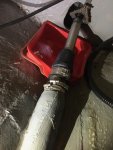
IMG_6773.jpg
 
There is something seriously wrong if you are getting leaks on a clear shaft and a new seal. It sounds like the lips are inverting - are you using the device supplied with the seal to install it - that keeps the lips in the right orientation. Of the face seals the PSS is the best engineered, but you might also want to look at Tides Marine which are also lip seals but on some models the seals are replaceable. You have more than enough space for either. A Radice version of the Volvo seal is an improvement as it has a greasing point and a built in water injection/vent fitting.

However first I would check the actual diameter of the shaft where the seals are running and the size of actual seal you have as the only way water can leak past a new seal is through a gap because of a mismatch in sizes or inverted lips.
 
There is something seriously wrong if you are getting leaks on a clear shaft and a new seal. It sounds like the lips are inverting - are you using the device supplied with the seal to install it - that keeps the lips in the right orientation. Of the face seals the PSS is the best engineered, but you might also want to look at Tides Marine which are also lip seals but on some models the seals are replaceable. You have more than enough space for either. A Radice version of the Volvo seal is an improvement as it has a greasing point and a built in water injection/vent fitting.

However first I would check the actual diameter of the shaft where the seals are running and the size of actual seal you have as the only way water can leak past a new seal is through a gap because of a mismatch in sizes or inverted lips.

Yes agreed something is wrong. I can't work out what. I have fitted two new seals now and I carefully checked that the lips were not inverted on the last one. Also, searching on the forums, it seems over-greasing could cause problems, so I have been careful about that. I thought it must be either the shaft is narrower at that point but I have checked with a micrometer and it is pretty much in tolerance, or that the shaft is scored and that is drawing water up, but it smoothed and polished. I am at a loss. Previously I had Volvo seals and they worked on the same shaft perfectly. Just moving it seems to have upset everything. ANy ideas gratefully received and will be tried as it would be a lot less hassle to fix this.
 
Anyone got any views or experience of the pros and cons of each type? Trying to decide which to fit.

Thanks

Background:
I have a 1984 Nauticat 43 sailing ketch with a Ford 90hp 2722 engine and a Borg warner hydraulic gearbox, driving a 40mm prop shaft at quite low rpm (max engine rpm is 2500 but don’t use more than 2100 in normal use). At the moment I have a Volvo dripless seal system. I did an extensive refit of the boat last year, including a new R&D shaft clamp and R&D flexible plastic shaft coupling, and this entailed moving the prop shaft backwards by 25mm so that the Volvo seal now runs on a different part of the shaft. Despite careful cleaning of the shaft, and replacement of two new Volvo seals, I have a continuous leak of water when the shaft is turning, and the volume of the leak is directly related to the speed of the shaft. The shaft runs true and there is no eccentric movement of the shaft.

So.. What I plan to do is change the seal system from a lip seal to a face seal system. Either the PSS seal or the deep sea seal system looks a candidate. I don’t have a water feed to the seal at the moment but this can easily be installed.
The stern tube diameter is 58mm
The prop shaft diameter is 40mm
There is 230mm clearance from the stern tube to the shaft electrical earthing brushes.

There is a picture of the existing setup attached below.

View attachment 66354

Before you fitted the R&D flexible plastic shaft coupling what type of coupling did you have. Also how is the shaft supported at the volvo seal.

If you had a rigid coupling the addition of a flexible coupling would allow the shaft to move more radially thus distorting the seal.

In any stern shaft setup you have 3 elements the engine the shaft and the coupling. Only 2 of these can be flexible and the third must be rigid.

If you had a flexible engine shaft and rigid coupling this would be fine but with the additional of a third flexible element you have cause this leak to occur.

I have a rigid shaft and flexible coupling and engine mounting. I also have a PSS seal on a 40mm dia shaft and have had no problems or water ingress since fitting 8 years ago.
 
The stern tube diameter is 58mm
The prop shaft diameter is 40mm

Strictly speaking, the Volvo shaft seal is out of tolerance. For a 40mm shaft, the stern tube diameter should be 59.7mm minimum. I don't know whether you might be distorting the seal enough to cause a leak.
 
Hi. I had the same setup before. He components were replaced as the previous clamp had cracked. The shaft is supported by a cutlass bearing in the stern tube and also one in the P bracket. There is minimal play in these two as both are low hours. The Volvo seal is not supporting any weight. There is no movement in the shaft when rotating - everything is nicely aligned. The engine in on Trelborg engine mounts which were new is 2011.

Thanks p
 
Strictly speaking, the Volvo shaft seal is out of tolerance. For a 40mm shaft, the stern tube diameter should be 59.7mm minimum. I don't know whether you might be distorting the seal enough to cause a leak.

That's an interesting theory. I suppose that's possible. I will look into that. Thanks.
 
I changed from a Tides marine to a PSS. I my case this was because of corrosion ( thought to be crevice corrosion) at the lip. The PSS has been fine for 2 years now.
Assuming that there is no clear solution to your lip seal problem then, like others on this thread, I would recommend the PSS>
 
I've had both types of deal, on my previous boat it was a deep sea seal, never dripped, on my current boat the ***** PSS failed, cost my insurance company mega money. The insurance companies surveyed had found these seals to fail often, probably more than any other, my boat now has a conventional stuffing box, half the cost and pretty foolproof.
So get a stuffing box, virtually nothing to go wrong, DON'T put a PSS in, just Google PSS failures and see what I mean.
Best of luck
 
Hi. I had the same setup before. He components were replaced as the previous clamp had cracked. The shaft is supported by a cutlass bearing in the stern tube and also one in the P bracket. There is minimal play in these two as both are low hours. The Volvo seal is not supporting any weight. There is no movement in the shaft when rotating - everything is nicely aligned. The engine in on Trelborg engine mounts which were new is 2011.
Hi first thing I would is remove the cutlas bearing from the stern tube, give it a try without it. There is no allowance for engine movement or out of alignment no matter how small, my westerly Corsair like others is supported at the 'P' bracket and the engine this gives some tolerance for engine moving and alignment.
Mike
Thanks p
 
And if you should google "PSS failures" the first hit to pop up concerning stern seals is from this very forum:
http://www.ybw.com/forums/archive/index.php/t-271624.html


Yes, a very curious case.


".......The insurance companies surveyed had found these seals to fail often, probably more than any other..."


Really? I tried the Google search but confess I did not get a whole lot of different problems, mainly just the same one or two.
 
Not sure about loads of reports of failures, searches seem to bring the same ones up repeatedly. The DSS design is not that different to well tried designs used in non marine seals in their tens of thousand and in just as demanding environments with quite nasty stuff on the other side, and they seem to be ok. Stuffing glands do fail and mist industry's stopped using them many years ago because they fail. You ask any of the older industrial refrigeration engineers about liquid ammonia pumps and maintaining stuffing glands.
 
I had a PSS on a previous boat (Anderson 26) and didn't like it. Every time I had anything to do at the aft end of the engine a touch on the seal resulted in a stream of water... I replaced it with a Volvo, but am so hsppy with the stuffing gland on Gladys
 
Yes, a very curious case.


".......The insurance companies surveyed had found these seals to fail often, probably more than any other..."


Really? I tried the Google search but confess I did not get a whole lot of different problems, mainly just the same one or two.

+1 my search did not bring up evidence of massive failures on PSS seals. One long saga concerned a seal that turned out not to be a PSS but some kind of cheap fake!
 
I've had both types of deal, on my previous boat it was a deep sea seal, never dripped, on my current boat the ***** PSS failed, cost my insurance company mega money. The insurance companies surveyed had found these seals to fail often, probably more than any other, my boat now has a conventional stuffing box, half the cost and pretty foolproof.
So get a stuffing box, virtually nothing to go wrong, DON'T put a PSS in, just Google PSS failures and see what I mean.
Best of luck

Total opposite for me. Deep Sea Seal failed totally in a matter of moments and flooded the engine compartment until the belts started slipping and that was my first indication, hundreds of gallons in a very short time causing the boat to list. PSS seal was perfect and never gave any problems.
 
I have a similar set up, nauticat 38 motorsailor, ford engine, borg warner velvetdrive and 40mm shaft. I fitted a PSS about 8 or 9 years ago and its been very good I have no regrets. Just be sure to follow the instructions carefully. You can now fit a vent pipe to them and terminate it above the waterline so that you dont have to burp them after launching.
 

Other threads that may be of interest

Top