Deck Paint

If you want easy, but not that long lasting then a single part paint will do fine.

For longevity and best appearance I think its worth taking the time, tons of guides out there.
I used awl-grip particles on this cockpit cover, with a Jotun 2 part semi-gloss available from SML.
Colour matched to the correct RAL cover.

Two coats of paint, particles sprinkled on when wet, brushed off when dry and then a final sealer coat of paint over the top.

View attachment 209482
View attachment 209483
That is to my eye really excellent work.
 
If you want easy, but not that long lasting then a single part paint will do fine.

For longevity and best appearance I think its worth taking the time, tons of guides out there.
I used awl-grip particles on this cockpit cover, with a Jotun 2 part semi-gloss available from SML.
Colour matched to the correct RAL cover.

Two coats of paint, particles sprinkled on when wet, brushed off when dry and then a final sealer coat of paint over the top.

View attachment 209482
View attachment 209483


We have experimented a lot with none slip. Fortunately we were under cover in a big shed so we decided to go with the broadcast method of total saturation. We made up a number of sample panels first and worked with the guys at the boat yard on this as they had done many decks.
The method is as follows;
You prime the deck with an epoxy primer to ensure perfect bond for the new paint. You then role on a coat of 2 pack paint followed rapidly by a second person with a sieve sprinklers the Toppus none slip particles to a full layer over the painted area. The idea is to 100% cover the paint to a good thick layer, maybe 3mm deep. More is not a problem.
The next morning, you very carefully vacuum off the excess particles with a soft brush attachment, barely touching the deck. Let the suction remove the particles. Pressure from the brush will mark it. We bought a brand new vacuum cleaner for this job so we could recover and reuse the excess none slip particles. Once the deck is vacuumed, we roller on two coats of jotun paint. The finish is superb and the consistency of none slip is uniform across the deck.
We used a lot of paint and none slip particles as we were painting over 20m2 of deck. Doing such a large area, the Jotun paint is economical and the Toppus particles also.
 
We have experimented a lot with none slip. Fortunately we were under cover in a big shed so we decided to go with the broadcast method of total saturation. We made up a number of sample panels first and worked with the guys at the boat yard on this as they had done many decks.
The method is as follows;
You prime the deck with an epoxy primer to ensure perfect bond for the new paint. You then role on a coat of 2 pack paint followed rapidly by a second person with a sieve sprinklers the Toppus none slip particles to a full layer over the painted area. The idea is to 100% cover the paint to a good thick layer, maybe 3mm deep. More is not a problem.
The next morning, you very carefully vacuum off the excess particles with a soft brush attachment, barely touching the deck. Let the suction remove the particles. Pressure from the brush will mark it. We bought a brand new vacuum cleaner for this job so we could recover and reuse the excess none slip particles. Once the deck is vacuumed, we roller on two coats of jotun paint. The finish is superb and the consistency of none slip is uniform across the deck.
We used a lot of paint and none slip particles as we were painting over 20m2 of deck. Doing such a large area, the Jotun paint is economical and the Toppus particles also.

That's essentially the method I used, the particle distribution on the pic I showed wasn't the best as there was a bit of breeze, however when I did the coach roof I managed to find a windless day.
I think I used a mix of the coarse and fine particles.
So far 3 years on there are no signs of wear, and it cleans down very easily.

In the past interdeck used to be starting to show signs of wear by this point.
 
That's essentially the method I used, the particle distribution on the pic I showed wasn't the best as there was a bit of breeze, however when I did the coach roof I managed to find a windless day.
I think I used a mix of the coarse and fine particles.
So far 3 years on there are no signs of wear, and it cleans down very easily.

In the past interdeck used to be starting to show signs of wear by this point.
We are hard on our decks as we are using the boat full-time. We have been aboard since July and don't expect to lay the boat up until summer 2027. This will only be for about 3 months whilst we do some travelling, then back onboard. Compared to the typical UK based boat we put our decks through about 5 times the usage in a 12 moth period. We expect the deck to wear.
Previously we used Awgrip paint and there Griptex particles. Stupidly expensive and very poor wear rate. What we do now is a third of the cost. The finished texture is nicer and the paint is far more uniform. Its better in every way. We just hope it wears better
 
I've used their deck paint and normal paint on the hull, very pleased with the results. They also supply non slip bead additives to give extra grip.
Builders sharp sand is no good?
Im thinking I might try that, or a more techno nonslip, with bituminous paint. Asphalt, after all, is pretty comonly walked on.

I suppose if really cheapskate (and I do try to be) one could solvent extract and recycle some chunks of old pavement.

Would get hot under the sun, but that probably isnt going to be much of an issue in Scotland
 
Sharp sand is cheap, but you'll be cursing the day you ever used it if you need to sand the decks in the future to refresh or repair the non skid.
As soon as the paint wears, it looks like loads of black dots all over your deck.
Its not a good look.
Also, i have found that you need to be very careful where you source the sand. Often there are metal bits in the sand. The deck can then have rust spots. No amount of rust treatment deals with it.
The only way to remove a deck with sand as the none slip is with an angle grinder.
 
I cant think of a worse product to use for grip than sand, well maybe aluminium oxide. I looked at a yacht that used sand on the cabin sole at the galley, it was unsightly, and wear particles fell into the bilge. Utterly shit.
 
A sachet of International anti-slip granules costs £6 and is enough for your entire deck. Why are we even talking about sand?
And if that's too much, you can buy non marine granules. I used some in two pack paint on my dinghy and they worked very nicely.

I've also heard of using sugar but have never tried it myself.
 
As soon as the paint wears, it looks like loads of black dots all over your deck.
Its not a good look.
Also, i have found that you need to be very careful where you source the sand. Often there are metal bits in the sand. The deck can then have rust spots. No amount of rust treatment deals with it.
The only way to remove a deck with sand as the none slip is with an angle grinder.
Bitumen dissolves in white spirit, which ought to avoid sngle grinder action, and obscure any black dot rot.
 
Last edited:
Who in their right mind would put bitumen on the deck of a grp boat
Perhaps someone who has already put bitumen on the keels of their GRP boat, over sunflower oil and aluminium, and has some left over?

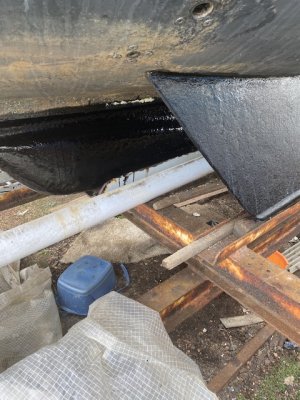
The first SFO/aluminium treatment polymerised very slowly in the Scottish winter but did eventually get touch dry, which encouraged me to apply another treatment. This stayed slightly tacky, perhaps because it lacked rust as a catalyst, and the three coats of bitumastic paint on top dried slightly crinkly.

4CF3E4C7-C6F2-4858-8581-FB7896CAA506.jpeg
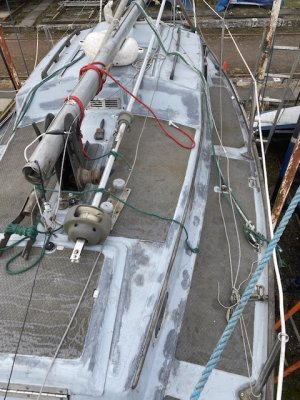
Perhaps also someone who has patch primed their pressure wash damaged deck paint with boiled linseed oil ising aluminium foil as an abrasive, so it now looks a bit patchy?

06FC2EF4-7375-4358-B9E5-FEC932B1FD92.jpeg

Of course, someone like thats view of “in their right mind” might not be the same as yours..,

Perhaps you could explain why you find it such a bad idea, rather than asking a question so rhetorical that it lacks a question mark?
 
Last edited:
And if that's too much, you can buy non marine granules. I used some in two pack paint on my dinghy and they worked very nicely.

I've also heard of using sugar but have never tried it myself.
I suppose the idea with sugar might be that when/íf it dissolves it'll leave pits in the paint which might themselves have a non-slip effect.

A pavement gritting salt mix might partially work in the same way, though would lack uniformity.

BUT sugar will make syrup, which is slippery, while dissolving, and will probably encourage mould.

("non marine granules" seems rather a broad term)
 
Perhaps someone who has already put bitumen on the keels of their GRP boat, over sunflower oil and aluminium, and has some left over?

The first SFO/aluminium treatment polymerised very slowly in the Scottish winter but did eventually get touch dry, which encouraged me to apply another treatment. This stayed slightly tacky, perhaps because it lacked rust as a catalyst, and the three coats of bitumastic paint on top dried slightly crinkly.

View attachment 209695
Perhaps also someone who has patch primed their pressure wash damaged deck paint with boiled linseed oil ising aluminium foil as an abrasive, so it now looks a bit patchy?

View attachment 209696

Of course, someone like thats view of “in their right mind” might not be the same as yours..,

Perhaps you could explain why you find it such a bad idea, rather than asking a question so rhetorical that it lacks a question mark?
Bitumen will get very soft and sticky in the sun. It will get tacky enough to to stick to feet, ropes, and sails.
Surface temperatures of a black deck will make it impossible to walk on. It may even flow if it gets hot enough and the deck is cambered.
Bitumen contains oils and solvents that will stain gelcoat permanently.
It will be impossible to remove without solvents that will run down your hull doing even more staining and damage.
Like I said. Who in their right mind would use bitumen on a deck of a grp boat
 
Bitumen will get very soft and sticky in the sun. It will get tacky enough to to stick to feet, ropes, and sails.
Surface temperatures of a black deck will make it impossible to walk on. It may even flow if it gets hot enough and the deck is cambered.
Bitumen contains oils and solvents that will stain gelcoat permanently.
It will be impossible to remove without solvents that will run down your hull doing even more staining and damage.
Like I said. Who in their right mind would use bitumen on a deck of a grp boat
Well, if that was all true, you would of course be correct.

However, the large scale experience of deployment as pavement doesnt seem to match your apocalyptic vision, certainly not in Scotland.

Ive used it on cars and boat trailers and it is standard on cast iron drainpipes, which dont of course get walked on, but it doesnt seem to melt much there either.

People routinely use it on steel narrowboat hulls yet they dont seem to suffer from life threatening burns. Perhaps the steel hull conducts the searing white heat of the industrial revolution canal system away.?

Im thinking Ill use it on my dinghy and maybe do the waterline boot stripe with it as a first cut, which is maybe just minor psychosis in your terms, but if I DID do the deck with it and later wanted to apply solvent to it, runs (which are a potential problem with ANY surface coating, especially if one is a bit sloppy) should be pretty well contained by the raised gunnels.

If it wasnt I could always paint the hull black

Cue The Stones?…
 
Well, if that was all true, you would of course be correct.

However, the large scale experience of deployment as pavement doesnt seem to match your apocalyptic vision, certainly not in Scotland.

Ive used it on cars and boat trailers and it is standard on cast iron drainpipes, which dont of course get walked on, but it doesnt seem to melt much there either.

People routinely use it on steel narrowboat hulls yet they dont seem to suffer from life threatening burns. Perhaps the steel hull conducts the searing white heat of the industrial revolution canal system away.?

Im thinking Ill use it on my dinghy and maybe do the waterline boot stripe with it as a first cut, which is maybe just minor psychosis in your terms, but if I DID do the deck with it and later wanted to apply solvent to it, runs (which are a potential problem with ANY surface coating, especially if one is a bit sloppy) should be pretty well contained by the raised gunnels.

If it wasnt I could always paint the hull black

Cue The Stones?…
You go ahead and do it. Send us the photographs of it in a couple of years time. Let's see how it looks. It will be good for a laugh
 
You go ahead and do it. Send us the photographs of it in a couple of years time. Let's see how it looks. It will be good for a laugh
I expect it would look black, dont you?

Unclear whats supposed to be hilarious about that, and your apocalyptic description above focuses on pain and suffering rather than appearance.

Black Humour?
 
Last edited:
Top