'Decision-Tree' approach to COLREGS

Regrets, WindermereColvic: I do not keep references, but I'm pretty sure it was in an RYA item in one of the sailing mags within the last year. (or maybe it was in an old one I re-read?)
Twister Ken's arithmetic looks impeccable, but assumes that the Centre of Gravity 'pivot' is on the waterline. If it were, the boat would be unstable when upright as the Centre of Buoyancy (centre of displacement) must be well below the waterline (obviously!).

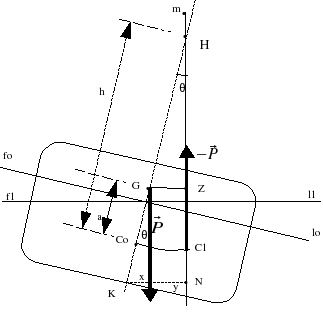
I'm sure someone here will come up with the appropriate diagram: Sorry, but I'm off to bed!
 
Twister Ken's arithmetic looks impeccable, but assumes that the Centre of Gravity 'pivot' is on the waterline. If it were, the boat would be unstable when upright as the Centre of Buoyancy (centre of displacement) must be well below the waterline (obviously!).


erm, no, the CG may well be (usually is) above the CB Centre of buoyancy, but as the boat heels the CB will shift laterally, hence producing the righting moment

Ship_Stability.png


add: in the end, what matters is the vertical position of the CG: adding a moment (weight x distance) above it (radar scanner on the mast) will raise the CG and reduce stability,

decreasing the keel weight will likewise raise the vertical position of CG and reduce stability
 
Last edited:
erm, no, the CG may well be (usually is) above the CB Centre of buoyancy, but as the boat heels the CB will shift laterally, hence producing the righting moment :
in the end, what matters is the vertical position of the CG: adding a moment (weight x distance) above it (radar scanner on the mast) will raise the CG and reduce stability,

decreasing the keel weight will likewise raise the vertical position of CG and reduce stability

Quite right of course! I knew it too late at night for accurate recall of all the technical details!
But the conclusion is the same; heavy stuff up the mast of a small yacht not designed for it is worse for its prospects of survival than most people are aware of!

If anyone can come up with the (RYA?) article I mentioned it should be another thread; my apologies for the thread-drift here.
 
Last edited:
Now updated with bigger text
Original: http://dl.dropbox.com/u/4282445/COLREGS.pdf
Bigger Text: http://dl.dropbox.com/u/4282445/COLREGS_V2.pdf
Vision 2007: http://dl.dropbox.com/u/4282445/COLREGS_V2.vsd

Any errors or suggestions just shout...

Forgot to add: Files are released under GNU CopyLeft - see http://www.gnu.org/copyleft/gpl.html
Keep them free and don't try to claim them, as yours

Excellent thank you. Will be a really useful aide memoir for SWMBO's first year helming a "big boat".

One possible correction maybe? On the original after "Is there risk of collision?" the "No" output loops back to the top whereas on the new version the "No" output goes down to "is it an overtaking situation". Or have I read it wrong?
 
Excellent thank you. Will be a really useful aide memoir for SWMBO's first year helming a "big boat".

One possible correction maybe? On the original after "Is there risk of collision?" the "No" output loops back to the top whereas on the new version the "No" output goes down to "is it an overtaking situation". Or have I read it wrong?

You are correct - the new version has three outputs from the decision below "Is there Risk of Collision?" I will correct it over the weekend and repost when done.
 
I'm sort of with you on this. Say a 20lb scanner is 30ft up, that's 600 ft lbs of heeling force.

Say she draws 6ft. you'd need 100lb more ballast at the tip of the keel to offset.

Not 5 cwt.

For your calculation to be valid the 30ft and 6ft distances must be measured from the centre of gravity. I doubt that this will be 6ft above the tip of the keel!
 
Freestyle is another fan of the decision tree - just need to find somewhere to put a laminated version.

But while on the thread's alternate subject, I can't leave this one unchallenged
Quote "Originally Posted by Twister_Ken
I'm sort of with you on this. Say a 20lb scanner is 30ft up, that's 600 ft lbs of heeling force. Say she draws 6ft. you'd need 100lb more ballast at the tip of the keel to offset. Not 5 cwt."

For your calculation to be valid the 30ft and 6ft distances must be measured from the centre of gravity. I doubt that this will be 6ft above the tip of the keel!
Erm, forgive me if I've misread this, but isn't it a bit more complicated than this? The righting moment on a heeling yacht depends on a progressive lateral shift of the centre of buoyancy as the boat heels (form stability) or a centre of gravity which is well below the centre of bouyancy (erm, thingummy stability, as used on older heavy displacement yachts) - or of course a combination of these two types. Keeping the centre of gravity low helps both types of stability, but clearly the latter more than the former. Consequently he destabilising effect of a rise in the centre of gravity is, I think, much greater in older, displacement yachts, although of course it is also important in form stable yachts at greater angles of heel.
 
Top