DC switches vs circuit breakers

KompetentKrew

Well-Known Member
Joined
27 May 2018
Messages
2,627
Visit site
My boat's electrics are one of the jobs for this winter - the distribution panel uses the PROS modular system (more), and is equipped with a dozen fused switches and five circuit breakers.

Most of the switches are labelled in Dutch, a language I don't speak, and I don't know what they all do. Some, testing by actuation, don't seem to do anything, so I'll have to start tracing the wiring.

I know that a fuse protects electrics by burning out if too much current is drawn, and wikipedia tells me that a circuit breaker is a similar kind of protection that works in a different way.

What would be the reason for mixing fused switches with circuit breakers, please? Would there be a reason for protecting some circuits with a fuse and others with a circuit breaker, or was this layout likely just a product of the available panel shapes?

Thanks in advance for any thoughts.

FTBfvIX.jpg
 
Cost is the main reason, and all circuit breakers is how the more expensive ready made boards are configured.
 
It looks like breakers used for nav lights?
It's possible for some bulbs to draw a lot of current as they blow. You don't want this to blow a fuse, so some people use a breaker. Also avoids blowing fuses while fiddling with nav lights trying to get them to work...

Likewise some people prefer to protect a motor with a breaker, so it will pop if stalled, but you don't need to find a new fuse.
Fuses are generally used where you don't expect them to blow unless something is really wrong.
But there are exceptions....
 
I don't speak Dutch either but on the basis that it's the language that's nearest to English , (barring Scotch/Ulster Scots), it's easy enough to make a guess:
Koelkast = Refrigerator ..................................kast = cast, "to make" . ...........koel = "cool"
Zoutwaterpompe = Seawater Pump ...............zout = "salt"
Zoetwaterpompe = Fresh Water Pump...........zoet = "sweet/ fresh"
Fan Verwarming Units = Fan Heating Units ...........vervarming = "warming"
Verlichting Hut = Cabin Lighting (B.B. ?) .....................hut = cabin, verlichting = "lighting" ...("it's a braw bricht moonlicht nicht the nicht" :) ) In German and Dutch action words like those are generally prefixed with "ver-"
I had to look up "voeding" and got "nutrition" ( "fooding"), but it obviously has something to do with fuel, and "spanning" means voltage. I also had to look up "achter" and got "rear".
There don't appear to be any nav lights.
I do cryptic crosswords too :)
 
Last edited:
It looks like breakers used for nav lights?
Nav lights are on a separate similar panel in the companionway.

lCsdXr2.jpg

I find the top breaker, labelled "Verlichting Achter" (Lighting Rear) switches that panel on and off, and the second breaker, "Verlichting H.M. B.B.", provides power to all the fused switches in the top panel.

Koelkast = Refrigerator ..................................kast = cast, "to make" . ...........koel = "cool"
Yes, the fridge is affectionately known as "Helmut" for this reason.
 
“Voeding” in this context means supply. BB = bakbord = port, SB = stuurbord = starboard. Sorry, no idea what HB stands for.
So, verlichting achter = stern lighting, verlichting BB hut = cabin lights port, verlichting SB hut = cabin lights starboard.
Zoetwater pomp = fresh (sweet) water pump, zoutwater pomp = seawater pump.
Hope that helps.
 
hi, as Aurai said cost is probably a big factor, the switched circuit breakers are very expensive. About £55 each on my boat, although mine are a bit different to yours. However, one reason to have fused circuits is for accessories which might be changed at some time. Obviously, the fuse is to protect the wiring, but some items do need to have specific fuse ratings i.e. bilge pumps. Also some items may need to have a lower rated fuse than would be appropriate for the wire. You could simply use in-line fuses for these, but imho it's better to have the fuses where they are easily accessible.

When I took over my current boat it had all circuit breakers (24 of them) but I found that over time I've had to add a number of switch and fuse circuits for various items the builders hadn't allowed for.
 
“Voeding” in this context means supply. BB = bakbord = port, SB = stuurbord = starboard. Sorry, no idea what HB stands for.
So, verlichting achter = stern lighting, verlichting BB hut = cabin lights port, verlichting SB hut = cabin lights starboard.
Zoetwater pomp = fresh (sweet) water pump, zoutwater pomp = seawater pump.
Hope that helps.
I think you're right.
Probably some sockets in the cabins on breakers then.
I twigged the BB=Port, SB=Starboard from sailng in Ned some decades ago,

Sockets on breakers is a sensible idea, people can plug in an inverter or other powerful device.

Of course the labels don't always reflect reality!
 
I don't speak Dutch either but on the basis that it's the language that's nearest to English , (barring Scotch/Ulster Scots), it's easy enough to make a guess:
Koelkast = Refrigerator ..................................kast = cast, "to make" . ...........koel = "cool"
Zoutwaterpompe = Seawater Pump ...............zout = "salt"
Zoetwaterpompe = Fresh Water Pump...........zoet = "sweet/ fresh"
Fan Verwarming Units = Fan Heating Units ...........vervarming = "warming"
Verlichting Hut = Cabin Lighting (B.B. ?) .....................hut = cabin, verlichting = "lighting" ...("it's a braw bricht moonlicht nicht the nicht" :) ) In German and Dutch action words like those are generally prefixed with "ver-"
I had to look up "voeding" and got "nutrition" ( "fooding"), but it obviously has something to do with fuel, and "spanning" means voltage. I also had to look up "achter" and got "rear".
There don't appear to be any nav lights.
I do cryptic crosswords too :)
That is very impressive
 
Nav lights are on a separate similar panel in the companionway.

lCsdXr2.jpg

I find the top breaker, labelled "Verlichting Achter" (Lighting Rear) switches that panel on and off, and the second breaker, "Verlichting H.M. B.B.", provides power to all the fused switches in the top panel.


Yes, the fridge is affectionately known as "Helmut" for this reason.
Ach so! Der stalhelm!
 
That is very impressive
Over here, our education system aspires to bilingualism, so Irish people generally have their brains hardwired to deal with more than one language. For the first three years at secondary school I took English Literature, Irish, Latin and French, (plus Maths, Physics, Chemistry, History, Geography and Religion). We do narrow it down slightly in the Senior Cycle, but not nearly as much as in the UK!
I have picked up some Spanish , Italian and German, but really only enough to order food and drink articulately. I would conjecture that many Welsh people are good at languages also.
 
Nav lights are on a separate similar panel in the companionway.

lCsdXr2.jpg

I find the top breaker, labelled "Verlichting Achter" (Lighting Rear) switches that panel on and off, and the second breaker, "Verlichting H.M. B.B.", provides power to all the fused switches in the top panel.


Yes, the fridge is affectionately known as "Helmut" for this reason.
That panel looks a bit exposed to the weather in the companionway. If it were me I would move it to a more sheltered spot.
 
Last edited:
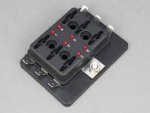
I've no claims to expertise, but the advantage of a circuit breaker is that it's the press of a button to reset it. If you blow a fuse, you have to work out which one it is, probably in the dark, and find a spare. OTOH, the only fuses that have blown on my boat have been because of my own stupidity while working, so she has fuses. A fuse holder like this will, at least tell you which fuse has blown

1603529263651.jpeg

Of course, since I fitted them, I haven't blown a fuse.
 
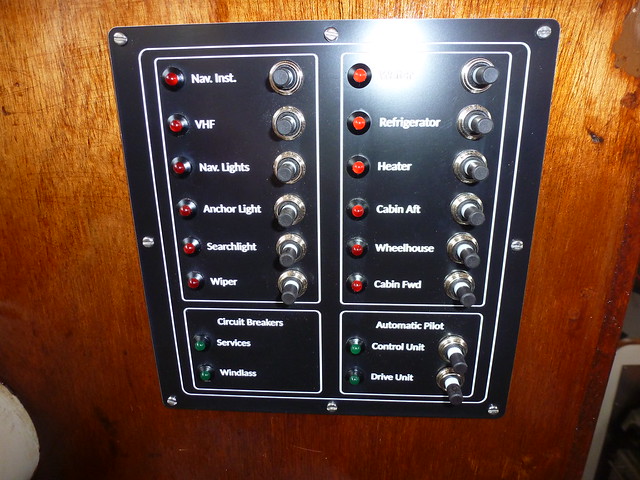
I decided to completely re-wire the motor boat. So I had a panel made up using combined contact breaker/switch units and linking in the warning lights.

P1040683 by Roger Gaspar, on Flickr

The boat has 24v and 12v systems - 24v for the engine, 12v for everthing else except the windlass. So those with red light are separate circuits: the DSC radio has a manufacturer's fuse so that is 'south' of the panel circuit breaker. Ditto for the Nav instruments that specify the requirement e.g chart plotter. The lower part - green lights for the main circuit breakers 'Services' tells me the 12v main circuit is working, ditto for the 24v circuit for the 24v windlss. The Automatic Pilot requires two separate circuits hence that is included. Only issue is; this is in a wheelhouse so the combined CB/switch would not be welcomed outside! Mind you I could look up the specification but I am sure it is not designed for outside. Some other services are elswhere.
 
Top