Danger in the SW Sunk Crossing

Daydream believer

Well-Known Member
Joined
6 Oct 2012
Messages
23,576
Location
Southminster, essex
Visit site
On Friday 18 June 2021 I was SH en Route from Bradwell to Ramsgate & sailing in company with a Leisure 27 ft bilge keel yacht with about 1.200 draft which we will call SN to avoid any embarrassement to the owner
My yacht Daydream Believer is a Hanse 311 with 1.75 draft.
Wind was roughly NE 22Kts
the time I got to the Knoll I was already vomiting. To make matters worse my Raymarine AV 100 autopilot had finally failed & my boat being directionall unstable meant that I could not let go of the helm. I could not turn back to Bradwell as not enough water & I could not let the sails down & motor to shotley Which I would have preferred.
So I carried on by following SN
30 mins from the crossing I heard the radio call from a 42 ft bavaria "P" telling Dover CG that she was aground on the southern side along with anotherlarge ketch "S"
P's VHF was rubbish & Dover had to keep asking for repeats & the lady on board was having difficulty & extremely worried as the yacht was well aground. Dover also kept asking lots of low key questions & I suspect this lead to a delay in calling a lifeboat. I did note that one question- what safety equipment do you have - answer life jackets then-- anything else- was left with a blank response!!!.
Dover made thing difficult by insisting on coordinates which took numerous transmissions . The ketch did not give any transmission as it later became obvious to me that its vhf was virtually inoperative & P was relaying messages to Dover.
To make matters worse S had pressed her AIS alarm & every few minutes a MOB signal flooded my chart plotter. This had to be cleared & being sea sick I managed to turn the plotter off which took several goes to turn back on. Every few minutes I had to clear the signal that came right across my Garmin.
I had vomited a further 2 times by then
It ried to call SN to tell him of the situation & tell him to stick to Tillergirls waypoints & not try to help as we could never do anything to help. However, he either did not hear or ignored my suggestion. S replied to one of my calls but the signal was so distorted that I then gave up as he was destroying any attempt to contact SN
By this time I was level with SN & we entered the swatchway.
To my utter amasement SN sailed towards S where there was clearly a line of breaking surf.
He sailed into the surf & ran hard aground in the swell. I saw his rudder come out of the water . The boat then rounded to stbd & it rolled such that it tripped over the port bilge keel & rolled on its side. Fortunately a couple of waves later the stbd keel pulled it back onto its 2 keels.
By this time I was half way through the channel & was vomitting. I let go of the tiller & the boat did a 360 & I got trapped in the mainsheet as it gybed.
I lost all orientation & whilst I had been following tillergirls 2019 waypoints I did get of course for a few minutes.
My depth went down to 300mm below the keel when I did get back on couse as I exited the channel. I exited around 12-00 & 12-05 ( Walton LW 11-46) BST
A large tug had arrived but could not enter due to depth so FINALLY Dover decided to call Walton & Clacton lifeboats who were on the scene in about 30-45 minutes.
SN actually managed to motor off in the swell because the bow turned to deaper water. The life boats attended to the other 2 & followed them North. SN carried on to Ramsgate. By then she established that she had damage to the skeg & was leaking, A damaged rudder but could later return to Stone where she will be hauled out for repair this week.
When we looked at the navionics chart a couple of points come up that I think east coast sailors should be aware of.
S was transmitting ais as MOB. This lead SN over to her . She could see the wind generator & radar pole & thought it was someone on the stern. The navionics showed her to be in 6 M of water when in fact she was aground. S should NOT have sent MOB signals
SN logged the position where she grounded. The latest navionics shows 6M which demonstrates that the sands have shifted considerably
When SN returned to Bradwell she reported ample depth by following Tiller girls latest waypoints when crossing a couple of hours after LW. I returned via the norther crossing towards Barrow No2 which I much prefer. Longer but I like being able to see reference points rather than rely on GPS

So the point of this is the AIS alarm was wrong & the navionics chart of the sw sunk is wrong-- Could have done that in one line I suppose :unsure:
 
Last edited:
TG has some data on this so I won't steal his thunder... The locations of grounding were shown on the chart as 6m... In fact from our survey earlier this year, they were both drying...
 
There's also some discussion about this on the RNLI Frinton & Walton Facebook page (and some video of the RNLI attending to the Bavaria),
 
Shortly after launching into moderate seas and a falling tide, the UK Coastguard advised that further reports were coming in that another yacht had also gone aground in the same position as the 2 that were already known. With this new information Clacton Lifeboat was requested to launch given the number of casualties needing assistance.
While proceeding to the location of the 3 yachts another vessel also responded to the “Mayday” putting their daughter craft in as close as possible to try to offer assistance however the lack of water prevented them getting close to the casualty yachts.

Once on scene, one of the casualty yachts had managed to re-float without damage and continued on their passage however that still left two yachts aground, with moderate seas continuing to push them up the bank. As both lifeboats arrived on the scene Clacton Lifeboat approached one of the casualties that was hitting the sand bank and placed a crew member on board to assist with securing their sails and configuring a slow tow to assist them coming off the bank. This was achieved by slowly turning the nose of the vessel around and with enough power to gently get the vessel off the sand bank, despite the Clacton crew grounding out on occasion due to the low tide.

Walton Lifeboat approached the 2nd casualty deploying their y-class daughter craft, which is carried onboard the Tamar All-weather Lifeboat, to allow a tow to be passed to assist the yacht off the bank.

With both yachts safely off of the sand bank, assessments were carried out to make sure the yachts could continue safely on their passage. Unfortunately one of the yachts had experienced a rudder failure upon grounding resulting in no steerage so a tow was established by Walton Lifeboat to ensure that the casualties were taken back to the nearest safe haven. The 2nd yacht had faired slightly better and didn't require any further assistance however was escorted back to Brightlingsea at the same time.

While the journey back to Brightlingsea had only just begun, one of the persons onboard the vessel under tow was experiencing severe sea sickness and required first aid treatment for the duration of the tow, and a Clacton crew member already aboard was joined by a Walton crew member to provide oxygen and medical treatment. As the conditions improved and the seas flattened the casualty continued to receive treatment, the Clacton crew member returned to their lifeboat, and were released to return to station. The yacht undertow was soon secured alongside and Walton Lifeboat was released and able to return to station some 8 hours after the initial call out.


Walton lifeboat press release
 
Very scary especially about the bilge keeler flipping over and by pure chance popping upright again. Well done Daydream Believer for coping as you did.
I'm sure Roger will be along in a moment, but in the meantime I have added warnings on the ECP website and the (increasingly busy) ECP Facebook page.
 
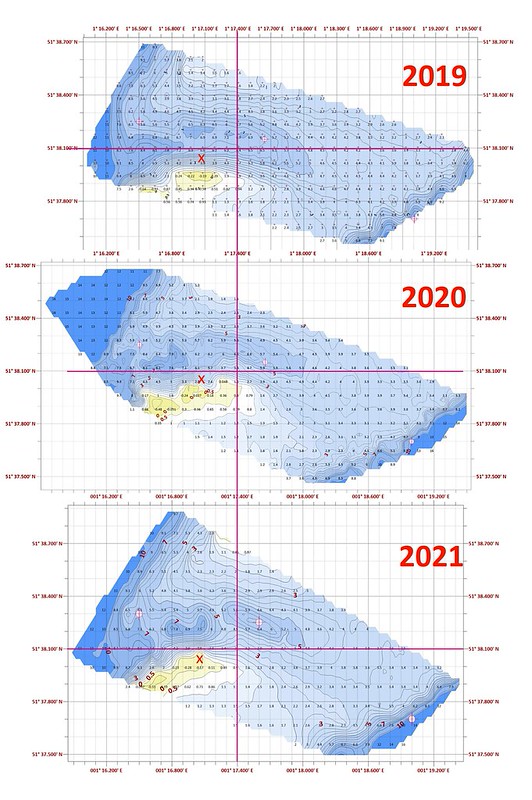
A couple of readers alerted me yesterday and one kindly provided the reported position as quoted on the VHF. X marks the stranding:

SW Sunk stranding by Roger Gaspar, on Flickr

If plotted on any current electronic chart the position would been firmly in the middle of the deep water of the swatch. That is irrespective of whether it is Navionics, C-Map or Imray. Indeed since Larry and I were using all three charts during the survey we knew their were inadvertently 'out of date'. I give 'out of date' in 'thingies' because the charts are not out of date just 'out of date' - if you follow me. No official body could be done the correction in time. I have sent in the data to the UKHO - admittedly a little late because I got caught up a fair bit of work. The UKHO will now be processing the data and considering whether they trust me - I am just an amateur using leisure kit - but they normally accept the data - and very kindly. They will need to consider either a Notice to Mariners or incorporating the changes in the next edition. By bad luck the next edition of the primary chart (1975) is due out on 8th July and therefore I am sure it will be tough for them to include any changes in time. The electronic chart makers have to wait for the UKHO (Imray may act now).

So the simple message is: DON'T USE A CHART PLOTTER to pilot through the swatch this year for the time being. Second message: if you trust me, USE THE 2021 WAYPOINTS PLEASE. You will be safe - subject to appropriate weather conditions.

Larry and I have confidence in the data - I assure you I am risk adverse personally and do not hazard the boat lightly (I have shared a few of my readers a video made during the survey going through the flood tide rip around the SW knoll. On the day the conditions were brilliant, no wind at all so quite interesting - indeed Larry steering through the tide rip was a busy time. A serious lesson from that rip is once you are too close to the knoll with any reasonable rate of tide you will have a busy time - I will try and see how to post it on Utube).

The OP makes a good point - no visible marks. Even the NW Long Sand beacon has gone now. We have tried to see if there is any transit thrugh the swatch but the best is on the second leg of the swatch from west to east when the BDM2 Yellow buoy in the Black Deep becomes visible. But unfortuantely by the time that is clear you are well away from the knoll.
 
Agree. WOT (that's wind over tide not that wide open throttle nonsense) and a lee shore. SN's grounding was very unpleasant on DB's description and that sand is rock hard. Ugh.
 
I cannot describe the shock of seeing one's friends possibly drowning. The worse point is being totally unable to do a thing to help & having to ignore their situation & concentrate on my own. I asked them afterwards if they had a liferaft & they carry one down below. However, getting to it with a boat at 90 degrees to the vertical would be almost impossible, especially if they had been washed out of the cockpit. It reinforces the rule of always wearing a lifejacket aboard a small yacht when under way. I was wearing mine & do so in the lightest of weather.
My liferaft is in the cockpit floor & retained with just 2 clips It is in the way most of the time but somehow I would have it no other way. I could not imagine getting it out of a locker with the lid wanting to smash down on my head, whilst I was reaching in for a heavy load.
My friend usually sails single handed but this time had his son & he was able to furl the genoa ( actually I think they just dropped it but I cannot be sure) which allowed the bow to come head to wind. On his own the situation would have been different
 
Last edited:
Apart from all that…did you have a nice sail? ?

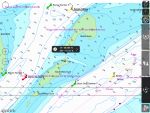
Seriously though, this is the current iSailor chart for SW Sunk with TGs grounding red X approximately marked. (didn't have both co-ords)

5C424C41-7498-4925-8C63-BEED61FDC997.png
 
Close enough - 51.38.046N 001.17.086E was what I was told. So don't use iSailor at the moment. That is using the 2019 data. As I said it isn't wrong - it is just dated!

In 2019, the SW Knoll did not 'encroach' the 51.38.000 parallel. In 2020 it encroached 51.38.500. In 2021 it nearly (very nearly) encroaches the 51.38.100 parallel. Arguably it moved about 900 metres further north over the season last year and winter. Subject of course that GPS accuracy has been constant.

In 2020 the Admiralty didn't issue a NtM after I had sent the data in. Given the scale involved I can understand that no Nt M was done.

The 2020 waypoints were fine. Indeed they would be ok this year but I recommended moving them north to match the move for comfort and safety. But of course since 2019, the knoll has arguably moved 1.8 km north and that is quite a move! I have sent the video links to the UKHO to emphasis the local importance of this to us.
 
For me, as for someone who plans to do this route soon, this thread is valuable information. I don't have chartplotter and have already have prepared 2021 map from tillergirl's website. I am planning to use GPS and sounder during crossing. I have 2 questions:
- how serious could be grounding in such conditions. Yachts are rather strong, could they be destroyed by waves - so that liferaft mentioned earlier would be needed?
- how 'easy' is to get into such situation? I see by the map that it could be easy to see the contour of the edge and recognize that we are getting close to the shallow water on sounder - during my sailing on Blackwater I already know that when I am close to some places depth can change fast - and I am waiting to tack when depths will start to decrease. Is it the same here? I understand that cautious skippers should be able to spot danger earlier? Of course, I understand that this conditions are making paying attention harder, but in such case, my plan is to follow the tide and abandon crossing.

@tillergirl youtube video would be lovely
 
Remember that you are going through a channel rather than aproaching a shoreline as when sailing in the Blackwater.
The problem sometimes is that the depth may change slowly. One has to make a decision at what point does one start to panic when the depth below the keel is one that one cannot live with. I often enter Bradwell creek with virtually zero below the keel & regularly touch. However, in the creek there is little swell & the bottom is soft mud. This means that I have the choice of just stopping when I touch & wait for the tide or push thruogh the mud because I know that there is a bit of a bump at a certain point.
Passing over the SW sunk the bottom is hard sand. In 20 kts of wind from the NE a boat on the southern side of the channel that touches may suddenly ground & bounce. This can cause serious damage to a fin keel or a boat where the rudder extends to the depth of the keel & may be a spade pattern. So the last thing I want to do is hit bottom. I lost my rudder in the Murray Firth on a shallow sloping bank in very flat water. The blade just dropped onto a small boulder.
I have often crossed the Sunk in flat water over the N part & had 300mm below the keel. This happened to me last Friday in the SW Sunk. The trouble was that unlike many channels the area where I had that depth the bottom is fairly flat. If it was shelving one could deliberately keep to a known side & then turn to deaper water. One cannot do that if the botton is fairly flat, but shelving very slowly.
To make matters worse if one gets to the 300mm depth one has to decide- Do i carry on in the hope it will get better or do I turn back & hope that I can definitely get the reciprocal course. With cross tides & cross winds the chances are that one might actually not get a reciprocal, hence turning back may not actually be a safe option.
The best thing is to make careful calculations of tidal heights times etc, Make sure that you are on a rising tide, keep on the up tide or up wind side ( whichever is the strongest) of any channel rather than dead centre.( Gives a better chance of getting off) Then decide on a minimum depth you are prepared to accept. Once you get this & it is still dropping, turn back & wait. Have the engine on tickover to assist if needed
Try not to go for dead centre of a channel if it is dipped in the middle. By keeping to one side you have a direction to turn and some spare depth.

Always check for local notices & things like Roger Gaspars " Crossing the Thames Estuary" for guidance & latest updates
 
Last edited:
Thanks for sharing this @Daydream believer. We’ll be crossing the Estuary in July with our young kids on board. I have Roger’s book, but this is a very timely reminder to check the website for updates. It’s too easy to get lazy and rely on the charts, especially as we’re coming from the land of soft, forgiving mud.
 
The OP expressed some comments about the lack of visible ques and clues at the SW Sunk. He is entirely correct and that is a reality about which I think you should be confident or use another route such as the Little Sunk. All you need is GPS for the SW Sunk but you need to be able to get to the waypoints accurately. If you are using a heldheld GPS and the conditions are very bumpy, things are going to be more complicated and may well be too complicated for that choice of route. I think RYA Instructors always stress that you are planning for a passage towards Ramsgate NOT to Ramsgate. the fine distinction of the english language is that there is a need for a plan that can be changed on route. So exiting the Spitway conditions into the Swin (such as described by the OP at the beginning of this thread) may well be good cause for a change of decision.

Have a practice in the Blackwater sailing towards a waypoint set on your GPS and see how you cope with that by yourself. You don't have to be right on the spot of the waypoint but you shouldn't be 500metres off the waypoint. Or practice with your crew. Once, quite a lot time ago before there was no GPS, I had a trusty Decca machine and we were planning to find Fisherman's Gat at a time when there was no buoyage at all. Gosh that dates me! I sat at the chart table (Gosh that dates yachts as well) and I plotted the lat/long on the chart with my pencil through the Gat while Adrian steered and followed any course changes called by me. If it works, you and your crew will enjoy the process and progress and it will have a great sensation of achievement.

How easy is it? There is ample room for width and depth for your boat but this swatch does need concentration and you need to know where you are.

I would disagree with DB over the rising tide point. I know your intended passage of course because we have discussed it by PM's. The timings I recommended would have you around the half ebb at the SW Sunk and you would be fine even at LWS. To time the SW Sunk on a rising tide would add 3 hours on your intended passage. I am hoping you would not need to tack through the SW Sunk. The SW Knoll is very steep and you should not get too close. If the wind direction requires tacking through the SW Sunk swatch, I think on a first crossing estuary passage using the Little Sunk is a better plan. But the ebb will run largely through the swatch so engine might be sufficient for the 1.7nm lenght of the swatch.
 
Daydream believer - have every sympathy for your plight - I'm a "chucker" in the wrong conditions and although I feel instantly better when I've thrown up -it's a horrible state.

I did wonder, reading your post whether you had thought about other refuges at the knoll - given the gear failure etc. B'sea would be a 3m beat to windward - doesn't sound far but I wouldn't fancy it in a NE'ly - so not a greata option. Did you consider the Crouchor Medway? You could have turned at the spitway and run into the Crouch , or similarly run down to Queenborough. Just curious really, as I know from experience that the outer estuary is the very devil of a place to be in wind over tide - even if you're not tom 'n' dick.
 
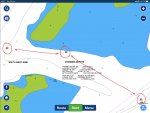
... and as many folks did, I'm sure - I dialed up the location on my chart to make sure I've got the right waypoints plotted. The good news is - my Navionics chart seems pretty up to date - the waypoints all lie in what is shown as the channel...
IMG_0326.jpg

The chart used for this screenshot is on my ipad - and syncs to the plotter when on board... the waypoints are plotted using Roger G's chartlet (May 27th 2021. So Navionics is more up to date than I thought, although as always - not as up to date as Roger!
 
I think (at some risk of suffering of anorakism) this is an interesting modern lesson. If we were using paper charts I think everybody would have been a lot more risk adverse and would be entering the swatch with a lot of care. But using electronic charts without my rec. wpts. people would aim for the deep water perhaps with great confidence? I think we should not 'over-zoom' and assume the contours are absolute.

I have sent in another email to the UKHO this morning enclosing the 2019-2021 comparison and a screen-grab of Pete's post of iSailor to illustrate the importance of the issue. It is a shame Chart 1975, which is a primary chart upon everybody else copies, is due for a new edition on 8th July. Rather too soon I guess for a change.

Should I be marking my chartlet 'Not for Navigation'? I use other language of course.
 

Other threads that may be of interest

Top