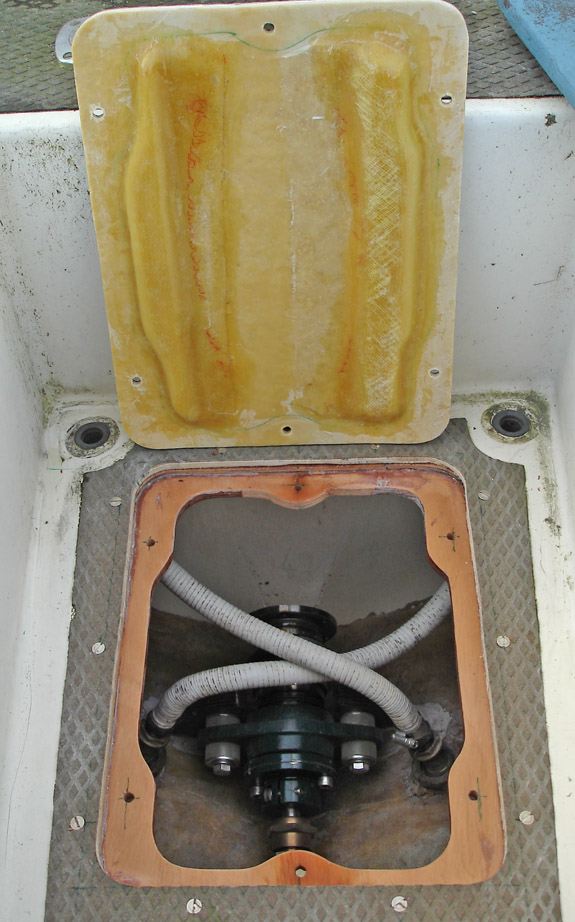
cutting a hole in the cockpit floor

bond9007

Active Member
Joined
7 Feb 2009
Messages
43
Visit site
Hi

thinking of creating a hatch in the cockpit floor to give access to the stern gland and prop shaft on my Elizabethan 29. My question is do I need to strengthen the cockpit floor? The hatch will be about 12" square (in old money) or will it simply be enough to cut the hole and fit the hatch. The floor is solid grp about 1/4" thick. Would a round hatch give enough access and be stronger without additional support than a square hatch.

Any ideas would be welcome, if it all looks too complex it may have to be a job for the experts.
 
A hole in the cockpit floor.

A 12inch square hole is a bit marginal. If it were say7 inches in diameter with one of those dinghy inspection ports fitted I would say no worries.
Aircraft wings often have an inspection panel in a stressed skin. They simply fit enough screws around ie every inch of circumference that the lid becomes part of the panel. I don't imagine that 40 screws would suit you.
One solution would be to cut the hole then reinforce the floor. This could be done by laying fibreglass around inside under the edge of the hole. If this were to turn upwards about 30mm it would give more stiffness plus tend to keep water out. This would be a bit difficult making a mold to suit.

One thought would be to set a box of hole size and shape onto a piece of flat glass or wood. Fill in the iside corners to a suitable size and shape then wax the whole thing. Lay up fibreglass to about 5mm thick. 30mm + up the sides of the box and out about 50mm. Leave the glass actually bigger like 100mm with the last 50mm without resin. When it is hard remove from or destroy the box. You should have a lip frame which can hopefully be fitted from underneath and attached to the under side of the floor with resin in the bare glass and or screws.
You may be able to insert from above especially if it was rectangular shaped.
You then need a cover molded again out of fibreglass or made of wood which fits over the lip with sealing rubber to make it water proof if the water level rises above the lip.
You will of course have a raised section of cockpit floor which might be annoying depending on location.

You might also fit a basket to the lid such that you have additional storage.

Or just cut the hole fit a cover and look at under floor supports, hull to floor to make it stiff again. But water entry will be difficult to stop. Good luck olewill
 
Are you going to buy or make the hatch itself?

If you are going to buy it I would get one that is either round or has round corners. Cut a piece of good 3/4" plywood 3" or 4" larger than the hole size. Taper it to a bit less thickness around the edges. After cutting clamp it in place and drill the holes required for the hatch. Using thickened epoxy bolt it in place. After it has set for 24 hours remove the bolts and bed the hatch in place. The hatch bolts will reinforce the epoxy bond although it really doesn't need it. The cockpit floor will be stiffer and stronger than before.
 
cutting hole in cockpit floor

Hi

thanks for the replies, I was going to fit it the cut out myself but have never done any fibreglass work before so perhaps this is not the job to strat on. I could manage to fit a plywood stiffner but access would be very tight, hence the need for a hatch as the only other entry is either over the engine of a very small cut out in the cockpit locker.

Could the hatch sit on an boss around the opening rather like a forehatch which would impart some stiffness.

Thanks
 
Could the hatch sit on an boss around the opening rather like a forehatch which would impart some stiffness.

Certainly could, as long as you don't mind the lump in your cockpit sole (perhaps you have bottom boards over it?). This will also raise the hatch above any minor water in case it's not 100% watertight.

Pete
 
Hi,
the cockpit sole on an Elizabethan 29 is strong. However, you could do a similar thing to that which I did on my Twister. See.....
http://www.twister.org.uk/techfaq/index.php?action=artikel&cat=5&id=29&artlang=en
By carefully marking up and taking note of any extra strengthening beams beneath the sole, I cut out the sole in two main rectangles using a Fein Multimaster tool (Bosch do a similar, cheaper unit)
This enabled me to then have two stainless steel frames made up to fit which are machine screwed down. The central circular hatches can be removed in a second whilst the larger s/s framed take around 15mins to remove for bigger maintenance issues. This method maintains /strengthens the original and is very easy for a DIY job to become easily first class. Just the s/s frame needing the expert.
The sole has a teak grating which just clears the raised circular hatches.
On the same section of the Twister website you can see another method of doing a similar job in timber. I was keen to use as little wood as possible so as to minimise future maintenance.
Good luck.. PM me if I can help further.
S.
p.s. The waterproofing to keep the integrity of the sole was easy.. a simple bead of clear silicone all the way round.
 
Last edited:
I opened up the floor in my Corribee, using the cut-out as the hatch, and stiffening up the opening with a marine ply flange epoxied in place. It gives a completely flat floor with no lumps and bumps to trip over. Full details about 1/4 way down this page.

All the fixing nuts used were stainless 'Bighead' fasteners bonded to the underside of the ply with epoxy. A 10mm neoprene strip bonded to the lip all the way round (not shown in the photos) provides the sealing.

aquadrive31.jpg


As well as the stern gland, I have access to the cockpit drains, gearbox (oil changes and control cable adjustment), the Aquadrive, the anode fixing and the earthing point on the prop shaft, and the seacock and filter.

The only disadvantage is that I have to unscrew 6 socket-head screws to gain access (so I have a little electric screwdriver on board). If anyone has a better suggestion for fixings I would be very interested - I'm well aware that my solution is not the best for quick access.
 
I opened up the floor in my Corribee, using the cut-out as the hatch, and stiffening up the opening with a marine ply flange epoxied in place.

Seems like a neat job. I'd probably be happier with that than the manufactured hatch screwed into my own sole.

If you can't live with undoing the bolts, I believe there are similar fasteners intended for aircraft access panels which only need a quarter turn. Not used them myself.

Pete
 
Seems like a neat job. I'd probably be happier with that than the manufactured hatch screwed into my own sole.

If you can't live with undoing the bolts, I believe there are similar fasteners intended for aircraft access panels which only need a quarter turn. Not used them myself.

Pete

I agree and much easier when you retain the original cut-out/s.

Strength and watertight integrity are of course paramount.
I'm not sure that I would thoroughly trust bonding in the timber with grp as it will be the timber or the bonding that will be a weak point.
A large person jumping into my Twister cockpit wouldn't have concerned me. Similarly the type of hatch that sits over the old sole around its edges would have more strength.

Screwing down was the main headache when I did mine. I would have liked less screws all around and in hindsight we used too many machine screws.... a bit over engineered.
The wooden hatch shown on the Twister website does have a very quick system I believe.
Parsifal of this 'parish' may be able to tell you more.
 
Last edited:
This was one of the first jobs I did on my Elizabethen 9m (it was actually impossible to reach the seacocks for the raw water inlet and the cockpit drain).

The floor on mine is made of sandwich - are you sure yours is solid? It may have been made in a different yard, of course.

I used a commerical hatch. It doesn't seem to have weakened the floor. I did have trouble with the hatch itself cracking as it's just where people step down into the cockpit, but I bought another and filled the back with epoxy and it coped well last season.

No pics I'm afraid as I've just given up on summer and come back from the boat.
 
I fitted one of those 7" circular hatches in my cockpit floor for access to the rudder stock bearing suipports and for checking the lower through hull fitting for the tube.
As it was at the stern end of the floor it was not under any pressure with the floorboard covering it; however do lubricate the threaded edges of the screw-in lid ,or the base, as they are difficult to undo and unsuitable for any metallic tool use to do so; this will also seal them from water ingress.
No extra reinforcement or support was needed,just sealed with sikaflex.

ianat182
 
Avocet's previous owner cut a whacking great big one, which takes up just under 1/3 of the cockpit sole! as previous posters have said, I'd be surprised if your sole is just a 1/4" thick lamiate of plain fibreglass. I think it wil leither be a sandwich or wil lhave stiffeners laminated into its undersides every so often, but I'm not familiar with Elizebethans.

In Avocet's case, it is not quite rectangular (more trapezoidal), because the cockpit narrows as you go aft. He just screwed a frame of 4 pieces of hardwood, bedded in some sort of mastic, to the bare edges of the cut sole and then made a wooden cover which screws to the top of that. He didn't skimp on the wood - good quality and about half inch thick planks, but I probably wouldn't have doe it! Anyway, there have been no structural repercussions.
 
I decided that I needed smallish round inspection hatch in the forward cabin sole to allow better access to the bilge. I drilled a couple of pilot holes to check the location, and began to cut a hole into which I would fix a commercially available frame and screw-in cover. I used an adjustable-arm cutter, and a fairly beefy drill. After a while, I noticed that sparks were coming from the cutter - the hardened point was wearing away as I watched. When downward progress finally ceased, I resorted to using a wood drill (find them best for GRP, and they have a locating point) to drill the usual series of closely spaced holes around the channel I had made so far. I then finished with the blunted hole cutter to make the final break-through. The circle of solid GRP which I extracted was almost half an inch thick, and this was just the cabin floor....a confirmation of the legendary Hardy build quality.
 
Top