Custom made block

Personally i would not go for tufnol.( yes I know one gets tufnol blocks & pullies, i still have some But!!) It is usually made by laminating cloth together & as such loading along the laminates could end in failure. because the laminates might open up. Tufnol whale may be better but in any event I would avoid it.
Researching the link i gave would show cheaper & better alternatives I am sure.
Perhaps UHMWPE which can be obtained in rod form up to 200mm diam or sheet for up to 80 mm thick might do the job
An extract from the site for it may be of interest because instead of SS cheeks it could be used depending on load tests & then it would just need inserted ss strips for the main load as described in #4
This engineering plastic can be machined into virtually anything, from small gears and bearings plates to huge wear guides that until recently were only possible with metals. It not only outperforms metal in abrasion applications, it's also easier to machine and therefore cheaper. This versatile plastic can be milled, planed, sawed and drilled to create a huge variety of parts at a very competitive price. UHMWPE sheet has an exceptionally low coefficient of friction which offers superb sliding properties and is one of the best materials for wear and abrasion resistance. UHMWPE Sheet is tough even at low temperatures, it offers low weight, and is easy to weld.
UHMWPE is relatively soft and creeps under load
Something like Delrin, Acetal, Oilon, or better still PET would be better
Tufnol is available in several different forms and construction methods but the dust is considered hazardous
 
Daydream. .... Wrong? - nothing at all.

I had always spelt Pulley as pulley, not pully. Your post 20 made me look, initially ar Wiki, which suggests you are quite correct and pully is perfectly acceptable - which made mo look at a really old fashioned, paper, Oxford, which did not mention Pully, at all - and suggested the plural was pulleys.

So now I'm just apologetic and confused.

I was taught never to comment on people's use of English - and assumed you had an auto-correct like mine which converts some of my English so far removed from what I thought I had typed to become unintelligible

:)

Jonathan
 
None of us know everything.

When you stop learning ......?

When you know everything you are probably a grandfather and self delusional (as the grandchildren will soon discover reality).

:)

Jonathan
 
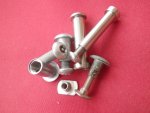
A very small collection of sex bolts, inter screws, Chicago Bolts (though I think this terminology are used for devices to bind documents) etc, etc. I think there are other names.

Commonly used for flat pack furniture (and in swivels)

Consider - the head of the female portion has minimal attachment area - the head is commonly simply attached to a hollow cylinder, unlike a bolt head which is attached by the area of the cylinder itself. Because you cannot thread to end the end of the hollow cylinder the male portion does not always extend to the end of the female portion so the 'unfilled' end is particularly weak. So - be careful how you use them.

But do not be discouraged - they do have their uses. :)

Jonathan

IMGP2623.jpeg
 
Daydream. .... Wrong? - nothing at all.

I had always spelt Pulley as pulley, not pully. Your post 20 made me look, initially ar Wiki, which suggests you are quite correct and pully is perfectly acceptable - which made mo look at a really old fashioned, paper, Oxford, which did not mention Pully, at all - and suggested the plural was pulleys.

So now I'm just apologetic and confused.

I was taught never to comment on people's use of English - and assumed you had an auto-correct like mine which converts some of my English so far removed from what I thought I had typed to become unintelligible

:)

Jonathan
Now you have pointed it out I would have typed "pulley" if I had noticed. As for pulleys I would have changed the "Y" to "ies" as taught years ago. But i admit my spelling now is somewhat lacking. But I will quite happily stand corrected if wrong.
But then, "which made mo look at a really old fashioned, paper" also has an error. But we know who you meant :unsure:
I suggest that you might use polycarbonate in your greenhouse. Harder to break I am told ;)
Better we call it quits & stick to the thread? :p
 
Now you have pointed it out I would have typed "pulley" if I had noticed. As for pulleys I would have changed the "Y" to "ies" as taught years ago. But i admit my spelling now is somewhat lacking. But I will quite happily stand corrected if wrong.
But then, "which made mo look at a really old fashioned, paper" also has an error. But we know who you meant :unsure:
I suggest that you might use polycarbonate in your greenhouse. Harder to break I am told ;)
Better we call it quits & stick to the thread? :p
There are no Pullies on a boat. There are blocks and sheaves!
 
There are no Pullies on a boat. There are blocks and sheaves!
Until we know the purpose of said contraption then "pulley" may not be out of context.
Has Neeves said it is going to be used on a boat yet( is that a motor boat or a rowing boat you are referring to ? Or were you thinking of a Yacht?) ?
You have "assumed" have you not?
Neeves might be getting ready to hang himself :unsure:
Or his wife :eek:
Or there again, it may be for the weights for the local church tower clock.:devilish:
 
Until we know the purpose of said contraption then "pulley" may not be out of context.
Has Neeves said it is going to be used on a boat yet( is that a motor boat or a rowing boat you are referring to ? Or were you thinking of a Yacht?) ?
You have "assumed" have you not?
Neeves might be getting ready to hang himself :unsure:
Or his wife :eek:
Or there again, it may be for the weights for the local church tower clock.:devilish:
We are on a forum dedicated to boating, so I think my assumption is not unreasonable, but I thank you for pointing out alternatives.
 
I bet they looked magnificent! :D

"Classic Boat Supplies sells a wide range of tufnol pulleys or tufnol blocks for traditional boats, or for new vessels recreating the antique look".
Tufnol Pulleys | Classic Boat Supplies | Sydney Australia

I get all my plastics out of a recycle bin at a plastic sign fabricators. I think I might have a fair bit of "Tufnol" type sheeting
Yes, that's the stuff. It can be worked with regular woodworking tools, but is a bit hard on the blades. As I said, the SS strapping takes the load, for the sheaves, the compressive quality is the most important aspect. Plastics can be bought in cylinders (columns) of many different diametres; it is equally easy to cut the disks out of sheet material and have a consistent thickness.
 
Personally i would not go for tufnol.( yes I know one gets tufnol blocks & pullies, i still have some But!!) It is usually made by laminating cloth together & as such loading along the laminates could end in failure. because the laminates might open up. Tufnol whale may be better but in any event I would avoid it.
I'm sure there are better materials available these days, but I have struggled along quite successfully with a couple of large tufnol blocks on my previous boat, cruising some 35000 ocean miles. They were used for the 1000 sqft genoa sheets with a 160 degr return to the central winch and regular working loads of over 2000lbs. In spite of living outdoors for some 30 years, all without much care or attention, they showed not the slightest signs of wear or delamination. That is a lot more than I can say for the collection on of plastic shelled Lewmar and Harken blocks I had on the same vessel.
 
I'm sure there are better materials available these days, but I have struggled along quite successfully with a couple of large tufnol blocks on my previous boat, cruising some 35000 ocean miles. They were used for the 1000 sqft genoa sheets with a 160 degr return to the central winch and regular working loads of over 2000lbs. In spite of living outdoors for some 30 years, all without much care or attention, they showed not the slightest signs of wear or delamination. That is a lot more than I can say for the collection on of plastic shelled Lewmar and Harken blocks I had on the same vessel.
I think it has a lot to do with the way it is used.
Rod is made by rolling the laminate around itself. Thus a sheave cut from a rod will not be trying to split the laminates.
I got the impression ( sorry for the assumption) that Neeves may be looking for a large diameter. But one does not know. That could suggest rod not being large enough diameter, or excessive cost. Cutting from sheet means the load down the laminates & the possibility of opening them. Sheet is made by compressing layers together.
For the cheeks, the sheet would be OK as it would be in tension so that would be OK for the laminate layers, as it is not forcing them apart.
Of course that is only my opinion & others may disagree
As for the strength of tufnol blocks- I have certainly had a couple fail. In the 70s all my blocks were tufnol. That being said I have had some Lewmar ones fail spectacularly so I do agree with your comment about some blocks. But any block will fail if the load exceeds the design load or it is miss used
In the end it comes down to matching the block to the application . Your tufnol block is clearly designed to match the loads to which it has been used. That does not actually prove/disprove anything other than the spec should always be matched to the task in hand.
Thus, whatever Neeves decides he will have to undertake some testing & this will surely indicate what does & does not work
 
Testing is always part of my schedule - but I have to make it, them, first.

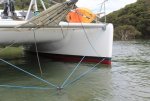
This is the application.

The snubber, the 2 blue ropes, run through blocks at the bow to the stern where the snubbers are restrained by clutches, one on each side, then to another block and to a sheet winch. The bridle can then be extended, or retrieved. It is thus an 'everyday' snubber/bridle, when at its shortest, (and shortest is actually quite long) or can be extended if the wind increases. At its shortest it is still long but cannot touch the seabed. A bridle has a normal triangle, that reduces veering - a horizontal triangle - this arrangement offers a vertical triangle as well, which reduces the effects of chop and swell. Use of the LFRs results in the tension being applied 'more' horizontally' much lower than would occur is you simply had the rode tensioned directly from the bow roller.

The vertical triangles and their positive effect are 'accidental' or fortuitous - but having found the advantages I'm trying maximise the effect. I don't think I can improve on the overall effect, the long and longer snubber itself and the way the snubber cannot touch the seabed.

This can be applied to a monohull - if you have a pad eye at or near the waterline (bobstay).

Now....

What's not to like.

Some of the positive effects result from the friction of the LFRs. I'm trying to find out what positive or negative effects might develop from use of 'friction less' blocks instead of the LFRs.

IMG_4782.jpeg

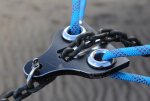
Basically I want to replace the LFRs with sheaves within the bridle plate itself.

So make the plate from 2 sheets of 316, or 2205, and sandwich the sheaves inside. I would need to make a solid slot for the chain - but that is a minor issue - its the sheaves that are the unknown or concern.

The trouble with defining exactly what I'm doing focusses thoughts and some of the best ideas come from being unconstrained (out of the box, off the wall, Debono (spelling?) and lateral thinking- but I've done it now!

Thank you for the flow of ideas so far. Gratefully received - I'm not going to analyse until the flow becomes a trickle.

Take care, stay safe

Jonathan
 

Attachments

  • IMG_4759 3.jpeg
    IMG_4759 3.jpeg
    65.8 KB · Views: 1
Top