Cummins

Falling Star

Well-Known Member
Joined
4 Mar 2011
Messages
583
Location
Essex
Visit site
I'm thinking about a boat with a Cummins M10TA engine.

Does anyone know anything about these please?

I know that Cummins are generally thought to be good but there doesn't seem to be much information about this particular model.
 
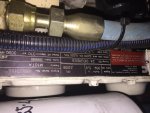
I'm confused with Wikipedia and Google answers. So much so, I went and checked my engines which are 6bta5.9m3's. The label clearly states Engine Family: M10TA, certainly not 10-11 ltr. The 6bta series went from 210 HP (I believe) up to 370 and was derived from a 5.9 truck engine that got marinized. The QSB series went up from there, then the QSM's.

IMG_3774.jpg
 
Last edited:
Cummins
Some of the older ones are sensitive to the cylinder liner seals deterioration .Theres some sort of kit / test you can do with the coolant to determine if theses seals are ok or not as the case may be .
According to Cummins if the service program is or was followed ( regular coolant change - with the correct inhibitors) then it’s a none issue .
I don,t know if the above apply to modern Cummins but it did to the New York trash truck derived 15 L KT 19 marine diesels found in 80/90 ,s Rivas and such like .
They may nowadays use a more robust cylinder seal at the bottom of the wet liners , designed that issue out .

But worth checking/ digging around on the coolant change Fq and how critical it is , and if so has it been adhered to ?

Replacing these seals is an engine stripdown jobbie btw .
 
After further research, it does appear that the engine is in fact a 6BTA5.9. Confusing with a label showing M10TA. Maybe later engines were re-badged?

Anyway, from what I've read, the 6BTA's seem to be generally OK, unless someone can tell me different?

Will look for a coolant change record re. Portofino's comments above. Also, was there something about the intercoolers getting sea water in?
 
After further research, it does appear that the engine is in fact a 6BTA5.9. Confusing with a label showing M10TA. Maybe later engines were re-badged?

Anyway, from what I've read, the 6BTA's seem to be generally OK, unless someone can tell me different?

Will look for a coolant change record re. Portofino's comments above. Also, was there something about the intercoolers getting sea water in?

The 5.9 is a parent bore engine it has no wet linners .My seal / o ring point was for the wet linner Cummins which I think the 10;L is .

How ever there are some porus block casting out there in the 5.9 .
You have not said how old the motors are in the boat you are looking at ?

http://www.cumminshub.com/cummins-53-block.html

http://www.trucktrend.com/how-to/engine/1103dp-cummins-fatal-flaws/

Parent bore means the cylinders are just machined out of the block metal casting , no linners inserted .
This means if it ever needs a rebuild you either chuck it away hence the name a “ chuck away engine “ often used with parent bore engines - or have them re honed and fit bigger pistons or recut even bigger and a machine shop makes up a custom insert to press in .

With the larger Cummins that are wet lined and indeed other wet lined diesels this is the basic problem they have to deal with ( not applicable to the 5.9 )

But a bit of background while on topic

Wet Liners

Generally the water jacket is formed by the cylinder liner and a separate jacked which is part of the cylinder block.*A static seal must be provided at both the combustion and crankshaft ends of the cylinders to prevent leakage of coolant into the oil pan sump, or combustion space. Generally the seal at the combustion end of the liner consists of machined flanged fit, rubber or neoprene liner seals generally form the seal at the crankshaft end of the liner. Liners of this type are constructed to permit lengthwise expansion and contraction. The walls of a wet liner must be strong enough to withstand the full working pressure of the combustion gases.
Cylinder Liner Issues
One of the fundamental problems with wet liners in diesel engines is cavitation damage on the outside diameter of the liner. Harmonic vibrations produced by combustion inside the cylinders cause tiny air bubbles to form in the coolant on the outer surface of the liners. When the bubbles implode or collapse shock waves are created that can erode the surface of the metal. Overtime, this can lead to serious erosion and surface pitting that may eventually cause the liner to leak of fail.
Cavitation damage can be reduced or eliminated by ensuring that the fuel injection timing is correct and that the engine is not subject to over-speed outside its specified RPM range. Cavitation damage can also be mitigated by using supplementary coolant additives and following OEM coolant recommendations.

Hence take a close look at the coolant change Fq in some marques who’s wet linners are prone to cavitation.
 
That is interesting. Thank you.

I'm not sure of the age of the engine but I believe it to be 2002 or later. The serial number is
46255178.

I'll look to see if there's a 53 on the casting.
 
Go to sbmar.com, all things Cummins and Tony is the expert (as is latestarter)

The 6bta is I believe the most manufactured diesel in the world, and has a Stirling reputation for reliability if it is looked after, and if the cooling and aftercooler system is kept well maintained. I beleive commercially in the lower hp ratings 20000+ hours is not unusual,, but marine age kills them quicker than anything. The exhaust system as with all engines is critical also. I specifically looked for boats with Cummins or iveco.

Steve
 
After further research, it does appear that the engine is in fact a 6BTA5.9. Confusing with a label showing M10TA. Maybe later engines were re-badged?

Anyway, from what I've read, the 6BTA's seem to be generally OK, unless someone can tell me different?

Will look for a coolant change record re. Portofino's comments above. Also, was there something about the intercoolers getting sea water in?

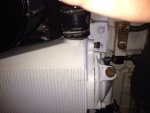
Falling Star, what else is on the label, like HP and year built? If its a 330/370hp version, the large "box" on the rear left side, is the aftercooler that raw water (seawater) passes thru cooling fuel air, then transmission cooler, and heat exchanger to the exhaust riser. (I've included a pic, not the best sorry). Generally these Cummins engines that have been well maintained over the years have a long working life, but the aftercooler maintenance is key including removal/cleaning of the core (tube stack). There are anodes top and bottom and if maintenance is lacking, the bottom anode and surrounding alum cooler housing can corrode, even splitting the housing allowing seawater to make its way around the core and into inlet manifold. Lower HP versions don't have raw water aftercooler, but have an alternate system.

The other area of susceptibility on all of the HP version of the bta5.9's is the raw water pumps. The Sherwood pumps that Cummins used aren't the best and apart from chewing out impellers, bearing seal failure behind the impeller can allow sea water to leak thru past the shaft into the timing gear area and turn the oil to cream with obvious issues throughout the engine. Check the pump weep holes for rust discharge.

If it looks a good boat otherwise, and you're looking to make an offer, get a engine mechanic WITH Cummins expertise to do an engine survey as part of the purchase process. No doubt he will check blow by and the overall engine health.

I think someone mentioned it previously, but go look at sbmar.com. Their site has just about everything you'd ever want to know about Cummins engines under Tony's Tips. It is excellent. Good luck with your purchase.

Cheers

IMG_0209.JPG
 
Last edited:
That is interesting. Thank you.

I'm not sure of the age of the engine but I believe it to be 2002 or later. The serial number is
46255178.

I'll look to see if there's a 53 on the casting.

The serial number says it is a 6BT5.9-M330 built on 27 Sept 2002.
 
Top