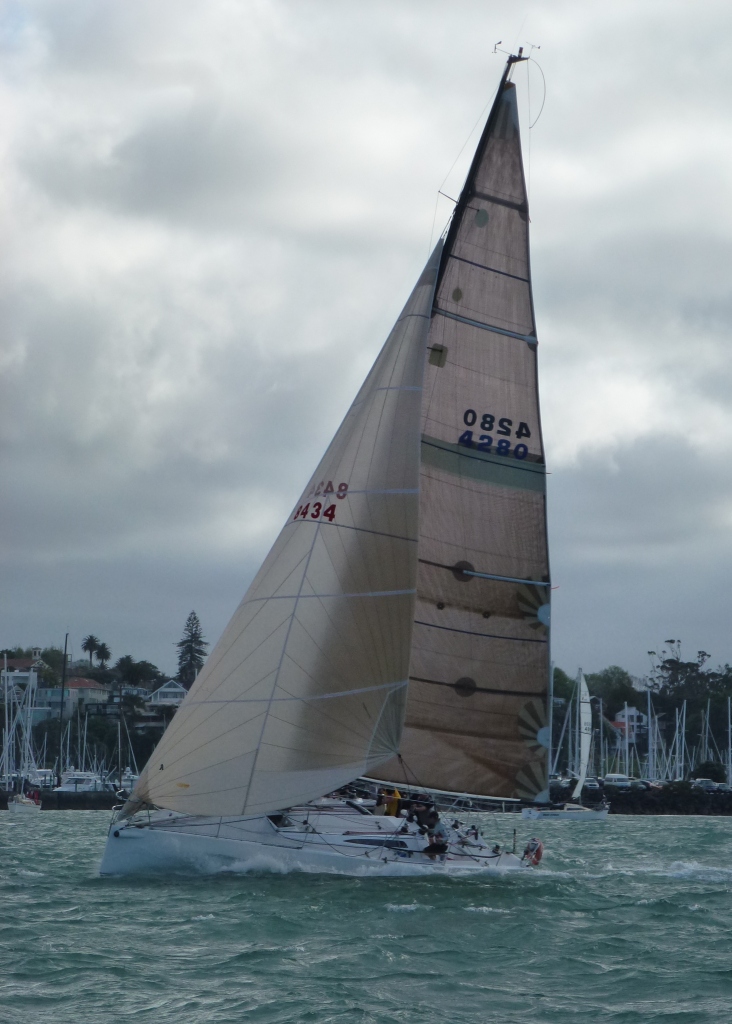
Cruising Yachts and Blade Jibs Instead of A Genoa

  • Thread starter Thread starter Deleted member 36384
  • Start date Start date
I was also questioning the assertion made by another poster that his large overlapping Dacron sail was faster than the blade laminate. Though I am mostly thinking about windward performance, on a reach the overlapper will be faster for sure until it's overpowered. Upwind I think shape is more important than area, and your Dacron sail may have great shape on day 1, but it won't in season 3, or 4 or....

As with absolutely everything else in yacht design, it is a compromise. Yes you will be underpowered in light winds, but with the advances in sail design probably less than you might think.
.

Question away if you like. Yes with the No. 3 blade our boat goes very well to windward in 15+ knots, and using the inner sheet leads points very high - in flat water.
But in 5-10 knots true wind speed it lacks power - hence when the boats was raced seriously it had bigger No.1 and No. 2 genoas as well for light stuff.
As we like to avoid motoring, big sails to sail effectively in 5 knots is a priority. And we have found a well cut genoa with foam luff plus adding third reef point means we can change gears very quickly and effectively as the wind increases.

Each to their own. But my point was need to look at the whole design package - above water (rig position, mainsail size) and underwater (hull weight, foil depth and aspect ratio) as messing with one component may not work unless the rest aligns
 
A blade jib will, as others have said leave the boat under canvassed in light winds, and do little when running downwind. I did sail on a Moody 419 which is about the same age, size and displacement as the Rival, where the genoa had been replaced by a high cut yankee. It was a good choice in many respects, and had the advantage of making a big improvement in the helmsman's ability to see what was ahead of the boat. Though I did not sail a downwind course on that boat I think it would have coped reasonably well in a breeze, and would have needed to give way to a cruising chute in light winds. Upwind it performed well. On my own boat which had a 140% genoa I had the new genoa made smaller in size when I bought a replacement. Nothing scientific, I just asked the sailmaker to make the new tri radial cruising laminate genoa half a metre less in the foot. Better sail shape more than compensates for the lost area, and its easier to handle. Downwind the lack of a pole means that a big and heavy genoa will collapse in light winds.
 
the key issue is track position. true the sheet lead for a 140 furled to 110 is the same as it would be for a 110 but since that reefing is only likely to take place at f6, what we are saying is that the lead will be all wrong for the blade sail in just the winds when its most important.

I investigated this change for my boat which has a masthead rig and a big genny and it was the impossibility of adding new inboard genny tracks that stopped me
 
the key issue is track position. true the sheet lead for a 140 furled to 110 is the same as it would be for a 110 but since that reefing is only likely to take place at f6, what we are saying is that the lead will be all wrong for the blade sail in just the winds when its most important.

I investigated this change for my boat which has a masthead rig and a big genny and it was the impossibility of adding new inboard genny tracks that stopped me

Are you saying that you can't get the leads far enough forward, or far enough inboard, or both?
 
I have a 3/4 ton IOR type yacht.

I have a 150 ish % genoa on a roller with a foam luff. I have used it in up to 30 knots. I can also pole it out downwind on a run. I use it most of the time.

I also have a blade jib which hanks onto a removable forestay and a it has a slab reef. That covers everything until I need to pull the storm jib out. I deliberately fitted very long genoa/jib tracks and can control the carriages from the cockpit.

I imagine that more modern materials and construction would considerably lighten the sails and make them easier to handle than the heavy Hood cloth.

I would be very reluctant to dispense with a large genoa in lighter winds.
 
Last edited:
I have sailed another Rival 41C quite intensely (coastal and ocean) and she had a full suit of hank on sails, including a very large goaster and a cruising chute. Back then they were all dacron of course. I am comfortable handling the boat and managing the sails but I am very much a product of 1980s technology. The basis of my query is really about using modern sail materials and cuts to get the best drive. I can stick tracks anywhere on the coach roof or side decks as there is good access all round.

The yacht was a bermudian sloop but has been converted to a cutter rig. Currently she has the staysail, and 120% roller reefing headsail and main with standard battens. No Yankee and no tracks fitted for the yankee on the quarter. The staysail tracks have been fitted well inboard on the side decks. She has a kite which I use for reaching/downwind in preference to the Genoa.

I know John at Saturn Sails and will talk to him about it all anyway. Thanks again, BlowingOldBoots
 
Hi Flaming.

I'm a fan of non or marginally overlapping headsails and our Elan 295 has c110% jib with a bit of roach and horizontal flexi battens (will furl but you shouldn't keep furled for long) that sheets inside the front of the spreaders - she was designed that way and has a suitably sized main. Incidentally the original cruisy jib didn't have battens or roach although may be bigger than the racing sail as I think it overlaps a bit more. More for the OP to mention to the sail maker - area, sheeting position, roach and battens as well as whether the main is suitably sized.

Your Elan 37 I believe was designed with overlapping originally and is a boat I would love to move up to one day - I'll consult you if it ever becomes possible! Anyway do you know how moving to non-overlapping reduced your rating?

I echo your view on a wheel going hard downwind and by the time you get to about 35 feet I would say is the answer. Sunday in the solent was speedy even on the 295 and we kept the boat under the rig downwind in both races (tiller between legs, tiller extension in both hands and standing well back, thinking a few feet longer and I would be doing it with a wheel). Heart racing a bit in the process. Well done on your wins.
 
When we made the change we dropped 16 points I believe. Went from being sort of competitive, to winning stuff. IRC really does hammer the overlappers!
 
I have a 3/4 ton IOR type yacht.

I have a 150 ish % genoa on a roller with a foam luff. I have used it in up to 30 knots. I can also pole it out downwind on a run. I use it most of the time.

I also have a blade jib which hanks onto a removable forestay and a it has a slab reef. That covers everything until I need to pull the storm jib out. I deliberately fitted very long genoa/jib tracks and can control the carriages from the cockpit.

I imagine that more modern materials and construction would considerably lighten the sails and make them easier to handle than the heavy Hood cloth.

I would be very reluctant to dispense with a large genoa in lighter winds.

If one headsail is covering everything from 1-30 kts, it may not be doing it very well. If it's heavy enough for the heavy weather end, it's too heavy for drifting conditions. The racing solution used to be a light and heavy #1 genoas, with the change happening somewhere around the 10kts apparent mark.
 
So its not necessarily about the boat going quicker, but about making the handy cap better?

Seems so at our club from listening to conversation about it and seeing what boats are carrying. Not what I do though. On a heavy boat why miss out on lovely lighter wind sailing? Previous boat (heavy) had a 130%ish roller and a long easily used detachable inner stay that I had a huge light No1 and a No3 blade all on piston hanks so could easily raise and drop single handed. Foils must be great if numerous crew are available for sail changing. On current boat (36' conway) I could not/ can not afford a roller system so have collected a set of hank on sails and quite happy with this. If the wind is going from heavy to light will set a bigger genoa and reef the main, if going light to heavy set smaller genoa and full main ready to reef main. Also have a spinnaker and mizzen staysail. No idea about modern cloths but would love to try them, cost though! I also fitted a huge pair of primary winches which I acquired second hand. As I get older I would fit electric winches rather than go for smaller sails (if I could afford them).

Yes I am feeling broke at the moment!
 
So its not necessarily about the boat going quicker, but about making the handy cap better?

Not entirely. The boat was just as fast - certainly over 10 knots - and can be made to point higher in less than that (with a lot of care..) but the handicap had dropped. We think we are only noticeably slower in 5 knots or less. And with Solent tides it's pretty rare to be racing in that little wind.

There are other benefits too - we now carry less sails, and smaller sails, so the interior is a little less "busy" and obviously we've shed some weight and where the old overlappers had quite a short life due to being constantly battered around the shrouds the small jibs seem to last much longer.
 
On another thread its been suggested by Flaming that a Blade Jib is a good choice for cruising yachts; indeed Flaming advises that new racing yachts haven't had Genoas for years now.

It is my plan by the end of next year to replace all the sails on my tub. So, on a Rival 41C, Masthead Rig, 10 Tonne at 41' LOA, 36' LWL, cutter rigged, would cruising laminate blade jibs be a good idea on the inner and outer forestays; main would also be in a cruising laminate. I think they would be when the wind gets up into No3 territory, so I am really querying low wind performance where I currently believe a big Genoa would be better.

What do think about cruising and blades in general and doing away with big Genoas? Clearly, the Rival weight and hull shape reflects old design and technology and I think blade jibs would not work on this type of hull design, however, maybe it would, as Flaming suggests VMG is likely to be better, although the Rival heels over and doesn't have the form stability of a fat arsed yacht.

I am intrigued.

I was thinking along the same lines; a self tacking blade jib (possibly one that could be reefed down as a spitfire jib), and then a big furling yankee so that visibility forward is not hindered.
 
What do think about cruising and blades in general and doing away with big Genoas? Clearly, the Rival weight and hull shape reflects old design and technology and I think blade jibs would not work on this type of hull design, however, maybe it would, as Flaming suggests VMG is likely to be better, although the Rival heels over and doesn't have the form stability of a fat arsed yacht.

I am intrigued.

Blades are great for windward leeward racing - which is now the majority of keelboat racing, especially inshore. The problem is when you crack sheets - the unequal lengths between foot and leech means that the clew lifts, twist increases massively and trimming becomes a matter of compromise. The cure - for when you're using the blade, is athwartship jib tracks and height adjustable leads. For longer times spent reaching, (offshore), racing boats hoist a jib top. Reminds me of something...

Mojo.jpg


Or here: trim on the left - pretty nice. Trim on the right..... ug.

62JT_Siren_Tabasco.jpg


Also, on racing boats, genoas are a rating dodge - (they were invented before the war in the 6 metre class as such) - where the extra area is cheap in rating terms, despite the fact that overlap is an inefficient place for sailcloth. So the reasons that racing boats used to have big genoas and now don't doesn't necessarily correlate to cruising boats. For cruising, I would talk to a sailmaker, and not dismiss a yankee out of hand.
 
Last edited:
My idea of a perfect rig would be a blade foresail - maybe not self tacking as that usually requires just too much compromise, too little area, possibly a job for barber haulers ?

With a chute on a furler ( not reefer ) situated just ahead of the forestay, bowsprit or not.

I tried barber haulers on my Anderson 22 but that was with the overlapping genoa, frankly it didn't work but that was with the overlapping genoa, not much sublety just area.

Re-leadiing the foresail sheets inside the guardrails certainly does help a lot in light winds going to windward though.

Both sails would have to have high cut clews for visibilty as well as performance, crews joke about my constantly calling ' keep a lookout under the jib ' !
 
How does a high cut clew benefit performance?

Simon,

a foresail with a high cut clew primarily helps performance by visibilty, avoiding one running into other boats, breakwaters etc !

A well cut and suited blade foresail will optimise the ' slot effect ' between the leech of the headsail and luff of the main too, this is very significant.
 
Racing boats try to have the jib touch the deck for the end plate effect, and minimize leakage from the high pressure windward side of the sail to low pressure leeward.
 
Top