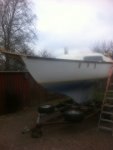
cross an ocean in a Hurley 18

Looking further at the picture of the Bristol 27 he has three rusty anchors and chain on the foredeck none of which meet the exacting standards of the forum...... two danforths and a plough....... how on earth did he make it across.....
 
Looks like an up together little boat.....I would be interestd in more info about his vane gear and inner fore stay a arrangement........ obviously of the go simple err go school of thought!
Bottom line it was a big swivel! The vane bit was about a third of the length, the bottom bit was between two mild steel square sections lined with plastic as a bearing fore and aft plus it had a circular plastic tube bearing. Plus a small rudder. The top bit was turned by the vane, the whole lot swivelled, the rudder was turned to either side which forced it to swivel side to side which then pulled a rope tied to the rudder. They reckoned it worked faultlessly.
S
 
There's not much call for anchoring mid Atlantic!
Looking further at the picture of the Bristol 27 he has three rusty anchors and chain on the foredeck none of which meet the exacting standards of the forum...... two danforths and a plough....... how on earth did he make it across.....
 
Hi folks... my work is ongoing... reinforced the chainplats and more....My question: Suatible selfsteering? Your oppinion?
mine: Cape Horn, windpilot, or purhapse a trim tab? have too use something farely light, I guess?! Aries, probably no, no!?
 
Hi folks... my work is ongoing... reinforced the chainplats and more....My question: Suatible selfsteering? Your oppinion?
mine: Cape Horn, windpilot, or purhapse a trim tab? have too use something farely light, I guess?! Aries, probably no, no!?

Seafeather purhapse?
 
While Im on it... Purhapse I lay my route as following: Swe-"the channels" in europe, gibraltar, down the african coast towards south africa. How does that sound? ups and downs?

(this before I cross any wast oceans)
 
wow,,,Tanx for all advices and everything! a couple of things caught me..."Foam" will over time suck-up water?! (no good!) Better with air-tightcompartments?! Dont know if you've been/seen a Hurley 18? There are many divided compartments, and a thougt was too make them airtight anyway...but I need the "loading" capacity...have too be wise and use my head! there is much I want your oppinion and advice on, I'll get back too you soon...
Why amI doing/ want this?! Because Iam curious, and want too get too know my self (for real!) I allways loved the sea. and I have owned bigger sailboats, but bigger boats means bigger expensives, unlikley too ever "get going"...So I stay with my Hurley 18, prepear her and make her ready for open water...tanx again folks and a merry christmas

It can be done with an 18' boat. However with all ocean crossings in small boats there is an element of risk. Just take breaking waves as an example: most merchant ships are designed to resist 50' waves which, until relatively recently, were considered the largest waves likely to be encountered. Such a wave breaking has been calculated to hit with a force of 15mt/sq metre. Now it is known that rogue waves can be twice that height but the corresponding impact is 6 times as much, ie 100mt/sq metre. No pleasure boat could resist that.

Although these are very rare and are more likely in some areas than others they are also unpredictable.

The movement of a very small boat in bad weather is amplified and can be very tiring. You have to consider that this state may last days rather than hours and so it is indispensible to know your own limits before undertaking a major project. The sensible thing would be to begin with shorter trips and a variety of weather to assess whether it is really your thing.

Bouancy : use empty plastic water bottles.
 
Last edited:
It can be done with an 18' boat. However with all ocean crossings in small boats there is an element of risk. Just take breaking waves as an example: most merchant ships are designed to resist 50' waves which, until relatively recently, were considered the largest waves likely to be encountered. Such a wave breaking has been calculated to hit with a force of 15mt/sq metre. Now it is known that rogue waves can be twice that height but the corresponding impact is 6 times as much, ie 100mt/sq metre. No pleasure boat could resist that.

Although these are very rare and are more likely in some areas than others they are also unpredictable.

The movement of a very small boat in bad weather is amplified and can be very tiring. You have to consider that this state may last days rather than hours and so it is indispensible to know your own limits before undertaking a major project. The sensible thing would be to begin with shorter trips and a variety of weather to assess whether it is really your thing.

Bouancy : use empty plastic water bottles.

I well remember seeing 'vessels' at Earls Court Boat Show, which had crossed the Atlantic & were little more than a barrel. Seemed to be great competition, with each 'loser' cutting a few inches off, in order to try again & become the smallest to do so.
 
This autumn I met a little chap (in his retirement years)... name withheld.

He came into Cangas Marina, (Ria de Vigo) NW Spain in a very grubby looking 22' foot twin keeler with a

tiny and well used mercury 2 stroke outboard engine and an old faded red ensign, flying from his backstay.

He had designed and built his own self steering system which although very lightweight in construction, had reportedly done a good job.

He had screwed a few very solid pieces of ply over where his companionway used to be to form a sort of

doghouse so his 5'2" could stand. He closed it off with a rotating plastic locker lid with a big handle inside.

All his windows were boarded over and he had a permanently reefed rig, with very large standing

rigging cables and strengthened chainplates down the outside.

He had no radio, a handheld gps, otherwise no electronic instruments, just a handheld compass.

A camping gas stove warmed his tins of food in the can, otherwise when ashore he ate from the town markets.

The inside bore a resemblance to when I slept for a term in an old truck to save money as a student.

He had tied back all hard objects and was prepared for any knockdowns.

I invited on board to drink and chat........

"I've just 'run away' from the U.K. after having had enough of a nagging wife!" he said.

S.
 
Last edited:
> Now it is known that rogue waves can be twice that height but the corresponding impact is 6 times as much, ie 100mt/sq metre. No pleasure boat could resist that.

Those are found in the Southern ocean not the Atlantic. Peronally I wouldn't cross the Atlantic in a small boat, you risk running out of water and food and the boats motion will be extreme in bad weather. When we crossed we had light winds and were praying for squalls to get the speed up which we eventually got. Speaking of motion for three days we had ten foot waves and a twelve foot swell from behind, a three foot swell from a gale in the north Atlantic and a two foot swell fron the south Atlantic. Normally boats roll but this caused the boat to corkscrew and it was almost impossible to eat or change clothes as you had to hold on all the time with one hand.

Also the Atlantic weather can be really bad. We were on the ARC finish line and the boats had gale force winds all the way gusting beteeen 40 to 50 knots. They arrived with broken booms, torn off booms, broken rigging jury rigged, broken rudders jury rigged, broken carboan spinnaker poles and torn spinnakers and sails. A Canadian boat we know well arrive with just a staysil, the spinnaker, genoa and main had been torn beyond repair. We had those conditions over Biscay but kept sailing because we had a 38 foot heavy displacement steel ketch with a long keel and cutaway forefoot. A Moody ketch ran of with drogues, a cat hove to using both engines and sadly a local fishing boat was lost with all hands. This is why I said I wouldn't cross the Atlantic in a small boat in addition to the points above.
 
> Now it is known that rogue waves can be twice that height but the corresponding impact is 6 times as much, ie 100mt/sq metre. No pleasure boat could resist that.

Those are found in the Southern ocean not the Atlantic.

No that's not true; rogue waves are more common in, but are certainly not confined to the Southern Ocean. Occasionally they even occur in non-ocean locations such as the North Sea.

Edit: please accept my apologies for being so forthright. The thing is a lot of people (including me) look to this forum for advice regarding matters of safety. In that light and notwithstanding the comical undertones of this thread, would you mind clarifying whether the above account is set more on the factual as opposed to the fictional scale?
 
Last edited:
> Now it is known that rogue waves can be twice that height but the corresponding impact is 6 times as much, ie 100mt/sq metre. No pleasure boat could resist that.

Those are found in the Southern ocean not the Atlantic. Peronally I wouldn't cross the Atlantic in a small boat, you risk running out of water and food and the boats motion will be extreme in bad weather. When we crossed we had light winds and were praying for squalls to get the speed up which we eventually got. Speaking of motion for three days we had ten foot waves and a twelve foot swell from behind, a three foot swell from a gale in the north Atlantic and a two foot swell fron the south Atlantic. Normally boats roll but this caused the boat to corkscrew and it was almost impossible to eat or change clothes as you had to hold on all the time with one hand.

Also the Atlantic weather can be really bad. We were on the ARC finish line and the boats had gale force winds all the way gusting beteeen 40 to 50 knots. They arrived with broken booms, torn off booms, broken rigging jury rigged, broken rudders jury rigged, broken carboan spinnaker poles and torn spinnakers and sails. A Canadian boat we know well arrive with just a staysil, the spinnaker, genoa and main had been torn beyond repair. We had those conditions over Biscay but kept sailing because we had a 38 foot heavy displacement steel ketch with a long keel and cutaway forefoot. A Moody ketch ran of with drogues, a cat hove to using both engines and sadly a local fishing boat was lost with all hands. This is why I said I wouldn't cross the Atlantic in a small boat in addition to the points above.

The Draupner oil rig : North Sea where for the first time the height of a rogue wave was scientifically validated.
1985 - the Fastnet lighthouse was hit by a 157' wave,
2014 - a person was killed on the ss Marco Polo in the English Channel
A ship was sunk on Lake Superior
The QM2 struck one on a N Atlantic crossing
etc etc

See : https://en.m.wikipedia.org/wiki/Rogue_wave

Here you can see some caught on video:


https://m.youtube.com/watch?v=l_8hOai9hGQ
https://m.youtube.com/watch?v=TAjgRd_YnR4
https://m.youtube.com/watch?v=sor5KTqNdxk
 
Last edited:
min.jpg

about rogue wave...Size of boat hardley matters. I dare too say they occur only in "surten" areas:...agula./indian ocean.North sea/ north atlantic and far south cape horn...
 
when the wave height is twice as long as the boat, (i've read!) it could (not nessesary!) flip...12meter waves is quite big in my book :/

and in heavy condition -my thought- is using a parashut anchor if dangerous/ needed.

If the worst will happen, so be it...And nomatter what size of boat will be safe...ever!

"Oh God be good too me, thy sea is so wide and my ship is so small" (fishermans prayer)
 
Last edited:
First post and it's to ask about taking an 18 footer on an "Atlantic cruise" - is that across the Atlantic or along one of the edges? Have you done a lot of sailing and navigating before because, if it is across, the potential for disaster is great without the requisite knowledge and skills which you won't pick up on here - the best you will get on here is lots of advice, some useful and some you can totally disregard...:)

Mayb you ought to read Shrimpy by Shane Acton re: equipment and experience!
 
Top