Cracks in anti-fouling- Altex (Black)

I followed the directions of the supplier of the product

Re-read post #16, nothing to do with following directions.

In post #8 you said: "I think you'll find the past ablative anti-fouling is history"

In post #9 you said: "Thanks for that but my anti fouling is not ablative (?) "

Not what the data sheet says.
 
Please read earlier comments before commenting further!!?
I have. You’ve given the reason that you had to overcoat the primer with antifoul. But you haven’t explained why you’ve applied a primer when the prospect of launch appears to be a distant thing. So, why did you do the job now and not just before launch?
 
I have. You’ve given the reason that you had to overcoat the primer with antifoul. But you haven’t explained why you’ve applied a primer when the prospect of launch appears to be a distant thing. So, why did you do the job now and not just before launch?

The boat's been in his garden for 20 years. It isn't going anywhere in the near future. My guess is he's just doing easy jobs which will make him feel he's making progress.
 
How long to go before the boat is launched? I don’t understand why you’d be doing the antifouling well ahead of launch, for me it’d be the last job to be done before launching.

The online specs for the barrier coat and anti fouling stated the product should be applied in warm dry weather so I applied it in our summer (ie your winter). In Western Australia we basically have six months of dry weather followed by six months of wet/cold weather (unlike the UK where I believe it rains every other day)

As I am building my boat in the open I do outside jobs in the good weather and the inside jobs in the winter ie cold wet weather. I wondered why you seem bewildered at my approach but I suppose when you built your boat, since it rains often in the UK, it really didn't matter when you scheduled your jobs?

To answer our query "How long to go before the boat is launched?" I think about six months.

I trust this answers your query
 
The online specs for the barrier coat and anti fouling stated the product should be applied in warm dry weather so I applied it in our summer (ie your winter). In Western Australia we basically have six months of dry weather followed by six months of wet/cold weather (unlike the UK where I believe it rains every other day)

You really are an insulting little troll, aren't you ?

As I am building my boat in the open I do outside jobs in the good weather and the inside jobs in the winter ie cold wet weather. I wondered why you seem bewildered at my approach but I suppose when you built your boat, since it rains often in the UK, it really didn't matter when you scheduled your jobs?

Here in the UK we sail our boats on the water, not in our gardens (y)

To answer our query "How long to go before the boat is launched?" I think about six months.

I trust this answers your query

Delusional.
 
On the up side, the antifoul has been protecting the epoxy from the sun.

That'd be right.

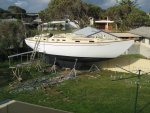
It is only the keel that has the hairline cracks but that would be the only area of the anti-fouling that would get direct sun. If you look at the yacht, West, is to starboard (bow pointing South)

Placing the lead in the keel is my next trick. What are you doing next week?:D

IMG_1923 Compressed.JPG
 
Hi coopec, that is a beautiful looking boat. Best regards, Oz
Thats a beautiful job and boat
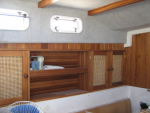
Thank you! :D :D

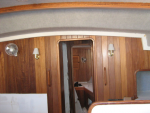
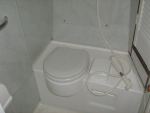
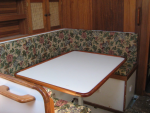
I made the mistake of getting a Furniture Maker (not a cabinet maker) to show me how to fit a yacht out. He said what style do you want and I made a fatal mistake of saying "It's up to you". Once we started he left town and I had no alternative but to stay with the same theme.

Screenshot_2020-08-21 Yacht main cabin.pngScreenshot_2020-08-21 Main Cabin.pngScreenshot_2020-08-21 IMG_1088.pngScreenshot_2020-08-21 IMG_0983.png
 
I think you made the right choice to get a furniture maker. Thanks to him and your skills, you have made yourself nothing short of a work of art. I was a boatbuilder by trade. I went to Falmouth technical college in Cornwall and did yacht and boat boatbuilding and worked in boatyards ( all traditional building ). This was in the 1960's and 70's, and i can honestly say i doubt if i could have done a job anything remotely as good as yours. Congratulations to you. All the best, Oz.
 
Coopec,

I'd question why you used Altex No5 - its a really dated formulation - technology has moved on and though everyone has been suggesting AF will be banned - there is actually no major momentum in Australias to do so. Ring Phil Ross at Cruising Helmsman and ask for the copy of the AF survey they did a few years ago.

AF are not designed to be pretty and are not like decorative paints that strentch and compress - the resins are simply vehicles to allow you to adhere micron sized particles of poison to your hull. If your hull expands and contracts (in the sun) then you can expect there to be cracks - as long as the AF is not blistering my worry would be what 'underneath' is expanding and contracting to allow the AF to crack. As is implied AF is designed to be applied and the vessel immersed in water and the temperature range to which the paint is subject is not as extreme as you get in the fresh air - of Sydney or Perth - where our sea temps are from about 16-26.

It would have helped if you had posed a picture of the cracks - and then the armchair experts could have had a field day.

I don't think there appear to be any surface coating experts here - I'd ring Altex and ask for their comments. They are local - they might know (though I suspect they will offer some platitude and suggest you should have wetted it, continuously.

Better AF would be Hempel's Globic and Jotun's SeaQuantum Ultra. Both are professional use only but both are available if you ask nicely and will give you 2 years (in the water). But they are not cheap - so I'd wait till your are ready. We will be applying Seaquantum in the next few weeks (and I'm not a professional - whatever that might be - monkeys could apply AF :) )

Jonathan

Lovely interior, we too used cabinet makers (or our boat builders did) for the interior (or they made all the doors, dovetails drawers, door frames (no veneers) - well worth the effort.
 
Jonathan

I've thought a lot about the hairline cracks and I now have now come the conclusion exactly as you described. Altex No 5 (or any antifouling) would not be formulated to handle temperatures as high as 40° c+

As far as my choice of Altex No 5 is concerned I made inquiries as to what people in our local clubs were using and the message was Altex No 5. When it comes to something like this I think people are like sheep and just follow the leader. (But I'm not wedded to any particular product) Altex No 5 is supposed to last two years.

Altex No.5 Antifouling is recommended: Where multi-season effective fouling ... incorporates all the benefits of both ablative and hard paints in one superior product. Its hard, smooth surface withstands trailering and read more »

Thank you for your compliments and advice.(y)

I'm bemused by some idiotic armchair experts posting here! (Full of gratuitous advice and criticism but none of them would have a bloody clue)???

Screenshot_2020-08-21 Pinterest.png


Coopec,

Don't let them get to you, I find your post interesting and would not want you to go on shore leave. Bite your tongue, leave them alone. Not everyone can be working on a yacht quite as well found as yours.

I've tried Altex No5 - you cannot get 2 years here. But AF performance varies with local conditions. Using any AF we get a different performance on one side from the other, presumably some affect of sunshine and from inside the hulls to outside, more and less light. I don't quite understand the sunlight effect as the yacht swings with the tide/wind and the sun regularly sweeps across the sky :) but presumably the hulls face more in one direction than the other.

Jonathan
 
Top