
You are using an out of date browser. It may not display this or other websites correctly.
You should upgrade or use an alternative browser.
You should upgrade or use an alternative browser.
Cracked exhaust riser
- Thread starter Steve_N
- Start date
oldgit
Well-Known Member
Cast iron risers are notorious for failing simply due to old age.
Constant expansion and contraction with bit of added corrosion.
Have had risers crumble on both Volvo Penta and Mercruiser engines.Probably require renewal after 5 years or so.
Just goes with the territory...................
Constant expansion and contraction with bit of added corrosion.
Have had risers crumble on both Volvo Penta and Mercruiser engines.Probably require renewal after 5 years or so.
Just goes with the territory...................
haydude
Well-Known Member
It is rather a design flaw. Volvo Penta should know better that you cannot mix cast iron and salt water and expect durability. If you are lucky find an after market stainless steel replacement. Or have it made for you. The original replacement is a waste of money.

pvb
Well-Known Member
My old boat had a 24 year old Volvo Penta 2003T, with the original cast iron exhaust elbow still fine after 2300 hours. I don't think that one could reasonably expect much more.
rogerthebodger
Well-Known Member
Stainless also has a problem with hot sea water. I have welded up both my stainless steel exhaust elbow and water cooled manifold.
This is not problem to me as I have stainless welding equipment at home.
This is not problem to me as I have stainless welding equipment at home.

vyv_cox
Well-Known Member
It is slightly less clear on a Volvo manifold than on a Yanmar but I believe the cause of cracks in the latter to be thermal fatigue. This is not the result of repeatedly heating and cooling something, but the repeated change in stress levels due to differential thermal expansion in something that has various thicknesses, definitely the case with the Yanmar ones. Fatigue is rather more difficult to imagine with the Volvo one in the photo, partly because it does not have such pronounced section changes but also because the text books state that fatigue is not a problem in cast irons as the crack growth is always arrested by the graphite. However, I know this to be untrue having investigated the failure of cylinder liners in locomotives. Except in very special cases corrosion does not cause cracks, which almost certainly rules it out.
Steve_N
Well-Known Member
Interesting, thanks.
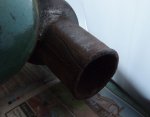
I'd often wondered how the builder had managed to get the exhaust hose onto the tail of the elbow because there was such an increase in diameter visible at that point and the hose is wire-reinforced. It was only when I cut the hose away with a saw that I realised that the tail had swelled and spalled with corrosion and expanded inside the hose - the crack wasn't visible until I chipped away fully 5mm of rotten cast iron all the way around to get down to the remaining 'good' iron, but even this is fairly porous. Perhaps it was that pressure that did for it. It is the original though so has lasted 32 years.
Once the engine comes out I'd hoped that someone might get some use out of what is still a good unit but sadly this now changes the economics of that situation somewhat.
I'd often wondered how the builder had managed to get the exhaust hose onto the tail of the elbow because there was such an increase in diameter visible at that point and the hose is wire-reinforced. It was only when I cut the hose away with a saw that I realised that the tail had swelled and spalled with corrosion and expanded inside the hose - the crack wasn't visible until I chipped away fully 5mm of rotten cast iron all the way around to get down to the remaining 'good' iron, but even this is fairly porous. Perhaps it was that pressure that did for it. It is the original though so has lasted 32 years.
Once the engine comes out I'd hoped that someone might get some use out of what is still a good unit but sadly this now changes the economics of that situation somewhat.