Cote d Azur cruise

It's also my understanding that only the next (common rail) MAN engines are "fully" electronic.
That's how their own dealers call them anyway, whatever that means.
Otoh, the pic that PF posted suggests that also in his engines there must be electronic governors.
Not that they can be seen in the pic, but it would be very weird indeed to fit cable throttles pushing/pulling a potentiometer on a black box, and downstream of it a push/pull actuator, as a mechanical governor would require.
I mean, with mechanical governors, why not connect the throttle cables directly to them?
As they are in my boat, btw.
 
It's also my understanding that only the next (common rail) MAN engines are "fully" electronic.
That's how their own dealers call them anyway, whatever that means.
Otoh, the pic that PF posted suggests that also in his engines there must be electronic governors.
Not that they can be seen in the pic, but it would be very weird indeed to fit cable throttles pushing/pulling a potentiometer on a black box, and downstream of it a push/pull actuator, as a mechanical governor would require.
I mean, with mechanical governors, why not connect the throttle cables directly to them?
As they are in my boat, btw.

Yes EDC , the pot allows ease of compatibility with existing throttles and means no actuator on the g box in this example .
Also it’s ok if the helm gets a wash / drench and the pots are hidden away in the ER .
Several unbiblical leads leave the control box and disappear into the engine .

I do occasionally WD 40 around them and ck for ver de griss .
Spray silicon lub up the boden cables will Mrs PF works the levers .
Nothing stiffened up thus far .:encouragement:

I miss a sync function, it a bit of a phaff when setting cruise to get them within 10 rpm of each other .But it’s a 21 st C problem.
 
On the topic of throttles, mate has a 98 ish S/S Hawk 34 with electronic controls that were causing him no end of issues. I understand that these engines are fully mechanical and I told him that I suspected that the electronic controls were a retrofit offered by VP. Presumably they drive an actuator that works the throttles on the engine and shifts gears. He was quite adamant that this Frankenstein arrangement was fit.

Asked him a couple of weeks later if he'd cured the issue and he confirmed that he'd reverted to fully manual morse levers which has fully fixed the issue. Former bits now will appear on eBay no doubt :).
 
8BD2BC43-6BF8-400C-A356-FB10A54AD8B8.jpg

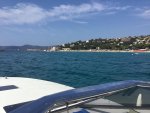
Just out side to the E of Lavandou is a pretty beach / cove called St Clair .
The weather feels back to normal there’s a nice coolI guess breeze the intense heat has gone .
Wind from the SE , so this is a bit exposed .
This coast twixt Lavandou to Cavalaire has plenty of finger caps , so we are anchored under the protection of cap Negre .
23DEBE05-6699-4E5B-8D9A-1FAE203315A2.jpg
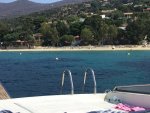
Beach , the yellow buoys are not far out so you get in close .

D816F56A-58EC-46D7-B018-A2FBBCCC1F23.jpg
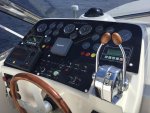
Infamous Morse throttles , I do toy with redoing the dash ( keep the Morse ) but one side says keep it original and retro , that side is edging ahead as the boat gets older and it’s value ( supply / demand ) is increasing .
Less molestation the better on balance .
 
I miss a sync function, it a bit of a phaff when setting cruise to get them within 10 rpm of each other
Those Rexroth "mini-marex" throttles in your pics are what I've always seen mated with MAN electronic engines, both CR and pre-CR.
Maybe in your boat they just didn't bother replacing the original throttles when they repowered your boat, and coming to think of it, I understand such choice, because it would have been an additional and somewhat pointless cost, considering also the single helm station.
You are obviously missing the sync function without them, but my guess is that the functionality itself is actually embedded in the black boxes, and by fiddling with the electric scheme you might find a way to activate it with a plain vanilla switch to be placed at the helm, if you see what I mean.

Not sure it's worth, though, 'cause engines sync is imho overrated.
In fact, in anything but seas with zero waves and current, perfect alignment only happens by coincidence: the way autosync works is by setting one engine rpm and make the other constantly "hunt" to match it.
Without pretending to know better than all engine builders, I don't feel any need for such functionality, since I have not just one, but two old school methods, which always worked for me pretty well, and I'm sticking to them also with the DP:

1) Ears - and nope, I kid you not.
Whenever engines are out of sync, on top of their "normal" sound, you can hear also a distinct cycling noise.
You can even forget the tacho completely: when by fiddling with the throttles you get rid of this cycling noise completely, the engines are spinning at exactly the same rpm, well within a 10rpm difference.
Tried and tested in my old lady, with a guy in the e/r cross-checking the rpm with a laser tacho!
But this method is mostly useful at low rpm/D speed.

2) A/p rudders control: if you think about it, it's not a perfect rpm alignment that we should aim for, it's a perfectly balanced thrust.
While cruising, I always keep the rudder position displayed on one of the instruments, and I adjust the throttles in order to see it as close to zero as possible, while cruising on Auto or Track mode.
Depending on the sea conditions (and also wind direction, hence possibly different tabs regulation), I often achieve this result with both engines at the same rpm, as common sense suggests, but in some occasions also with a perceivable difference.
And in such conditions, the autosync would still keep the rpm aligned, but with rudders constantly steered, even just by a few degrees.
Not an optimal tuning, in my books.

Goes without saying that when going out for a swim round the corner from my marina, I just keep the tachos roughly aligned, without bothering with these arguably OCD sync methods.... :rolleyes:
I did use both in longish passages, though.
 
On the topic of throttles, mate has a 98 ish S/S Hawk 34 with electronic controls that were causing him no end of issues. I understand that these engines are fully mechanical and I told him that I suspected that the electronic controls were a retrofit offered by VP. Presumably they drive an actuator that works the throttles on the engine and shifts gears. He was quite adamant that this Frankenstein arrangement was fit.

Asked him a couple of weeks later if he'd cured the issue and he confirmed that he'd reverted to fully manual morse levers which has fully fixed the issue. Former bits now will appear on eBay no doubt :).

There’s a lot of threads on here with VP pot trouble , recalibration , corroded spades , obscure flashing lights + much more resulting in a show stopper .
Hence I don’t feel hard done by not having the Rexmouth , Marex circuitry sat exposed waiting to go bang !

Time moves on you can’t stroll into a Porsche dealer and demand a air cooled 911 , they went just over 20 y ago .
 
Presumably they drive an actuator that works the throttles on the engine and shifts gears.
Make it two separate actuators, P - and for each engine, of course.
One of the silliest upgrades some people were fooled into paying good money for, back in the days of mechanical engines.
 
Those Rexroth "mini-marex" throttles in your pics are what I've always seen mated with MAN electronic engines, both CR and pre-CR.
Maybe in your boat they just didn't bother replacing the original throttles when they repowered your boat, and coming to think of it, I understand such choice, because it would have been an additional and somewhat pointless cost, considering also the single helm station.
You are obviously missing the sync function without them, but my guess is that the functionality itself is actually embedded in the black boxes, and by fiddling with the electric scheme you might find a way to activate it with a plain vanilla switch to be placed at the helm, if you see what I mean.

Not sure it's worth, though, 'cause engines sync is imho overrated.
In fact, in anything but seas with zero waves and current, perfect alignment only happens by coincidence: the way autosync works is by setting one engine rpm and make the other constantly "hunt" to match it.
Without pretending to know better than all engine builders, I don't feel any need for such functionality, since I have not just one, but two old school methods, which always worked for me pretty well, and I'm sticking to them also with the DP:

1) Ears - and nope, I kid you not.
Whenever engines are out of sync, on top of their "normal" sound, you can hear also a distinct cycling noise.
You can even forget the tacho completely: when by fiddling with the throttles you get rid of this cycling noise completely, the engines are spinning at exactly the same rpm, well within a 10rpm difference.
Tried and tested in my old lady, with a guy in the e/r cross-checking the rpm with a laser tacho!
But this method is mostly useful at low rpm/D speed.

2) A/p rudders control: if you think about it, it's not a perfect rpm alignment that we should aim for, it's a perfectly balanced thrust.
While cruising, I always keep the rudder position displayed on one of the instruments, and I adjust the throttles in order to see it as close to zero as possible, while cruising on Auto or Track mode.
Depending on the sea conditions (and also wind direction, hence possibly different tabs regulation), I often achieve this result with both engines at the same rpm, as common sense suggests, but in some occasions also with a perceivable difference.
And in such conditions, the autosync would still keep the rpm aligned, but with rudders constantly steered, even just by a few degrees.
Not an optimal tuning, in my books.

Goes without saying that when going out for a swim round the corner from my marina, I just keep the tachos roughly aligned, without bothering with these arguably OCD sync methods.... :rolleyes:
I did use both in longish passages, though.

Thx for that .
Yes I can concur point 1)
Yesterday we were pooling @9.5 knots ( burning 20 L / side , EGTs 400:)*) at 850 rpm and I went down below .
I rtn and sat down , admiring the view , the sun was on the screens I was peering out .
I noticed what sounded like a swish from the aft cabin where the p brackets are.A sort of water rushing effect that was not there before .
A turbo had also started to whistle , but the strange swish was the most prominent .
What I’d done had clipped the stb stick leaving the helm seat , climbing down and it was @ 980rmp instead of 850 .
A quick manual syncing and the noise went .
I did as you say apply some R rudder and the guage was not centred until I sorted it .
Every days a school day here .:encouragement:
 
So this noise at D speeds ( without the mighty engine roar ) if un synced by say 100 rpm ?
Some sort of cavitation under the hull ? From a prop or water colliding unevenly and hitting the hull near the p brackets ?
Resonation , uneven water flow hitting the underside of the grp near the p brackets , drumming on the hull ?
Just curious.
 
One of the silliest upgrades some people were fooled into paying good money for, back in the days of mechanical engines.

I agree. Problem is that the VP morse controls are fugly and the electronic controls are quite nice / tactile things so I do have some sympathy. Although a quick glance at the price of replacement parts for the Frankenstein throttles soon cures any thoughts that such an upgrade was ever a good idea.
 
So this noise at D speeds ( without the mighty engine roar ) if un synced by say 100 rpm ?
Forget 100 rpm, we are talking of MUCH smaller differences.
I have more experience of controlling engines by ear with my old lady, so I can make you an example based on her.
Cruising speed anywhere between 1400 and 1600rpm, 7 to 8.5kts or so.
The first time I was teached this trick, we were out for a sea trial.
I was at exactly 1500rpm on both tachos, and a guy in the e/r reported a laser measured difference of 50 or so rpm.
The Cat mechanic who was with me at the helm adjusted one of the throttles with VERY slight touches - not even enough to see the analogue needle moving at all. Then he asked the other guy in the e/r to re-check, and the difference was down to 6 (SIX, not a typo) rpm.
The most amazing thing, which I've never been able to replicate, is that he was even able by ear to tell WHICH was the engine with the lower/higher rpm.
It doesn't take a lot of trial and error to get rid of the cyclic noise anyhow, even without knowing which engine is doing what.

Ref. the reason, I don't think it has anything to see with the water flow or anything else hull-related.
Btw, it would have been impossible to hear anything like that with the very thick wooden hull of my previous boat.
I think it's just a mechanical resonation between two identical noise sources, whenever they generate sound at different frequencies.

As I was told, it does happen with any twin engines boat - some more, some less.
It sure happens also with the DP, and IIRC also BartW told me that he can appreciate such difference in BA, and he does use this method when pootling.
 
Those Rexroth "mini-marex" throttles in your pics are what I've always seen mated with MAN electronic engines, both CR and pre-CR.
.
Not necessarily. The controls for my MAN engines are ZF which are excellent. I'm guessing that the ZF controls are part of a package with the ZF gearboxes
 
So this noise at D speeds ( without the mighty engine roar ) if un synced by say 100 rpm ?
Some sort of cavitation under the hull ? From a prop or water colliding unevenly and hitting the hull near the p brackets ?
Resonation , uneven water flow hitting the underside of the grp near the p brackets , drumming on the hull ?
Just curious.


when the engines are "nearly" in sync you can hear the engine /props vibrations going in / out phase.
this in phase - out of phase cycling sound is best noticeable, (cycling period approx 0.5sec) at a tiny difference in rpm, <<100rpm
difficult to explain, easy to hear at least on my boat,
I'm addicted to get them in sync


edit nice post PF, thanks !
edit 2, crossed posts with Mapism, just confirming the same.
 
Last edited:
Problem is that the VP morse controls are fugly and the electronic controls are quite nice / tactile things so I do have some sympathy. Although a quick glance at the price of replacement parts for the Frankenstein throttles soon cures any thoughts that such an upgrade was ever a good idea.
In your boots, if the fugly things are still doing their job, I'd live with them.
But if and when you should really consider a Frankestein solution, I don't think you are restricted to VP, whose accessories are imho mediocre in terms of construction quality, also in their latest incarnations.
Having tried several types of electronic controls (on Cat, MAN and VP powered boats), my personal preference would be for Kobelt stuff, hands down.
No idea about their cost, but pretty sure it's not the kind of equipment which you choose to make a bargain...
 
Not necessarily. The controls for my MAN engines are ZF which are excellent. I'm guessing that the ZF controls are part of a package with the ZF gearboxes
Agreed, I forgot those. Another popular and very good choice, albeit not as good as Kobelt, imho.
Particularly for the Frankestein installations Petem was talking about (mech governor+gearbox, requiring two actuators), because the Kobelt actuator that goes in the e/r, on top of being a bronze thing of beauty, is afaik the only one allowing a a full manual control in case of failure of the electronic side.
All irrelevant when you don't need any actuators at all of course, because both engines and g/boxes are just electronically controlled.
Are yours, btw? I know the engines are, but not sure about g/boxes?
 
Top