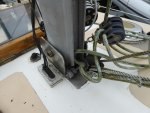
Cost of bringing all line back to the cockpit?

A good autopilot is even better. Press the button and off you go forward.

However, there are lots of ways of making a boat that was either built before easy handling was an issue or for big crews, more suitable for single handing. But better if you start from scratch with designing and building a boat where easy handling is a key feature. That is where most modern boats win hands down, using modern technology and good ergonomic design.

Many of the techniques can be retrofitted or adapted to older designs, but of course at a cost.

Hmm...

Both well over a hundred years old, both built to be sailed by a man and a boy...

IMG]https://www.sailingbargeresearch.org.uk/pages/EDME%20AGAIN.jpg[/IMG]

5439180_20160606065355960_1_XLARGE.jpg
 
Hmm...

Both well over a hundred years old, both built to be sailed by a man and a boy...

IMG]https://www.sailingbargeresearch.org.uk/pages/EDME%20AGAIN.jpg[/IMG]

5439180_20160606065355960_1_XLARGE.jpg

State of the art 100 years ago and fine tuned to extract the maximum out of the man and boy.

Just not a model for the modern leisure sailor in the 21st century who lives in a centrally heated house drives an automatic car uses brains to earn a living and a daily jog round the block is vigorous exercise.

In any era you make maximum use out the resources available to you. The equivalent seafarer of those today will be sitting comfortably at his control position in the wheelhouse "driving" his boat with a joystick.
 
Just a few comments re taking running rigging back to the cockpit. Yes it is very desirable especially for single handing.
For reefing however you need to sort out what you do about the slugs in the mast when reefed. I use just a bolt rope which witha guide means it can look after itself when reefing or shaking out. Alternative for one reef is to not have slugs in bottom 800mm of luff.
Now I find clutches very expensive and can slip. For my little boat a small winch was similar price and I then use a horn cleat. So 4 winches on cabin top. One for jib halyard one for main halyard one for clew reef line one for tack reef line (or anything else. As said it will cost a few bob with turning blocks new halyards and lines. Mind you these are all consumables so may need to be replaced before too long in any boat you buy. But yes forget getting professionals to do it you can't run a boat that way. ol'will
 
:encouragement: Rig a center line jackstay. Save your money and invest it in a decent autopilot.
Why do people keep on about centre line jack stays? Cannot agree with that. My boat , as an example, has an instrument panel over the hatch cover & the hatch cover is held with 6 screws so any jackstay could not get a secure fixing until 2 ft from the mast. Just not practical , as with many boats A lot of boats sail with a tent in front of the cockpit so to get to it they would have to risk climbing round that first. Then if they wanted to go forward of the mast they would have to unclip & find another clip on point. .......Do not tell me they can have 3 point harness because carrying extra lumps of steel about is like living like Marley's ghost all the time. The extra leg will not reach from the centre to the side deck so has to be totally unclipped anyway. My wife insisted on getting one & dumped it after the first trip........... As for autopilots I have a tiller steered boat with a Raymarine AV100. There are not many options for anything better on a 31 ft boat & the OP proposes a smaller boat. If I want to go forward to drop the sails or to the bow locker ( might want to get anchor gear ready) I head up wind & reduce throttle to reduce motion of bashing into waves. Invariably the autopilot will cut out as it cannot steer if there is little headway & once the boat drifts of course it cuts out, meaning a run back to the cockpit. One just cannot rely on it...........Bits of elastic. I have a Hanse 311 & bits of elastic would be useful for holding up the wife's knickers, but never to hold the boat on any sort of course, I assure you.............All these things add up to good cockpit controls & staying off the deck as much as possible............ As for friction---properly set up there is just a couple deck blocks & a deck organiser for the halyards plus some extra bits for reefing Any rope still has to go through a clutch or round a cleat. Now I am in my 70's I find that ropes hurt my hands more than they did, so I just chuck it round a winch. No problem with friction then.
 
Last edited:
I did a long passage on a boat weighing about 15 tons. The self-steering gear was broken.
We were doing solo watches. A little bit of experiment with sail trim made it possible to bungee the helm, the boat would hold a reasonable track for long enough to make a cup of tea. Or you could do other things in the cockpit with both hands free. The advantage of bungee over simply locking the wheel or tiller isthat you can give a sift nudge either way with hand, foot or other body part, which will correct the course and then revert to its balanced position.
 
I did a long passage on a boat weighing about 15 tons. The self-steering gear was broken.
We were doing solo watches. A little bit of experiment with sail trim made it possible to bungee the helm, the boat would hold a reasonable track for long enough to make a cup of tea. Or you could do other things in the cockpit with both hands free. The advantage of bungee over simply locking the wheel or tiller is that you can give a sift nudge either way with hand, foot or other body part, which will correct the course and then revert to its balanced position.

Yes. I’ve always owned boats that will do this, which seems to be more a matter of hull shape than of keel profile, but I have crewed on boats that won’t. Or at least I didn’t have long enough to find out how to do it on them.
 
Yes. I’ve always owned boats that will do this, which seems to be more a matter of hull shape than of keel profile, but I have crewed on boats that won’t. Or at least I didn’t have long enough to find out how to do it on them.

It seems to work on things varying from long keel cutters to a Lark dinghy. Which don't have a lot of hull shape similarities!
 
It seems to work on things varying from long keel cutters to a Lark dinghy. Which don't have a lot of hull shape similarities!


Worked fine on my Eventide as well and much less hassle than setting up the tiller pilot.

However nowadays much simpler to press the button on the Garmin although in light to moderate conditions and well trimmed sails doing up the friction knob on the wheel also works and more like the bungee in that a quick nudge is possible if needed.
 
My Twister can sit for hours with only a bungee steering on all points upwind but anything aft of the beam needs a little extra intervention. Key is to trim in a little weather helm then take that up with the bungee.

However, if you are doing this in order to reef, i.e. change the sail balance you will get a surprise the moment you ease the sheet.
I can ease first then set the bungee to balance the jib but it's not stable. Works ok if I add another line and go sheet to tiller though.

Having said all that, it's much easier to pop the Auto tiller on for a minute whist I go to the mast.

When I first bought her I thought of brining everything back to the cockpit but I'm happy to work at the mast now having done it a few times in testing conditions. I've got a lovely headlining that I don't want to ruin with unsightly lumps and bumps and the cost of brining 6 lines in terms of deck gear including winches I worked out at 2K plus labour. Without pricing new rope.

And in the end, half the fun is being on deck feeling the elements isn't it?
 
Last edited:
Singlehanded, there is much to be said for being able to work at the mast.
I second this. I have been single handing for about 15 years and have singlehanded across the Pacific. I like the simplicity of hoist and reef at the mast. Its far cheaper to set up and maintain, less friction in the system and far less to go wrong.
As others have mentioned it would probably prove very costly to modify your proposed boat.
I think that people overstate the supposed danger of leaving the cockpit to go forward, yes you need to be careful but you need to do that in all aspects of sailing don't you.
I also second the use of a length of bungy elastic to hold the tiller, I used this method for years.
Nowadays I usually leave the tiller to the wind vane self steering which is one of the greatest helps for single handing - spend your money on one of those rather than leading lines back to the cockpit.
 
And in the end, half the fun is being on deck feeling the elements isn't it?

No, not for everybody. The "fun" for me is being able to control the boat and do all the necessary things to set, use and drop sails without leaving the cockpit.

People get different things out of sailing and, for example much as I admire danaskip's style of sailing, it could not be more different from mine, so what he values and can do is of little use to me. Most of my sailing is day sails or 2 or 3 days up or down the coast in good weather but on my own.

From stepping on the boat to sailing with all sails set is less than 10 minutes, only leaving the cockpit to get the fenders in and tidied away. Similar coming back - putting the sails away and getting ready to berth is done under autopilot or heaving to outside the marina. In between can be 10 or 15 tacks to get in or out of the harbour and I can set the chute and get it away from the cockpit.

All this is possible because all controls are led back using good quality gear so it works smoothly and reliably. Not everybody values that in the way that I (and many others) do, so there is no right or wrong answer to the question.
 
The Red Monster was built after the invention of geared winches and before the arrival of Spinlock & Co., so she has her halyard winches on the mast, and four - count ‘em - winches on the forward end of the coach roof, not accessible from the cockpit - reefing, outhaul, topping lift and kicker. Needless to say, the primaries are not reachable from the wheel, and you can’t take the jib sheets to the secondaries. Oh, and did I mention the running backstays, which have their own winches, exactly where you would want to locate the winches that would, with rope clutches, replace the six that are outside the cockpit...

The reefing winch and the mainsheet winch (did I mention that one?) are genuine self tailers...

I claim a Gold Star for “most singlehander-unfriendly layout!” ;)
 
Last edited:
I claim a Gold Star for “most singlehander-unfriendly layout!” ;)

Look at something like a Swan 65 of the same era for even more unfriendly sail handling gear.

These boats were designed for big strong crews - imagine the beer bills for the owners!
 
On an point which I disovered this weekend, it's not absolutely required to have ALL line back to the cockpit, and worth thinking about what you plan to do with them.

Case in point for me was the weekend, looking at the layout of the new to me boat and realising that the genoa halyard - on a furler - was led back, whilst the topping lift was not. There had been a conscious effort to fill the clutches without regard for their ideal usage, no space left for a spinnaker uphaul for instance, no space for lazy jack adjustment both of which were cleated off on the boom.

It's all personal taste of course, but worth looking at why and what you put in the cockpit against the amount of times that you will use them.
 
In response to the OP's original question, I did exactly this about a year or so after I purchased my 70's 25 footer. I have some pictures I think too, which might help. If so, I'll post them at the end of this post. It was all very easy.

Original setup was everything at the mast. 2 winches on the mast, though with this size boat, I have never used the winches for the Mainsail, and very rarely for the Genoa. Brute strength is more than enough, if you are into wind to hoist the main. On my boat, at least. I had a couple scary moments with swell from other boats when I was raising/lowering the main near the marina entrances, and I sail almost exclusively solo. My boat has a nice deep cockpit, and I thought this the safest route for me. It has worked very well and I would not go back.

What I have now

All lines are led back to the cockpit. I have controls for the main halyard, the topping lift, and 2 reefs. They are fitted as follows

These 2 3 way blocks are what all the lines are run though, before going to a barton 4/5 way deck organiser, just off the picture to the right. The deck organiser is bolted through the coach roof with 6/7 bolts and large stainless washers underneath. It seems very well secured, but I think the blocks take most of the wear and they are not going anywhere.
P1010794-001.jpg

They then run back to the cockpit and I use a couple of clutches to hold the sheets in place. I have also since added a cleat on the companion way, just to tidy the reef line in use at the time. The reef lines otherwise just sit across the top of the companion way.

IMAG0423-001.jpg

To get the reefing to work with very little friction was a bit more of a challenge, but it works, and very well. Occasionally I need to shake the sheets out a little. I don't have any picture, but I will try and describe. I ran 2 lines from the rear of the head-sail, though 2 separate blocks on the boom cars, back to the mast, where they run though a double block, up to the reef points at the mast end of the sail. At these points, I did not run the sheets thought the sail. Instead, I mounted a block to a stainless ring the other side of the sail and ran the sheet through the block, back down through the big blocks at the mast base, then through the deck organiser back to the cockpit.

I did all this myself. It really didn't cost much. When I mounted the clutches, it seems this spot, in the original design was likely for whinches, so the layup is very thick and I believe there is a metal plate in there too. I also added an ali plate the other side, under the roof and bolted right though.

In the 6 years or so I have been using her like this, I never needed a winch. I can hoist and lower the mainsail, put in and shake out reefs etc, all without leaving the cockpit. The only tricky bit left is tying down the main once down. I've recently made some quick snap belts to minimise the time up front to get this task done.

Sorry if my terminology isn't 100% - As you can likely tell, I'm a diy sailor! Hope this helps, and I would not let anyone put you off setting up the boat like this. For me, it has proven to be a much easier, and I think safer way to sail.
 
Last edited:
On an point which I disovered this weekend, it's not absolutely required to have ALL line back to the cockpit, and worth thinking about what you plan to do with them.

Case in point for me was the weekend, looking at the layout of the new to me boat and realising that the genoa halyard - on a furler - was led back, whilst the topping lift was not. There had been a conscious effort to fill the clutches without regard for their ideal usage, no space left for a spinnaker uphaul for instance, no space for lazy jack adjustment both of which were cleated off on the boom.

It's all personal taste of course, but worth looking at why and what you put in the cockpit against the amount of times that you will use them.

That plan may make sense. Certainly, I have my (furling) genoa halyard led back but the topping lift left at the mast. I want to be able to add or reduce halyard tension under sail according to wind conditions, and to ease it before furling the drum and so as not to stretch the sail when not in use. And the topping lift is adjusted at the mast to a height that leaves it slightly slack when the main is in use but suspending the boom at a sensible height when not.

I recognise that this may not be perfect for all geometries, but it certainly gives us control from the cockpit of what needs to be adjusted under sail - but not nothing else.
 
I am hoping to offer on a boat (typical 1970s 26 footer) that in most respects is exactly what I am looking for, with the important bits well looked after. However it has slab reefing with all lines at the mast. There are no clutches or winches on the coach roof.
There will be a lot of boats of that era on sale with that work already done, find one and put an offer in on that.
 
That plan may make sense. Certainly, I have my (furling) genoa halyard led back but the topping lift left at the mast. I want to be able to add or reduce halyard tension under sail according to wind conditions, and to ease it before furling the drum and so as not to stretch the sail when not in use. And the topping lift is adjusted at the mast to a height that leaves it slightly slack when the main is in use but suspending the boom at a sensible height when not.

I recognise that this may not be perfect for all geometries, but it certainly gives us control from the cockpit of what needs to be adjusted under sail - but not nothing else.

We have the same now - I added 3 new clutches this season and had a choice of leading back the genoa halyard or the topping lift but not both, and chose the genoa halyard even though it's roller reefing. With a boom strut I don't use the topping lift except in harbour to keep it well clear of the Bimini. With sails up it doesn't touch it, but does brush a bit whilst reefing.

But I do like to be able to adjust the halyard tension now and again when sailing, especially as I leave it slack when leaving the boat to go home and find myself forgetting to tension it the next time, meaning I have to leave the cockpit when my wife has probably just gone off watch after we start sailing. And leaving the cockpit without waking the other person up is something we have agreed not to do.
 
Top