Corded impact driver to shift seized screws

Poignard

Well-Known Member
Joined
23 Jul 2005
Messages
55,664
Location
South London
Visit site
halyard winches.jpg

I want to remove the 4 slotted s/s machine screws holding this halyard winch to an aluminium mast.

I don't have access to an air impact driver which I am sure would shift them (or break the heads off!). I have no experience with corded impact drivers and I am wondering if a corded impact driver, costing between £50-£100) would do instead.

Does anyone have experience of corded impact drivers? Are they powerful? I don't want cordless for something I would rarely use.
 
some are very powerful indeed but you need to get from 1/2" Square down to the flat blade driver bit, which may need some intermediate stages.
alternatively there is a manual impact driver which you turn while whacking with a hammer. They are cordless and cheap. You probably already have a hammer!
Machine Mart sell them in the Garage tools section. Other suppliers of Sino-tat are available
 
My son has a coeded one that he bought from bangood which is really strong and has never failed to shift a bolt. He bought his for less than 20 quid.

I have a cordless version that cost about 100quid which would probably do the job.

But I think your best bet would be copious amounts boiling water followed by WD-40 followed by taking the bolt heads around with a long high quality screwever or using a hammer operated impact driver.

Alternatively drill off the heads..and bore and tap the mast with a slightly larger size or fit some insets.

I have had success with a bolt partially drilled out and then attacked with a hammer action masonery bit in reverse...
 
What about the manual type that you hold, then hit with a hammer as you twist it?
They have the advantage of not jumping out of the slots and so are less likely to mangle the heads.
The shock from the hammer seems to be quite good at loosening them, without crazy torques that might shear the screws instead.
The main bonus being that they are cheap and portable! Mine's saved the day a few times
 
I use lots of cordless tools as part of my work.. A 6mm hexagonal drive impact driver has more than enough power but it usually ends up shearing something that is really stubborn or will rip out all the thread in the aluminium.
As suggested, a manual impact driver that you hit with a hammer would be far better.
A quality slotted screwdriver of the right size with a hexagonal part on the shaft for a spanner is very effective and if that does not shift it then it might be time to break out a drill..
You could drill the heads off, remove the winch base and then use mole grips on the studs which often works !
 
^ wot he sed, with more waffle:

Before cordless 'rattle guns' became affordable, mate of mine had a 12V one I borrowed.
I reckon it would be as good as anything to shear off those screws.
He now has a cordless one, which is better still.
You could buy a tool and hope they'll undo, my guess is they will likely shear, if they are self tappers.

The hammer type impact drivers are OK, but I'd have reservations about knocking seven bells out of a small mast section which appears to be old and a bit corroded.
The electric tools will do less damage I think?
one thing to try is a bit that fits, heated and rammed into the screw slot. A brace and bit is a good tool for getting good force and control.

IF you don't have the ideal tools it might be just as well to drill the heads off and avoid damaging the winch?
There may be enough left of the screws to undo them with a mole type wrench.
I have some left-handed drills which are often effective. They remove a certain amount of metal, add a little heat, then grab the screw and undo it, if you're lucky.
 
some are very powerful indeed but you need to get from 1/2" Square down to the flat blade driver bit, which may need some intermediate stages.
alternatively there is a manual impact driver which you turn while whacking with a hammer. They are cordless and cheap. You probably already have a hammer!........

Yes, back in the day these were an essential tool for teenage motorbike butchers. They worked very well. Carpenters brace is good, but maybe not for the initial loosening. The other thing is to try the screws in the tightening direction first. This can break the bond, but don't overdo it.

1637608699393.png
 
I've had an exploratory go on one screw with a hammer operated impact driver but it wouldn't move. I'm not keen on hammering the mast as hard as would probably be needed so I was thinking of a corded impact driver.

I can't apply a blowtorch because it sits on a paxolin pad.
 
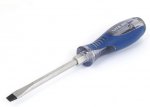
I use a screwdriver, similar to the one pictured, and use an adjustable spanner on the hex part by the handle to turn it.

screw driver.jpg
 
I've had an exploratory go on one screw with a hammer operated impact driver but it wouldn't move. I'm not keen on hammering the mast as hard as would probably be needed so I was thinking of a corded impact driver.

I can't apply a blowtorch because it sits on a paxolin pad.

Patience, try some more gentle tapping with the hammer. And penetrating oil.
 
Does it exactly fit the screws?
What are you going to turn it with to keep it properly aligned with lots of torque?, while forcing it into the screw?
Halfords Advanced Impact Driver & Bits | Halfords UK
The Halfords impact driver used with a hammer is perfect for that job. Somebody mentioned that they wouldn’t trust it with a weak sectioned mast. The answer is you don’t have to give it full welly as you start. Lots of hot water and some lubricating/releasing agent oil and then gentle taps and increase as necessary.

I’ve got a cordless impact driver with a half inch drive and I wouldn’t go near it for trying to undo screws. It would jump out the slots and mangle the surrounding structure before you could let go of the trigger.
 
Any impact tool needs a solidly non-yielding base to hit against. Another problem is the driver bit camming out of the screw slot with consequent damage. A favourite tool of mine for extracting recalcitrant screws is a carpenter's brace coupled with a large screwdriver bit, tools which don't seem to be on the market much these days. This gives high, steady end load and considerable torque.
 
Any impact tool needs a solidly non-yielding base to hit against. Another problem is the driver bit camming out of the screw slot with consequent damage. A favourite tool of mine for extracting recalcitrant screws is a carpenter's brace coupled with a large screwdriver bit, tools which don't seem to be on the market much these days. This gives high, steady end load and considerable torque.

Stick a Hex bit adaptor in the brace then you can use any size or type of bit.
 
A favourite tool of mine for extracting recalcitrant screws is a carpenter's brace coupled with a large screwdriver bit, tools which don't seem to be on the market much these days. This gives high, steady end load and considerable torque.

I've recently bought one of these, which seems a decent bit of kit (as long as you don't expect it to grip round shank drill bits well): Faithfull Carpenters Brace

Stick a Hex bit adaptor in the brace then you can use any size or type of bit.

I discovered that a SDS-Plus to Hex bit adapter fits nicely in a four jaw brace chuck. YATO professional Magnetic Bit Holder SDS-plus to 1/4" Hex Shank 60mm (YT-04690) 5906083026904 | eBay
 
Last edited:
Top