Coppercoat report

Graham_Wright

Well-Known Member
Joined
30 Dec 2002
Messages
8,185
Location
Gloucestershire
www.mastaclimba.com
After three years, mostly in brackish water but mixed with salt, we dried out this weekend to fix the log.
It was surrounded by small molluscs which blocked the impeller and couldn't be cleared from inside.
Given the opportunity, we inspected for growth on the hull.
None!
Just a black goo which wiped off with a sponge.
 
I'm not sure that comparing CC based on being applied to a yacht moored in brackish water is a fair comparison. CC is commonly used in salt water and many salt water organisms would not survive in a fresh water environment. Brackish in itself is a bit subjective. 'Black goo' might also be acidic which would react negatively with the exposed copper in CC, reducing its life (even though an acid environment would reduce fouling).

Jonathan
 
After two months in Portsmouth there was about a foot of green blanket weed at the waterline on mine where its in direct sunlight, although the boat has sat on the mooring for most of that. Fortunately it scrubs off fairly easily and there's virtually no growth below this but CC is absolutely useless with the type of weed that covers the mudflats at this time of year, before it detaches and starts blocking everyone's engine intake! I wouldn't go back to antifoul as it's easy enough to keep on top of it with a Scrubbis and its only this type of weed that seems imune to CC, but it does have its limitations..at least here it does.
 
In defence of CC. The Clipper yachts were all CC coated. I checked them when they last arrived in Sydney, So they had been coated, the yachts used in the UK for training and promotional purposes and then sailed hard, half way round the world. They were spotless.

Historically the Clipper fleet would all be hauled in Sydney and new AF applied. None of the yachts were lifted after CC was applied.

Its also not a fair comparison - if you use you own yacht and its CC (or AF) coated and used regularly - then the hull will be clean - I was impressed, no sign of any growth the CC looked as if it had been applied the day before.

Most good AFs (as with CC) will keep your yacht clean if you use it regularly, every week. But many AFs will lose effectiveness - they will wear. So you may gert 2 years if you sail hard every week, maybe more - but at the end of 2 years you will need to re-coat. CC should last longer and be equally effective all of its life (10 years ?)

Most people don't use their yacht sufficiently regularly.

Jonathan
 
I'm not sure that comparing CC based on being applied to a yacht moored in brackish water is a fair comparison. CC is commonly used in salt water and many salt water organisms would not survive in a fresh water environment. Brackish in itself is a bit subjective. 'Black goo' might also be acidic which would react negatively with the exposed copper in CC, reducing its life (even though an acid environment would reduce fouling).

Jonathan
I am intrigued by your reference to"black goo".
Would you like to elaborate?
Before anti-fouling, we had been moored on a canal (Gloucester-Sharpness) for a year, fresh, and then another year in Lydney harbour, "fresh" but possibly contaminated by iron and coal mine effluent.
The fouling we found prior to copper coating was hard and black and could only be removed by sanding.
Nobody could explain it.
 
In defence of CC. The Clipper yachts were all CC coated
Is that a fair comparison as the clipper yachts are far from stationary and can supposedly top 35knts.
Some of us rarely go out and maybe achieve 5 knts.
 
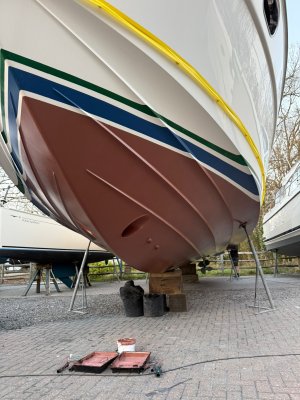
Following this with interest; I recently decided to remove decades of old antifoul from my 25 year old boat and apply Coppercoat - had it done professionally. Costly job but I reckon the breakeven is the fourth season, so as this boat is a keeper (it says here) I'm hoping to be quids in.

Post-application pic for interest.

Happy to recommend the team that did it. PM me if you want details.


WhatsApp Image 2025-03-26 at 18.45.32 (1).jpeg
 
Following this with interest; I recently decided to remove decades of old antifoul from my 25 year old boat and apply Coppercoat - had it done professionally. Costly job but I reckon the breakeven is the fourth season, so as this boat is a keeper (it says here) I'm hoping to be quids in.

Post-application pic for interest.

Happy to recommend the team that did it. PM me if you want details.


View attachment 194447
Fantastic job.
 
Is that a fair comparison as the clipper yachts are far from stationary and can supposedly top 35knts.
Some of us rarely go out and maybe achieve 5 knts.
Its a comparison, you decide if its fair.

It underlines the mechanism that makes CC successful - you need to use your yacht and if, for example, you have a racing yacht that is used and sailed hard every week, maybe twice a week - CC should be s success (though so would other AF coatings). The difference between 'other' AF coatings - you need to apply them every year.


If you potter about in fair weather maybe once a month and don't, when the wind is up - and you might under those condition achieve 10 knots - then maybe CC will not work - and you will be disappointed.

Jonathan
 
...if, for example, you have a racing yacht that is used and sailed hard every week, maybe twice a week - CC should be a success.

If you potter about in fair weather maybe once a month and don't, when the wind is up - and you might under those condition achieve 10 knots - then maybe CC will not work.

This isn't true. My yacht was CC'd eleven years' ago. It lives on a mid-river (tidal) mooring. It is only used for coastal sailing (usually 3-5kts 6kts max) say for a few weeks each season and not at all in the winter. The fouling is no more or less severe than when it previously had trad AF painted on. The only difference is that there's no scraping, painting, etc - and that the boat only needs lifting out for an hour or so, or dried out against piles for a single tide.

The most recent lift-out a week ago revealed the worst fouling I've ever seen, but it had been a ridiculously wet and murky winter (with excessive agricultural run-off) and similarly, earlier in Spring, I'd never seen my cockpit, decks and superstructure so green as a result.
 
Last edited:
The performance of CC is variable and very dependant on how you use your boat and it's location. Some people have great success. Other have no success.
We have found it is more effective if you use the boat a lot. Anchoring up in a high fouling area, it needs regular cleaning. For us, sailing in the Tropics, it's a good solution as we can use our hookah to dive on the boat and wipe the hull clean once a month. I wouldn't fancy doing this in the UK, but with the vastly lower fouling rates in the UK, it's not something you are going to need to do with regular frequency.
The other thing that impacts on performance is how it was applied. A smooth finish with minimal stipple will be more effective than a rough application. The CC need burnishing with 400/500 grit sandpaper to activate the copper. If the hull is super smooth, nothing can get a foothold to stick and the exposed copper can do the rest
 
Last edited:
Deacons marina coppercoat boats in a nice warm shed and spray it on. The finish is super smooth. In winter i would say nearly half the boats in the yard for winter storage are copper coated !
 
Top