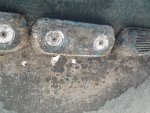
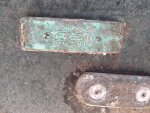
Coppercoat causing corrosion on through hull fittings

Pascoe,s credibility has just tumbled ( was not high to start with ) with this - shocker ( scuse the pun :))
Quote

“It does this by releasing electrons, which are positively charged ions of the metal itself. This causes the zinc to erode and disappear. These ions will attach themselves to the other metals, “

Electrons are in fact NEGATIVELY charged ! Oh dear oh dear oh dear —- not good !! What else in the link from Kashurst is Bolox ?

Returning to Zings pic
The halo distribution is what I would expect ,taken the shape of the zinc and its effect on the concentration of its reactive parts through the porus - ( note the word porus - cos it sure ain’t protecting it )CC to the cooler around it .

If it the anode - was a circle it the “lobe “ would be a symmetrical another circle - if that makes sense ?

Chemical reaction .
I don,t think we need to go looking for an additional complications, to justify applying CC to underwater metal structures
The zinc is taking something out of the cooler via the Copper coat caked on top .

It’s a pity ( those who have CC d over metal skin fittings - without proper epoxy coating ) folks can’t see inside say there normal metal skin fittings ,up the actual tube bit to the copper / fitting junctions .

If the anodic potentials are near enough and miles away from any other metals inc zinc - then fine .
if not - then you are chancing it .
 
Last edited:
Re Zing, keelcooler issue: .Just looked into Frigoboat keel coolers. They are sintered bronze with zinc anodes bolted on. On yours they look like they are "over-zinced" and have coated the keel cooler and surrounding area with zinc and zinc salts (possible substitution reaction with the copper chloride/copper salts of various types - sea water is complex stuff.)

so either the anodes are too big for the keel cooler and/or it doesn't matter. Or there is an electrical connection somehow from the sintered bronze part of the keel cooler to your main hull anodes and your keel cooler anodes are trying to protect some other under water metal and the localised galavanic current in the sea water has too much zinc compound ions floating about. Try measuring electrical resistance between the keel cooler and your main anodes etc. I would expect it to be a high resistance. If its a few ohms it may have been deliberately wired into the anode circuit. Have you checked with Frigo boat what they recommend re - galvanic bonding with the rest of the boat?

I believe you can get a similar effect if you fit anodes that are too big for a given boat and you end up zinc plating your props. People sometimes fit anodes twice the size speced by the boat manufacturer thinking they will last longer but it is often an error. I am wondering if you are experiencing a similar problem.

That white appearance is the residue of calciferous marine life. The keel coolers are made of sintered bronze, which is quite open in structure. The calciferous material cannot be easily removed without risking damaging the bronze, so a thin layer was left on.

The keel coolers are connected to the boat ground and main hull anode (GRP boat) as required by Frigoboat and there is negligible resistance (good connection). The main anode shows virtually no material loss from even before the installation of the keel coolers, which I have always wondered if it was correct. The shaft and prop anodes get eaten up at a normal pace.

Let me go back to the orignal post and the picture shown there. I can imagine that same zinc and/or copper salts created in the salt water cause a kind of deposit. The color change is large on top and bottom but not much to the left and right of the picture.

Questions which popped my mind when seeing the picture:

- How many month per year is the laying in a marina?

- Was the deposition ever be tested for being only a surface effect of some microns? (400 grad water proof sandpaper could be used for a test)

The boat sits in a marina for 7 months a year, less the time I am on board. In the marina I do not connect to shore power.

I don't think the coating has any zinc on it. It is not a great picture, but it is marine life residue what you see. The Coppercoat discoloration is not on the surface. It is throughout and cannot be sanded off.

quite intrigued by Zings issue and prompted by P435 post about the pattern having defined upper and lower areas (well spotted), I have been doing some research on the internet etc.
The upper and lower "lobe" pattern around the keel cooler can be created by stray electric currents going through the submerged metal part. You get the same lobe shapes with conventional copper based anti foul.

If its stray electric current, you have an electrolysis problem, which causes more rapid deterioration if left unchecked. Check the functioning of all your bilge pumps and switches and check your bilges are dry or where they are wet there's no electrical cables etc lying in the water. have a look at this article http://www.yachtsurvey.com/corrosion.htm

don't panic just yet as there is a lot of stuff about anodes etc that is misleading or just wrong, but don't ignore the issue.
PS have you got a galvanic isolator or isolation transformer ?

Bilge pumps switches are all above the water level and are left so when the boat is unattended. I don't use shore power, so have no need for isolation transformers.


Pascoe,s credibility has just tumbled ( was not high to start with ) with this - shocker ( scuse the pun :))
Quote

“It does this by releasing electrons, which are positively charged ions of the metal itself. This causes the zinc to erode and disappear. These ions will attach themselves to the other metals, “

Electrons are in fact NEGATIVELY charged ! Oh dear oh dear oh dear —- not good !! What else in the link from Kashurst is Bolox ?

Returning to Zings pic
The halo distribution is what I would expect ,taken the shape of the zinc and its effect on the concentration of its reactive parts through the porus - ( note the word porus - cos it sure ain’t protecting it )CC to the cooler around it .

If it the anode - was a circle it the “lobe “ would be a symmetrical another circle - if that makes sense ?

Chemical reaction .
I don,t think we need to go looking for an additional complications, to justify applying CC to underwater metal structures
The zinc is taking something out of the cooler via the Copper coat caked on top .

It’s a pity ( those who have CC d over metal skin fittings - without proper epoxy coating ) folks can’t see inside say there normal metal skin fittings ,up the actual tube bit to the copper / fitting junctions .

If the anodic potentials are near enough and miles away from any other metals inc zinc - then fine .
if not - then you are chancing it .

Zing
Next lift rub the CC off the keel cooler to a 1 cm border and use an alternative AF - Trilux eg .

There is no Coppercoat on the keel cooler. They are left bare without antifoul and due to that fact and their open structure get very caked up.

See attached pictures of my other keel coolers, which exhibit similar problems, but without that symmetrical sort of field effect in the original picture. In these two pictures you can see about half the anodes are used up after a season. They are pretty small. 25mm dia x 6mm thick about.


double keel cooler.JPG

keel cooler 4.jpg
 
unusual for the main anode to be doing very little - that needs checking out
the halo / discolouration around the keel coolers indicates something is wrong.
I still think there is an electrolytic problem caused by a stray current - happy to be proven wrong though.
I would get the boats electrical potential measured.
When you leave the boat for long periods do you isolate the batteries?
 
Last edited:
unusual for the main anode to be doing very little - that needs checking out
the halo / discolouration around the keel coolers indicates something is wrong.
I still think there is an electrolytic problem caused by a stray current - happy to be proven wrong though.
I would get the boats electrical potential measured.
When you leave the boat for long periods do you isolate the batteries?
Agreed, more testing needed.
The batteries are disconnected from all services except the bilge pump and the battery monitor display when in the marina.
A recent thing I noticed is a current drain on the battery of about 100mA/hr. That is far more than I would expect by self discharge, but the amp counter is always wrong when left. I need to look at that issue to get to the truth of the problem if there is one.
 
Well theres possibly another clue - I would put a known ammeter in series with your batteries and see whats actually happening. Could just be a bit of an iffy ammeter reading on the battery monitor for some reason, or it might be correct. If there is a significant current going somewhere then its time to start disconnecting things one by one to find the problem device. Check out the main anode wiring too, maybe its gone a bit crusty at the through hull bolts.
 
Three months in after Coppercoating and my anodes are still looking virtually as-new, so no change from the prior year with conventional anti-fouling. I haven't been over the side yet to check the skin fittings but trust that they are still okay too - the sea temp is only 8*C, so I will leave that until it is at least 10*C :)
 
I know this is an old post and lengthy post. But I have noticed a similar pattern around bonded skin fittings (raw water intake and stern tube intake) on my Beneteau Oceanis 381. The unbonded fittings elsewhere show no sign of this pattern. The boat was copper coated and then painted over with Micron by a previous owner. Presumably they we’re happy with the anti fouling properties of this CC application. Each season the antifoul blisters off in an area about 20cm around these two skin fittings exposing a rough dark area. Looks like something electrolytic is at play. The fittings seem good no de-zinkification seen. I have rebonded the fittings, engine, keel, to a new bonding point with 10mm2 copper wire, and then the common -ve. There are no stray currents detectable. The boat is mainly not connected to the mains. I know lots of people say coppercoat is electrically innert. But from my experience I doubt that it is electrolytically innert (at least in this example). I am considering either electrically isolating the existing fittings from the coppercoat, or fitting non-metal fittings. Comments?
 
Top