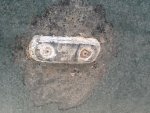
Coppercoat causing corrosion on through hull fittings

short answer I don't know why it really comes off, I suspect its lack of mechanical adhesion between the epoxy and the hard metal surfaces combined with water pressure, cavitation and vibration. I don't know what primers were used. My CCoat was done by Costa Blanca Yacht Services in Torrevieja. Dennis has been coppercoating for decades and done loads of boats, including a few forumites here - there is always one or two boats being CCed in the yard.

I have emailed Dennis and ask his experience with saildrives

Yep - the CC didn't stick to my props either.
And, yes, Dennis did our as well - great job - very happy with the CC that he did to our boat.
BTW - is he still in business - I was thinking of recoating in a couple of years when the current CC is about 10 years old.
If so, I was thinking of motoring the boat down to Torrevieja so that Dennis could do the job again.
 
My apologies. :( As an aquatic chemist by education, having at one time research interests in heavy metals in both fresh and saline waters, I found myself somewhat puzzled over 10 years ago (when there was a lot of discussion in the magazines and forums of various ‘copper-in-epoxy’ products) by the descriptions of the products of chemical copper corrosion in seawater, and set myself to sorting it out to my own satisfaction.

I do sympathize with those writing for a non-chemical readership – and with those who find my posts on the subject difficult. Unfortunately there is danger of confusion unless likely substances are correctly identified – not so much with the mineral names, which typically refer to naturally-occurring crystalline forms and ores, but with modern chemical nomenclature and formulae. And it is difficult to write with accuracy and concision without using the appropriate chemical terms like ‘thermodynamic equilibrium' or ‘thermodynamic stability’.

Put simply, and as far as I can see, in normal aerated seawater there is evidence of a chemical ‘progression’ from metallic copper, to an oxide (cuprous and/or cupric) to a green basic chloride (or perhaps, especially at lower salinity and therefore lower chloride concentration, to a green basic carbonate like the verdigris we see on copper roofs and bronze statuary).

I talk about the relative thermodynamic stabilities of different solid corrosion products, and thermodynamic equilibrium may take a long time to establish because of slow kinetics. Less thermodynamically stable products may persist alongside those that are more thermodynamically stable, which are the ‘ultimate’ chemical corrosion products over time.

I am not an expert on copper toxicity or antifouling, but do know that in terms of copper in solution (which includes many different dissolved copper complexes, with hydroxyl and chloride ions for example) there is much accumulated evidence that the free cupric ion (Cu2+) concentration is often the best predictor of toxicity to many aquatic organisms. As the ‘earlier’, less thermodynamically stable solids will typically maintain a higher Cu2+ concentration in the boundary seawater, to the extent that antifouling properties are a function of the dissolved copper in the boundary layer they will I presume be at least as effective as the ultimately thermodynamically stable forms.

I’ve perhaps made things worse for you – if so, I'm sorry but I have tried!

Sorry, I never did chemistry in school - it was a subject that I was never given the option to take.
Your post is lots of words - and I think you are just saying that CC is toxic to the fouling/growth and that it erodes - slowly.
 
Sorry, I never did chemistry in school - it was a subject that I was never given the option to take.
Your post is lots of words - and I think you are just saying that CC is toxic to the fouling/growth and that it erodes - slowly.

No apology necessary.

I am saying a little more (and a little less) than that. Of course CC is toxic to fouling organisms, that’s why it contains copper. Yes it does ‘erode’ – or more precisely, the metallic copper particles exposed to the seawater do dissolve and also become transformed into oxide and (probably) hydroxychloride solids. According to CC the former is the effective agent (it will produce a slightly higher copper concentration in solution than the latter, I believe) and the hydroxychloride is less physically stable and so is sloughed off. Were I a barnacle larva about to bash my head on a boat, release my glue and settle down, I doubt I’d like either particularly!

I have not said anything about the rate of copper loss, nor compared it with conventional copper-based antifouling paints, but ISTR that somebody did that calculation on one of the two other main forums within the last year or so. A search should find it.

PS A search did. AntarcticPilot did some rate calculations and comparisons here: http://www.ybw.com/forums/showthrea...-based-antifouling/page6&highlight=coppercoat. I have not checked his assumptions and calculations, but have no reason to think that he’d be way off beam – and I don’t think anybody dismissed them. He concluded that over time, CC ‘... releases less copper than conventional antifouling, though not vastly less’.
 
Last edited:
Yep - the CC didn't stick to my props either.
And, yes, Dennis did our as well - great job - very happy with the CC that he did to our boat.
BTW - is he still in business - I was thinking of recoating in a couple of years when the current CC is about 10 years old.
If so, I was thinking of motoring the boat down to Torrevieja so that Dennis could do the job again.

Yes Dennis is still in business - busy as ever
 
Yes Dennis is still in business - busy as ever

Just a little thread drift.
Here is THE MAN - himself at work.

serve.php
 
I have a puzzling problem. The coppercoat around all my keel coolers has changed colour. No other change. It is very slowly getting larger, this is a 3 year growth of changed colour area. The keel coolers are bonded to the boat earth and have no detectable voltage on them. I asked Coppercoat what caused this and they said not us, contact Frigoboat (the maker of the keel cooler). I did and they said not us, contact Coppercoat, so I did and they said .... Let's play piggy in the middle. Coppercoat did say they thought electrolysis was not going to be the problem because Coppercoat is not conductive. I do have zincs on the keelcoolers. I do wonder though if it has a role.

What is it?

keel cooler and coppercoat.JPG
 
Last edited:
See my previous posts ^^^^

It’s not a puzzle to me btw .Its related to the differing anodic potentials of all the metals in the salt solution we call seawater .
Oh one more thing did some say “ coated in epoxy “ then in the next breath “water soluble “ - to continue to re- expose ?

All very kings new suit and clique :)
 
See my previous posts ^^^^

It’s not a puzzle to me btw .Its related to the differing anodic potentials of all the metals in the salt solution we call seawater .
Oh one more thing did some say “ coated in epoxy “ then in the next breath “water soluble “ - to continue to re- expose ?

All very kings new suit and clique :)

Well I know it looks like it might be likely, but i think it is very unlikely. Coppercoat has enough epoxy to prevent the copper making a circuit with the keel cooler. It is an insulator. If that was not enough then you will have little galvanic potential between the keel cooler and the coating because they have virtually the same potential unlike the zinc anode, which should sacrifice itself first. It does not get used up by the way.
 
Hi Porto
you seem to be under the impression the epoxy is water soluble. It definitely isn't.
Where on the copper coat web site did you spot this? I have read it a few times and can't seem to find what you are refering to.

"coated in epoxy “ then in the next breath “water soluble “ - to continue to re- expose ? "
 
Well I know it looks like it might be likely, but i think it is very unlikely. Coppercoat has enough epoxy to prevent the copper making a circuit with the keel cooler. It is an insulator. If that was not enough then you will have little galvanic potential between the keel cooler and the coating because they have virtually the same potential unlike the zinc anode, which should sacrifice itself first. It does not get used up by the way.

Which elegantly brings you and the rest reading this thread back to my post #44 ^^^

Thats an observation too .

Just because folks can,t explain it - does not mean it does not happen .
In this case degradation of different anodic potential metals covered in CC ( not proper epoxy coated like a yacht keel )
Somebody @ CC as I think I already suggested / highlighted is sending out contradictory messages .

Zinc “ does not get used up by the way “
Nope your CC taking somthing out of the keel cooler - there’s chemistry doing on ,you can see it with your own eyes .
 
Which elegantly brings you and the rest reading this thread back to my post #44 ^^^

Thats an observation too .

Just because folks can,t explain it - does not mean it does not happen .
In this case degradation of different anodic potential metals covered in CC ( not proper epoxy coated like a yacht keel )
Somebody @ CC as I think I already suggested / highlighted is sending out contradictory messages .

Zinc “ does not get used up by the way “
Nope your CC taking somthing out of the keel cooler - there’s chemistry doing on ,you can see it with your own eyes .
I just read your post 44. Is that really true? Quite extraordinary science is behind it if so. It is clear, something is going on between the keel cooler and hull and I don't know what.

As I understand it plastics that are considered insulators are actually really extremely bad conductors, so maybe there just is enough current flowing to do the damage, so low that it is not measurable with normal electrical test gear.

By the way, to clarify a bit about how Coppercoat can work if immersed in a supposedly insulating epoxy, there are two factors probably at play. One is the surface has exposed copper. Secondly, epoxy is porous to a degree. You need I believe a number of coats on a wooden boat to prevent water getting through to the wood. So being porous you will have a transfer of copper slowly from somewhat deeper inside the coating than just the surface. Ah! maybe that's where the conductivity comes from. Conductive, not much, but only when wet in salt water?
 
Last edited:
Re Zing, keelcooler issue: .Just looked into Frigoboat keel coolers. They are sintered bronze with zinc anodes bolted on. On yours they look like they are "over-zinced" and have coated the keel cooler and surrounding area with zinc and zinc salts (possible substitution reaction with the copper chloride/copper salts of various types - sea water is complex stuff.)

so either the anodes are too big for the keel cooler and/or it doesn't matter. Or there is an electrical connection somehow from the sintered bronze part of the keel cooler to your main hull anodes and your keel cooler anodes are trying to protect some other under water metal and the localised galavanic current in the sea water has too much zinc compound ions floating about. Try measuring electrical resistance between the keel cooler and your main anodes etc. I would expect it to be a high resistance. If its a few ohms it may have been deliberately wired into the anode circuit. Have you checked with Frigo boat what they recommend re - galvanic bonding with the rest of the boat?

I believe you can get a similar effect if you fit anodes that are too big for a given boat and you end up zinc plating your props. People sometimes fit anodes twice the size speced by the boat manufacturer thinking they will last longer but it is often an error. I am wondering if you are experiencing a similar problem.
 
Hi Porto
you seem to be under the impression the epoxy is water soluble. It definitely isn't.
Where on the copper coat web site did you spot this? I have read it a few times and can't seem to find what you are refering to.

"coated in epoxy “ then in the next breath “water soluble “ - to continue to re- expose ? "


Water based - from the CC FAQ section on application.

“Specifically designed to be user friendly, this water based and VOC-free coating should be mixed thoroughly”
Clean up at the end is just rinse with water .
Try washing off a proper none water based two pack expoxy like Araldyte under the rap

Water binding it all up is a conductor, but this is immersed in a salt solution.

Meanwhile to protect metals like Aluminium, CC blurb suggest “ epoxy “ —- that’s i presume the proper two pack NONE water based to provide the electylolic barrier .

So let me get this straight —- there water based epoxy needs another presume proper none water based epoxy ( like araldyte ) on keels ,outdrives , rudders and such .

How odd :)
Therefore CC must react with those items ,—— why spare metal skin fittings ??

Then we are told it provides a “ proctective barrier “ in yet another breath .Why proper expoxy 1 st keels etc —

Hope you can start to see the contradiction s :encouragement:

Any how as said above , while I cannot exactly answer why the Zings keel cooler is undergoing a chemical reaction caked up in CC or why ( see my post #44 re CERN ) the split H atoms behave identically from the same parent He atoms
Nether the less that’s what we see .

Please can you report on the observation by Zing .
 
I just read your post 44. Is that really true? Quite extraordinary science is behind it if so. It is clear, something is going on between the keel cooler and hull and I don't know what.

As I understand it plastics that are considered insulators are actually really extremely bad conductors, so maybe there just is enough current flowing to do the damage, so low that it is not measurable with normal electrical test gear.

By the way, to clarify a bit about how Coppercoat can work if immersed in a supposedly insulating epoxy, there are two factors probably at play. One is the surface has exposed copper. Secondly, epoxy is porous to a degree. You need I believe a number of coats on a wooden boat to prevent water getting through to the wood. So being porous you will have a transfer of copper slowly from somewhat deeper inside the coating than just the surface. Ah! maybe that's where the conductivity comes from. Conductive, not much, but only when wet in salt water?

Agree .
It’s not black n white
Multi factorial
The unknown is the ions in the salt sol - seawater
 
Re Zing, keelcooler issue: .Just looked into Frigoboat keel coolers. They are sintered bronze with zinc anodes bolted on. On yours they look like they are "over-zinced" and have coated the keel cooler and surrounding area with zinc and zinc salts (possible substitution reaction with the copper chloride/copper salts of various types - sea water is complex stuff.)

so either the anodes are too big for the keel cooler and/or it doesn't matter. Or there is an electrical connection somehow from the sintered bronze part of the keel cooler to your main hull anodes and your keel cooler anodes are trying to protect some other under water metal and the localised galavanic current in the sea water has too much zinc compound ions floating about. Try measuring electrical resistance between the keel cooler and your main anodes etc. I would expect it to be a high resistance. If its a few ohms it may have been deliberately wired into the anode circuit. Have you checked with Frigo boat what they recommend re - galvanic bonding with the rest of the boat?

I believe you can get a similar effect if you fit anodes that are too big for a given boat and you end up zinc plating your props. People sometimes fit anodes twice the size speced by the boat manufacturer thinking they will last longer but it is often an error. I am wondering if you are experiencing a similar problem.
Good post :encouragement: from what we know :)

So the OP.s
Original Q is Yes ?

But we don,t really know why
 
... The coppercoat around all my keel coolers has changed colour. No other change. It is very slowly getting larger, this is a 3 year growth of changed colour area....

What is it?

View attachment 69551


Let me go back to the orignal post and the picture shown there. I can imagine that same zinc and/or copper salts created in the salt water cause a kind of deposit. The color change is large on top and bottom but not much to the left and right of the picture.

Questions which popped my mind when seeing the picture:

- How many month per year is the laying in a marina?

- Was the deposition ever be tested for being only a surface effect of some microns? (400 grad water proof sandpaper could be used for a test)
 
Re Zing, just found this on tinternet -
Understanding Boat Corrosion, Lightning Protection and Interference
John C. Payne

might give you some more things to check out.
 
quite intrigued by Zings issue and prompted by P435 post about the pattern having defined upper and lower areas (well spotted), I have been doing some research on the internet etc.
The upper and lower "lobe" pattern around the keel cooler can be created by stray electric currents going through the submerged metal part. You get the same lobe shapes with conventional copper based anti foul.

If its stray electric current, you have an electrolysis problem, which causes more rapid deterioration if left unchecked. Check the functioning of all your bilge pumps and switches and check your bilges are dry or where they are wet there's no electrical cables etc lying in the water. have a look at this article http://www.yachtsurvey.com/corrosion.htm

don't panic just yet as there is a lot of stuff about anodes etc that is misleading or just wrong, but don't ignore the issue.
PS have you got a galvanic isolator or isolation transformer ?
 
Last edited:
Top