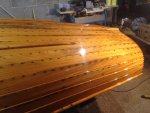
Copper Rivet Staining

picardy

Well-Known Member
Joined
31 Mar 2005
Messages
266
Visit site
I am considering buying an apparently structurally sound 20 ft clinker boat - the boat has a mahogany hull with elm ribs.

The copper rivets have staining / blackening which is a shame but my question is what are the options for this if I'd like to restore her to a near showroom finish. The timber is in good order but its the blackening around the rivets that spoils the look.

Thanks in advance
 
The staining around the fastenings is caused by a slow oxidisation of the copper fastenings and is visible through a varnished finish. I feel that one has to accept this as the ‘patina’ of a beautiful clinker built boat. This is our Redwing; just over thirty years old. If the oxidisationis excessive it may lead to some of the roves popping off inside the boat but is a very slow process in a well maintained boat. I’m restoring a 75 year old Admiralty boat and her fastenings are still in excellent condition.DAD14ADF-D4B4-4E8A-B0F7-CE9BD5C3237E.jpeg
 
Oxalic acid might work, but as it bleaches the wood somewhat, you'd have to apply it to the entire hull. Also, it's really only a surface treatment, so even if it removed the surface stain, the stain might come back pretty quickly. I think I'd agree with Redwing28 that such staining is to be regarded as part of the "patina" of the boat.
 
The staining around the fastenings is caused by a slow oxidisation of the copper fastenings and is visible through a varnished finish. I feel that one has to accept this as the ‘patina’ of a beautiful clinker built boat. This is our Redwing; just over thirty years old. If the oxidisationis excessive it may lead to some of the roves popping off inside the boat but is a very slow process in a well maintained boat. I’m restoring a 75 year old Admiralty boat and her fastenings are still in excellent condition.View attachment 88620
That's a beautiful boat. I have a question that strays slightly from the original post, but I think Picardy might have a diamond in the rough.

I've noticed that a lot of wooden boats in Europe, particlarly in Scandanavia, have the natural wood look whereas marine paint is the exterior order of day where I'm from. I'm currently deciding on the finish for a new wooden build of a traditional design (note that the builder is doing the finish, and also note that the boat will be in the water from at least June to at least September, inclusive, each season. Although I love the look of your boat, I am leery of going in that direction, primarily because I feel there must be a valid reason why I don't see it over here. Has it got something to do with environmental differences? Or the type of wood? (my planks are white pine on the bottom and spruce on top). Or maybe it's just more work or simply a case of "old habits die hard." I've tried looking things up on the internet but the sites were tailored to the knowledgeable. I haven't asked anyone on the North American forum I subscribe to, as they seem more inclined to humiliate those who ask novice questions. Can you enlighten me on whether/why you might think varnish is as good as paint?
 
Can you enlighten me on whether/why you might think varnish is as good as paint?

I don't think it is. I have a varnished boat and have had a few over the years. Dinghies both clinker and cold moulded. They look very pretty but generally require more upkeep than paint. Furthermore if you bash one you want to attend to bare wood as soon as possible to prevent marking. A lot is down to the materials used and they way they have been built. Woods like mahogany can bleach in the sun. With varnish you can see everything but that is part of the attraction. I just like it but know it demands more attention..
 
I don't think it is. I have a varnished boat and have had a few over the years. Dinghies both clinker and cold moulded. They look very pretty but generally require more upkeep than paint. Furthermore if you bash one you want to attend to bare wood as soon as possible to prevent marking. A lot is down to the materials used and they way they have been built. Woods like mahogany can bleach in the sun. With varnish you can see everything but that is part of the attraction. I just like it but know it demands more attention..

Thanks for your comments.

My discussions with the builder are currently focused on the plethora of construction details that would make one hold off on getting into the finishing details to deep, as there will be plenty of time for that later. On the occasions where finishing has come up, varnish has never been mentioned as an option. The preferred approach he has communicated, in my best interest, has been paint everywhere, except for floor and inside ribs/planking, for which he recommends linseed oil. It has to be applied more often than paint, but it's a lot easier to work with than varnish. Inside the focsle and wheelhouse will be the same, and the roof beams will also be oiled, for looks.

Spoke to the builder yesterday however, and the topic of varnish came up inadvertently as he was talking about how often he's seen some folks with varnish who spend more time working on the wood than they do boating. Your last post seems to support that notion. Probably best if I just stick with the paint and oil, which can be equally as good to look at provided it's properly choreographed.
 
A traditional varnished finish will not be as durable as paint when and if continuously exposed to sunlight. Our Redwing is dry-sailed and sits in a shady spot with an overall cover to protect her when not in use. Used like this the outer hull finish will last a decade without much attention. However the varnished cabin sides and other parts of our Finesse require attention every year.

Please could the OP, Picardy, post a picture or two of the boat he is interested in; would like to see.....?

Thanks, Bill
 
I completely agree with Redwing, I was told that 1 coat of paint was equivalent to 5 of varnish. In my experience it's also best to touch up varnish before laying up as any damage left over winter can result in unsightly staining, however preferring to sail rather than maintain I ended up keep varnish to a minimum, ie cabin sides, cockpit, spars, tiller etc.

oh, and stear clear of polyurethane varnish, any damage seems to let water under the skin and I've had it peel off in sheets.
 
Last edited:
I seem to recollect that there is something about copper fastenings reacting/staining with some wood types. I am using copper nails on a slate roof i am re covering currently, slates i nailed on on Friday with new bright shiny lovely copper nails were looking darkened and burnished by Monday morning, I am sure there is a reaction with the wood they are nailed in and atmospheric conditions.
 
Copper nails & some wood types reaction: yes, Honduras Mahogany which is/was a very high quality & expensive planking type has a bad affect on copper fastenings in that the fastenings react with the planking and cause nail sickness & timber degrading. African Mahogany does not cause this reaction. Some very high quality vessels were built with Honduras mahogany but long term problems did sometimes have a serious effect.
 
Top