Copper coat

rolfbudd

Member
Joined
7 Sep 2013
Messages
31
Visit site
Has anyone got any view on Copper Coat antifoul? Also how many rollers etc did you go through. Would like to do it our selves to try and save some cash so this will be our first time and so not sure on how much stuff we need.

 
There are many views on it's effectiveness, have a search around here. Watch the application videos and read the instructions thoroughly. If you have any questions left, give AMC a call and ask - they know their product well.

As for rollers, one per person. The epoxy is water soluble and you can simply wash them out (thoroughly) after use. I've also used a small roller for detail areas.

However, if you're in the UK it is getting a bit too cold for applying Coppercoat outdoors.
 
On balance it hs been good.

It does need to be the right temperature to get a good cure. That is getting marginal at this time of year.

Leave the boat, cleaned hull, out of the water and do it in the spring and then back in the water.

For a 33 foot bilge keeler we used a team - one to mix batches properly and 2 to apply.
The mixture is quite heavy and you need to be young or pace yourselves in the application.
For what you are spending on the copper coat and the time you expect it to last then do not try to cut corners with the rollers. Expect to consume rollers.

Ours has been on 10 seasons now and still doing the business.
 
I have applied Coppercoat on a very old wooden yacht.
Explanation :
The boat been build 1946, a sort of Bawley yacht. Total rebuild 1970, sheeted in fibreglass on new wood. In fact two hulls in one, hence the 8 tons for 8 meter length.
When I bought the boat, it was working as a semi professional shrimp fishing boat.
The fibreglass sheeting under the waterline was very rough, so back in 1987, I worked for three months to put some extra layers on it and smooth-en the surface a bit. Also applied a gelcoat.
Since liveaboard, Belgium Holland and France, cruising the Med for 13 year.
Taken such an old heavy yacht out on land is a pain in the ****, working on a yard even more, so after some problems on the shipyard in Rhodes I kept the hull clean by snorkelling in summer. At the end of winter we ware a bit slower, not a real problem, small as the yacht is, we are always the slowest. An old long keeled boat as ours needs to be taken out with the weight resting on the keel. A travel lift is OK, but on a lot of yards they move the boat by wagon so the yacht fits in a smaller space and that is no good at all for old boats.
Getting older, my nose grows huge, no diving mask fits, so I had to think of a way to keep the hull clean for our last ten years together.
Last summer I discovered a shipyard that pleased me. Made me think of the old days back home. Even the smell of sheep grease and old wood. In the middle of nature, a one way dirt road along the beach. Local fishing and taxi boats been hauled on sledges. Sheep, two guard dogs, chickens and Greek cats off course. Two brothers running their faters-grandfathers yard. Just a nice dingy sail to town for shopping. A ( Museum ) shed full of old wood and machines. I liked the place, for once had no “ Have to go “ feeling, so decided to take the boat out for a month and Coppercoat it.
First of May was the best time but safety and language problems made it middle May before the boat was taken on the brothers biggest sledge. They took the biggest because they hate it, needed the smaller easy handling ones for normal business. They left the boat standing on that huge sledge, the deck almost 4 meters above the ground.
The work was absolute horror. Thirty square meters of underwater ship had to be scraped. I used a Sandvic 3/4” blade scraper because the hull is so uneven. Had to take of 2 mm of old anti fouling and gelcoat to have a clean surface. Then sanding. Had been scratching trough the gelcoat so had to apply a new one. Four coats of gelshield. Could only manage half a hull a day, then lifting the boat, moving the keel supporting blocks, and on to the other side. Rolling on Gel coat for 12 hours to cover half a hull, most of it above my head. Was completely covered in green and grey sprinkles, My body had never been so valuable.
Made yacht legs out of 4 meter long scaffolding planks, then the Meltem came so I secured the boat by tying the halyards of the head sails to solid wharf. Eye height standing on deck 5,5 meters, the whole boat shaking, eight tons of boat standing on the keel and some scaffolding planks.
Living on board was no fun with that Meltemi. We had the wind blowing from behind, which is the wrong way. Imagine living on a open truck for weeks, the truck doing 35mph. All the time.
The new gelcoat had to dry for a week, so I painted the topsides, placed some new sea-cocks, ec...
By the time I was ready to apply the Coppercoat, May had gone, now mid June. Hot !
Knowing how long it took me to roll one half of the hull, curing time of the coppercoat with 26° C, doing some thinking ( To late ) I realised we needed 6 man to roll, and my wife for mixing the stuff. No way, so I mixed half a litre of Coppercoat at the time, reducing manpower to three.
In the end three of us rolling for 8 hours ( No breaks possible ) could do one half hull. Four days of curing, then lifting the boat again, moving keel timbers, coppering the other half hull. A total of 16 hours of rolling almost pure metal above your head. Three man, total 48 hours! Have to admit that one of my rollers was a Swiss guy ( Thanks Jean Pierre) who rolled extremely precise, and I am not used working any more. In total 47 kilo of epoxy paint went onto that old hull.
Another four days curing, then we could launch.
The huge sledge, weighing 20 ton according to Kώσtαζ, had been drying for a month and a half. It took the brothers three hours to get it moving, and then, by Murphy, the sledge had more floating power than our eight tons of boat, so the yacht stood firm onto that huge swimming raft, the waterline half a meter above the water. Theoreticley we just had to wait a few days, let the wooden sledge soak up water and free us slowly.
Panic, because if one of the dozens of ferry’s passes, making big waves, the old boat would be holed by the struts holding the yacht straight up.
I was on board, keeping the rudder strait during the launch, saw my dear old boat floating on top of a raft and flipped out. …....Mental hospital nearby.
Don’t know how but we got off, some nasty scars in our beautiful copper.
Decided not to worry about it, life is to short to grumble about something that cant be changed.
The day after, with the new sails set, towing the dingy, we ware doing six knots hard on the wind. Guess force three, not even white caps. What a boat.
Osmosis ?
We have some, about 3 inches above the waterline. The gelcoat ends 6 inches above water, from there on its plain ordinary paint on glass fibre. Guess the water wicks in from there, day and night been wetted in 20 cm waves. I do not care, it is a working boat, not a yacht.
Would I do it again ? Yes, it was absolute horror, despite the beauty of the scene, but now, it is over for ever. No more lifting, no more yards. With every bath some gentle caressing of the precious copper should do the trick.
Hope we are OK for the next, last ten years. Will let you know.

Five years now, perfect stuff.

BTW. Rollers. Since our under water hull is not smooth we had to use small ( 1” diameter, about 4 inches long ) rollers. More but easier work. As Gwylan said, do not spare on rollers.
 
We put on new CC this year over the 15 year old stuff, as it was getting thin in places. Preparation involved sanding the old coating with 80 grit paper (AMC recommend 120 grit but we found this wasn't aggressive enough (just had a think about this... In fact AMC recommend 240 grit and we used 120!)). That took us about four days hard work, in between the wet days when we couldn't do anything. Once completed, we taped up the hull and set about applying the CC. We did it half the hull at a time, which was knackering but quick. Our half hull took one litre per coat, so the four coats went on in such a manner that as soon as we'd finished one coat, the CC at the other end was ready to accept the next coat..... So a continuous process for two people. We had a propeller type paint mixer which went into the electric drill for mixing, which made that bit of the process quick and simple. In hindsight, we would have done better to do a quarter of the hull at a time.
Three days later, the yard repropped the boat so we could do the bits covered by the props. The whole process was simple if exhausting. The new coat has worked as expected for the first season and shows no signs of any problems adhering to the old coating.
We used small rollers for gloss paint to apply the CC as AMC recommend. The weight of CC is such that although you could apply it faster with a large roller, the weight would make it even more knackering and therefore not worthwhile doing. We used the rollers for the half hull and then discarded them rather than spending time and energy on trying to clean them: too tired to make it worthwhile. So, we used a total of about a dozen rollers, taking into account the fact that one or two fell to bits in use.
Obviously we find CC does the business or we wouldn't have applied a new coat. Do bear in mind that it doesn't stop the growth of everything on the hull. When we lifted out after eighteen months in the water, there were patches of coral worm near the keel and a good coat of slime but it was all removed by the power wash. And no antifoul to scrape and reapply. That's why we like the stuff so much!
 
Last edited:
Feed back backs up the research, as for application, we are on Aegina, Greece at the mo so temps are still in the 20's and quite dry. We have ordered and should be back getting everything ready sometime in the next 2 weeks :-) thanks for your help guys.
 
As said, rolfbudd, it's a process easy enough for the DIY-er. Just follow AMC's instructions to the letter: like any paint process, preparation is key (which you can take as an apposite play-on-words if you like, although that wasn't intended). If you're applying epoxy underneath, make very sure that's keyed, too.

You don't mention the size of your boat. Up to about mid-30s feet, it's practicable to do the entire hull in one hit. Longer, and it may be better (depending on manpower) to do one side at a time, as duncan99210 described. If you do it that way, key the margins of the first coat before applying the second.

An alternative to doing side A, side B, then the areas under the props is to do side A plus the parts of side B where the props will be moved to as one process; then move the props and do the whole of side B and the gaps on side A as a second process. This is obviously one process fewer, and obviates the need for small mixes, which is a bit of a pain.

CC mixes easily enough by hand, although there's no harm using mechanical help as duncan did. A key point is to have someone continually re-mixing, as the copper powder is heavy and quickly settles out. For the same reason, eve if power-mixing, also use something like a spatula for turning over the mix in the corners of the pot where the whisk can't quite reach.

If you use thinnners (iso-propryl alcohol, I think), hold some back during each mix: the stuff in the pot tends to thicken before it's finished. You may find that you need thinners more towards the end of the life of each pot to keep it easily workable.
 
AMC will advise on rollers and everything you need. They give comprehensive and friendly help, and are as keen as you are to ensure that you get a good result. I must have rung them 3 or 4 times before taking the plunge and ordering - and once afterwards, to correct a problem (of my own making).

But it is too cold in the UK at the moment - wait until the spring. You need at least 3 dry days, as well - or be under cover.

Surface preparation is important; I had mine blasted.
 
Self and helper did a 50ft catamaran. You need roller on long stick for high speed, and semi-pro DIY experience obv helped make this fast - an 8 metre boat in 8 hours isn't good enough. The whole boat 5 coats not a problem in a day.

We did it in canaries, g'teed good weather, 20+deg temp. Preliminary surface taken down with 80grit on the fibreglass. 3 days to cure, then touch up. I applied various light acids to get it going green before splash. They say scotched on he surface but meh, it'd not a tough surface. there are stories of people ripping the stuff off within days of applying.

You tear round and round, mixing the three 1-litre cans and applying about as fast as they can be mixed, with 10-15 minute pot life. It can dribble, but now big deal. I did 5 coats + at waterline.

A year later out again and it is then hard as heck, but not all green - still brown bits. Tried 100, then 80 then 40 grit for fast smoothing, then mild acid to tuen it green and all fine from there.

I wouldn't try apply in UK except in summer and/or indoors - it need to "go off" fast yet still have tack for next coat.

Fab way to go if you are keeping the boat. Bit of a waste if not. It would def last 10 years+.

Er "how many rollers did you use" is a too-tightwad question i think. You need a few, all disposable, full width, plus stick for faster application, plus trays, plus disp gloves and dip clothes or disposable overalls. You slam the stuff on and it looks rubbish first coat, second coat a bit better and so on. Not a solid opaque thing till 3rd or 4th coat. I think you should have already used roller paints a bit beforehand cos it is heavy gear, and you need to be ok about getting a new roller going when it's only applied on one side etc. I wd say new roller per coat so pack of six should be fine, spare roller, throw the whole lot, there's no washing the stuff out of anything, no time.
 
It works.
Applied as solo DIY project in Plymouth when bought boat - May 2009.
One roller - just keep going round and round, mixing paint when it runs out, until its all used up. If you have two people then two rollers etc . . . I did 35ft long keel boat in a day single handed. Roller in skip when finished.
Taken ashore for the first time in Sept 2015. Up to then pressure wash on hard between tides to remove slime.
Last pressure wash was April 2014, then sailed to Azores. Scrubed hull from pontoon and by snorkling autumn 2014 and spring 2015. On lifting out Sept 2015 only slime on hull. Sole exception was a small patch just down stream from the fridge cooling plate that had a solid block of small barnacles as did the bronze cooling plate itself. They probably colonised the bronze first then spread. This would be an area of warmer water when berthed. By contrast the bronze prop looked like a coral reef, which explained reduced motoring speed and doubled fuel consumption.
I am happy with the performance of CC and ease of only having to wash off from time to time. Strangely, slime growth was greater in Orkney and Scottish waters with sea temp around 10C than in the Azores. Both areas with clean clear Atlantic water.

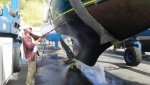
Pic on lifting Sept 2015, we have just started washing where the cradle supports will go.
20150911_150723.jpg
 
Last edited:
We've done both our boats with Coppercoat. I highly suggest that you dilute the CC with (whatever is the recommended additive) to the full 20% allowed by CC themselves. Call CC if you cannot find the exact statement online. Ensure the coats are THIN!!! I applied 4 coats to past boat and had some runs. Did 5 coats fully diluted on present boat and it is much better.

GL
 
We've done both our boats with Coppercoat. I highly suggest that you dilute the CC with (whatever is the recommended additive) to the full 20% allowed by CC themselves. Call CC if you cannot find the exact statement online. Ensure the coats are THIN!!! I applied 4 coats to past boat and had some runs. Did 5 coats fully diluted on present boat and it is much better.

GL


AFAIR, and I did it last year, it is only 10%. But fully agree you need to thin it as much as permissible; AMC will certainly advise this if you ask them.
 
AFAIR, and I did it last year, it is only 10%. But fully agree you need to thin it as much as permissible; AMC will certainly advise this if you ask them.

I also agree. But eqqually, as per my remarks in post #7, don't chuck all the thinners in a mix in one hit. With a typical application (one person rolling) it will thicken in the pot during each pot's life. So hold a little of the thinners back to compensate.
 
I also agree. But eqqually, as per my remarks in post #7, don't chuck all the thinners in a mix in one hit. With a typical application (one person rolling) it will thicken in the pot during each pot's life. So hold a little of the thinners back to compensate.


We had two people rolling and one mixing; we didn't have a problem with it thickening in the pot. From my experience, I'd suggest that two people rolling is ideal on a 31 foot boat; by the time we had done one coat, it was time to start the next. I'd have thought that one person rolling would mean that it had gone off a little more than ideal before you got to the next coat. But the ideal is certainly to apply all that AMC provide in as many coats as possible!
 
We had two people rolling and one mixing; we didn't have a problem with it thickening in the pot. From my experience, I'd suggest that two people rolling is ideal on a 31 foot boat; by the time we had done one coat, it was time to start the next. I'd have thought that one person rolling would mean that it had gone off a little more than ideal before you got to the next coat. But the ideal is certainly to apply all that AMC provide in as many coats as possible!

That was exactly my experience! Started doing it myself on my 31ft boat, and realised halfway through the first coat I couldn't keep up so earholed a nearby mate who owed me some favours and we had it done in an afternoon.
 
I have applied Coppercoat on a very old wooden yacht.
Explanation :
The boat been build 1946, a sort of Bawley yacht. Total rebuild 1970, sheeted in fibreglass on new wood. In fact two hulls in one, hence the 8 tons for 8 meter length....

....BTW. Rollers. Since our under water hull is not smooth we had to use small ( 1” diameter, about 4 inches long ) rollers. More but easier work. As Gwylan said, do not spare on rollers.

What a wonderful evocative post, the best I have read here in years.

Having applied it and removed it., I think copper coat is an absolute waste of time and money, but seems to work for some...
 
Last edited:
Top