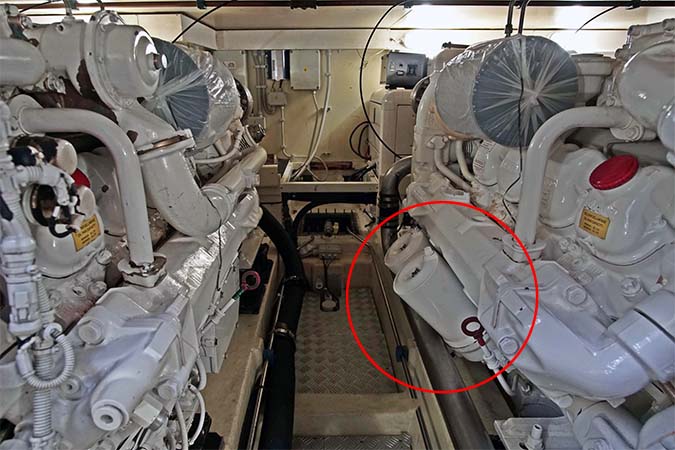
Coolant change Fq ?

labels were attached by wire to the sticks
RTS did the sign off .
My coolant is green fluorescent green Recommissioning after a3 y lay up done by RTS
I did have YES in CdA give them a once over shortly after I got iThey tested the coolant and OK d it
 
Sorry for the thread drift on to engine oil changes... but in my MTU maintenance manual, it says that when refilling oil, 4 litres must be pumped @ 3 Bar into the oil ducts (after removing 1st and last rocker cover) 'until bubble free oil emerges at the rocker arms'. This does seem quite an effort considering I would normally go to the filler neck to put the oil in. Thoughts?
 
Somebody once told me that brown staining in the header tank is the sign of a boat that hasn't been brilliantly looked after.
I believe the corrosion resisting properties of the green Glycol type (Volvo Penta) coolant are diminished with time , hence staining of the header tank.
I guess such staining doesn't necessarily mean other things have been neglected .
I'm not expecting to get enough coolant out of my kad32 using an extractor pump but may give it a go.... but it will be a while as my boat is ashore at the moment and focus is on the bits normally under water .
 
With regard to those pictures in portofinos original post, and the jelly like substance.

That jelly can be formed by mixing two different and incompatible types of coolant, and can block coolant flow, so could the issue actually have been caused by this rather than by infrequently changing the coolant?

Vp are very clear about this potential issue when different (incompatible) types of coolant are mixed.

I've had a similar problem in my bmw, but not in the coolant, but in the windscreen washer fluid, it came prefilled with some bmw washer fluid, I then partially filled it with some washer fluid from Halford, which when mixed with the remaining bmw stuff turned to jelly and blocked the pump, and jets.
 
With regard to those pictures in portofinos original post, and the jelly like substance.

That jelly can be formed by mixing two different and incompatible types of coolant, and can block coolant flow, so could the issue actually have been caused by this rather than by infrequently changing the coolant?

Vp are very clear about this potential issue when different (incompatible) types of coolant are mixed.

I've had a similar problem in my bmw, but not in the coolant, but in the windscreen washer fluid, it came prefilled with some bmw washer fluid, I then partially filled it with some washer fluid from Halford, which when mixed with the remaining bmw stuff turned to jelly and blocked the pump, and jets.
Yes all that’s correct best not to mix fluids stay with the same type for coolants .
This history with the car block is late 80 ,s no history ( not unlike a boat ?) purchased in 2012 .Since then 2x coolant changes so he did it every roughly 4 years .
No coolant symptoms what so ever inc several euro trips in high summer .....so it did not over heat .
As said it’s not the heat transfer properties as such ......more so in a boat with HE fouling and impeller hassle , it’s the corrosion properties that dropped leading to localised corrosion and ring binding and fracture .
Gel formation is possible mixing coolant types but I doubt he did that as it’s well documented which to use .
Yup car forums ( BMW in particular) are full of blocked washer jet PITA woes .

Thing is it’goes on out of sight .....the corrosion depletion and with diesels cavitation.
Sure with VP helpful transparent expansion tanks you can or should see the colour .Buts if it’s brown it’s rather too late imho .

Idea is increasing awareness to this hidden diesel engine killer in aged machinery.
With the bigger engines like MAN / MTU / CAT they have large metal header tanks ....pressurised .So you can’t see in without opening a cap ( two caps on mine ) .
Fortunately for me with a cap off ......they are under a hatch so I can get natural light / sun etc to beam in an assess the colour .
I guess some instals it’s difficult to get your head over the tank filler hole to eyeball ? So nobody checks .

As far as manuals go .....once out of warranty it’s common sense .
eg With a “ aged “ car I change ALL the fluids on annually that’s oil ( 5000km ) gearbox 2x year every 2500 km , brake fluid flush annually and the coolant annually ( same engine as the pics in post #1 ) .Goes in fluorescent green and comes out the same colour 12 months later .

So with the boat ......again it’s aged 2003 engines so lavish TLC on it .
oil annually ( 80 hrs this 12/12 ) coolant was replaced in 2014 , 2017 and the header tank replenished annual.
Twin disc manual says gearbox oil every 400 hrs or something I do mine every two years ....it hardly darkens changes colour .
All the fuel filters annually + use a anti bug enzyme all the time .

I also did the tappets / valve lash last year .Manual says every 400 hrs .....but why wait ? They sounded noisy .Bingo a few exhaust valves were out and the odd inlet .The difference in sound was unbelievable.
Reading further round the subject with a diesels the tolerance of incorrect valve timing is extremely narrow .
Its vital they open and close on time as due to the extreme pressure and temperature, you end up with cross contamination of combustion gasses , burning of the valve edges if the exhaust is a fraction open ....not quite shut etc etc .
Increase of bad soot particles which go on the prematurely knacker the injectors , which in tern just add to the demise and short life expectancy.

I mean how many folks on here end up having the injectors pulled ? Refurbed refitted and no adjustments of the valves .....madness imho .
 
I also did the tappets / valve lash last year .Manual says every 400 hrs .....but why wait ?
They sounded noisy .Bingo a few exhaust valves were out and the odd inlet .The difference in sound was unbelievable.
Do you mean that some Xhaust valves had no play at all, to the point of increasing the exhaust noise while running? :oops:
If so, you're very lucky if you adjusted them in time, because in such situation it doesn't take long to burn them, and their seats too...!
My guess, if as I understand you clocked less than 400 hours from the previous adjustment, is that they weren't tuned properly already back then.
 
Do you mean that some Xhaust valves had no play at all, to the point of increasing the exhaust noise while running? :oops:
If so, you're very lucky if you adjusted them in time, because in such situation it doesn't take long to burn them, and their seats too...!
My guess, if as I understand you clocked less than 400 hours from the previous adjustment, is that they weren't tuned properly already back then.
No the gap widens from its 0.6 upwards hence the tapperty sound .
They snap shut too soon before optimal evacuation , thus adding to the bad soot problem .
Also open a tad late again the extra bad soot is hanging around the injector tips for longer than it needs to ......not good .
EGTs were lower as a result after the adjustment by a bit too as expected .
With diesels due the immense pressures it’s the final 2 % of the cam timing that’s vital .

The first point is ( and you seem to be hooked line and sinker caught btw ) with aged machinery you do not have wait for the hrs and do it by the book .Why no “do it “ sooner rather than later ,

Second it’s time chronological time ie annually not the hrs like the acidic oil basis as opposed to “ Ive only done [ insert your perceived low hrs ] this year so it’s does not need doing .

There seems to be a recurring theme of opting for the cheaper.....leave it this time option because the book says so .

When was the last time your valves were checked ? Btw .....just the pic of yours shows no evidence marks on the valve coverbolts .
Also no white overspray on the two labels so it’s not had a rattle can before sale make over .
looks like they have never been off tbo from the pic .
And your coolant how old is it and has it’s colour changed ?
when did you last view it ?

saw mine last Sunday ....lovely fluorescent green . :)
 
No the gap widens from its 0.6 upwards hence the tapperty sound.
Not according to any MAN engineer I spoke with: all of them told me that the typical and most dangerous risk a gap reduction over time.
Whose potential nasty effects are the ones I previously mentioned, when there's no play left anymore.
That applies to my engines, anyway - no idea about whether there's a difference between V8 and L6 blocks.
Regardless, no worries: I only asked because I understood from your previous post that the noise before adjustment was from the exhaust, not tappet.

Ref.my engines, actually I just posted the pic to explain what labels I was talking about, not to make any comparison.
But if you're interested, here's the answers to your Qs:
When was the last time your valves were checked? Eight months ago.
And your coolant how old is it... Eight months.
...and has it’s colour changed? Not a clue. In my engines, it's impossible to tell just by looking inside the cap, and life's too short to pick a sample just to check the colour.
when did you last view it? Never, as per previous train of thought. There's a low level alarm though (which was checked), and that's good enough for me.
Otoh, I did choose the coolant based on MAN specs rather than price and supermarket availability. But each to their own on that, of course.
 
This does seem quite an effort
It certainly is, but sorry, I never heard of such requirement, neither for MTUs nor any other engines.
But since we have basically the same block, I'd be curious to check if the filters placement is the same.
Let me see if I find a pic of mine...
 
Let me see if I find a pic of mine...
Here it is.
The boat is on V-drives as yours, and the pic is taken looking towards the bow.
So, that should be just about the same view that you have of your engines when going down the e/r hatch and looking forward.
V45190GN_o.jpg
 
@ MapishM. When was that pic taken ?
Theres no witness marks to evidence the valve covers have ever been off before the pic.
The pic was taken before the last jobs, which also involved the injectors refurbishment, on top of the valve adjustment.
But some marks on the screws were indeed visible also before, albeit barely. It's all in the wrist, as they say... :cool:
I can see why you wouldn't tell from that pic alone, anyhow.
 
Not according to any MAN engineer I spoke with: all of them told me that the typical and most dangerous risk a gap reduction over time.
Whose potential nasty effects are the ones I previously mentioned, when there's no play left anymore.
That applies to my engines, anyway - no idea about whether there's a difference between V8 and L6 blocks.
The clearance gaps open up from wear in the components .
Never known them to close .
cam lobe , tappet , push rod ,rocker arm and followers wear , Just a fact of friction and age despite best materials and regular oil changes , etc

We are not talking a lot , exhaust should be 0.6 .....opens to 0.7 or 0.75 so out by .1 to .15 mm .
Inlet side cooler so 0.5 goes to say 0.55 .
Only say 1/2 if that need adjusting , other 1/2 spot on .
You don’t find tight “ closed “ gap s .......well I can’t remember ever seeing that , not saying I haven’t come across it but never noticed .The gaps are generally bigger and the feeler gauges loose , sloppy requiring the gaps closing down .Or with in spec .
Hence the “ tapperty “ noise .
It worse at engine start because they have not got hot enough to expand the valve stems to close the gap .Thats what the gap is a thermal expansion thingy , exhaust at 0.6 mm expands a bit more cos it’s hotter than the inlet valve stem which is 0.5 mm .

baby girl names with pronunciation

Suspect crossed wires with your MAN engineer , ??

They do not wear into silence, they can’t ...... they wear into noise a tapperty sound .
 
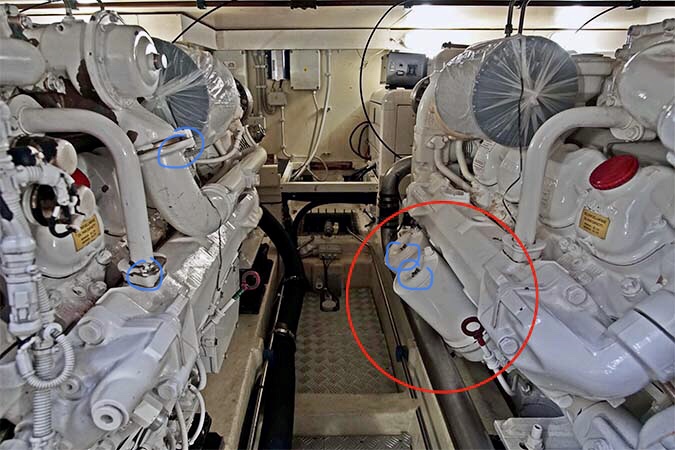
Ahh well you have some previous oil filter changes see the “ witness marks “ in blue on the RHS filter housing ......pic absent on the valve cover bolts .Thats what I would expect to see if those covers had ever been off .

LHS has had some coolant bits dismantled (y)

 
Here it is.
The boat is on V-drives as yours, and the pic is taken looking towards the bow.
So, that should be just about the same view that you have of your engines when going down the e/r hatch and looking forward.
V45190GN_o.jpg
Yes P, very similar view, same filters, however I find my engines run a bit better without plastic bags on the air filters :cool: (joking aside, I assume you do this over winter to stop damp air?)
 
Haha, yeah, precisely. The boat was still in the Adriatic when the above pic was taken, and fully winterised.
Not something I bother with anymore, now that she's in S Sardinia...! :cool:

Back to the point, I really struggle with MTU suggestion.
If the oil filters placement is the same, pretty sure the rest of the block and its lubrication circuit also is.
In fact, back in those days, MTU and MAN just bought the same blocks from Mercedes and marinized them.
I'm aware of several differences in the cooling system (for most of which I actually prefer MTU choices btw, aside from their spare parts costs...), but why you should pump pressurized oil in MTUs and not in MANs, that baffles me. :unsure:
 
They shared ( MAN / MTU ) the same foundry for a period of time in the 90 ,s early noughties......casting blocks .
So theres a commonality with the sleeves inserted into the blocks ie the swept vol .Plus probably other off the self bits like Bosche injected pumps etc .
How ever they may have different oil pumps and valve gear .....rockers etc .....with MTU going in a different direction re lubrication .In theory a better in terms of longevity some kind of pre start , pre fire prime of the rocker box contents .
we know they / MTU deviated away from rubber impeller sea water pumps in favour of a bronze permanent unit ......but like a see saw when ones up the other is down ......the downer with the solid metal pump is it’s tell tail can corroded closed and the resultant seawater / oil seal internal - fails and water enters the crank case mixing with oil .

Where as the trad rubber impeller pump might spread lobes , need regular changes but if it leaks there’s no way water can get back into the oil .....it just drips into the bilge .
Most go for the rubber impeller route for a reason .

Raw Water and Coolant Pumps
A key engine component that is often overlooked but results in catastrophic failure is the water pumps. The raw water pump is no stranger in being the culprit. Some pumps, like in MAN engines, use a rubber impeller that we recommend to inspect and replace as necessary every year or 1000 hours.
Other pumps use a bronze impeller like on the MTU engines. For example the MTU series 2000 raw water pumps are notorious for causing damage that could have been prevented. The pumps are built with an external weep hole that lets you know if the water or oil seal is leaking. If the pump is leaking raw water and the problem is not addressed on time, the leaking raw water will corrode and seal the weep hole shut. The leaking raw water will not have an exit now and will start flowing through the oil seal leading to the interior of the engine. Many overhauls have had to been done as a result.

You need to check this Marc ....not sure if your TE 183 has this type of pump ?
upload pictures

one of them will out of sight !
 
Haha, yeah, precisely. The boat was still in the Adriatic when the above pic was taken, and fully winterised.
Not something I bother with anymore, now that she's in S Sardinia...! :cool:

Back to the point, I really struggle with MTU suggestion.
If the oil filters placement is the same, pretty sure the rest of the block and its lubrication circuit also is.
In fact, back in those days, MTU and MAN just bought the same blocks from Mercedes and marinized them.
I'm aware of several differences in the cooling system (for most of which I actually prefer MTU choices btw, aside from their spare parts costs...), but why you should pump pressurized oil in MTUs and not in MANs, that baffles me. :unsure:
See my post #37 ^^^^ MTU s oil pressure system has to cope with the water / oil seal of the unique metal impeller pump .
I reckon it’s different lub system needing priming .....unfortunately @ change to keep ( working from 1 st principles) the pressure differential in the oil / water seal in the metal pump .....oil out as opposed to water in ! .

Btw the cosy relationship sharing the casting foundry failed about guess mid noughties and MAN bought the foundry ( in Germany btw ) and shut out MTU / Merc who along with DD .....well the worlds a big place :) .Vietnam , Mexico , where ever ?? Who knows in such a large corporation??
 
Last edited:
The clearance gaps open up from wear in the components.
Never known them to close.
I see your point and I don't disagree on the principle, but I just reported it as I heard it from MAN folks.
And old school ones btw, not young mechanics that can only do what the diagnostic suggests them.
No disrespect meant btw, that's just how modern engines must be handled.
But TBH, I didn't bother asking them the rationale behind the fact that - at least in V engines - valves can close over time.
There must be a reason I suppose, since I can't see why at least a couple of folks told me so, and I'm in doubt about whether I discussed that also with another one or not, but pretty sure if I did he didn't give me a different advise, otherwise I would remember that.
 
See my post #37 ^^^^ MTU s oil pressure system has to cope with the water / oil seal of the unique metal impeller pump.
While my efforts in understanding MTU engines stopped when I decided to go for a MAN powered boat, I did try to understand their pros and cons during my search, because I came across several MTU powered boats.
Btw, one of them - a Ferretti 175 with V12 MTU 183 engines - was among the top three of my short list.
And you know what? I heard nothing but praises on those engines, raw water pump included.
Not just by MTU engineers, mind: also by some MAN and Cat guys.
Actually, the overwhelming consensus was particularly for the TE92 version (as installed in that F175), which was the last fully mechanical one, and fitted with bronze-only components just about everywhere, not just in the raw water pump.
Anyhow, I still can't see why the lubricating circuit should have different requirements from MANs.
I mean, also assuming that the water/oil seal is as critical in 183 engines as you say it is in 2000 engines (though as I said, I heard nothing but praises on the 183 raw water pump), why should that require pressurized oil to be circulated upon refill?
If any component different from MANs could not withstand running for a few seconds with no lubrication, there should be also some pre-startup pressurization system, but I'm pretty sure there isn't any. Why only upon refill?
Anyhow, I don't think whoever wrote the manual did so while completely drunk, so there must be a reason.
In markc boots, I'd ask an MTU engineer with plenty of white hairs...

PS: M, if you will find out what the reason is, I for one would be curious to hear it.
 
Last edited:
Top