Compunding and polishing help

Ok so I may be a bit of a numpty but I thought polishing was waxing.... or can I improve the end result in some magic way? I have our cabin and cockpit sides to do cos they are looking a bit dingy grey and dull instead of gleaming white. My usual choice of "polish" is Lifewax but if I can get a better result then I'd love to know the secret. Has to be by hand as the sides are not flat but stepped.

S
Imagine your gel us like sandpaper...if it is poor condition,it will be likecoarse sandpaper in my analogy.now you can just give it a quick rub and a bit of wax,but you can already probably guess how good a result you will get.
So we have to cut/compound/polish(these are similar products,just with differe nt names to indicate how coarse they are)
So you wothbthrough the grades to end up with a gel surface like glass.then you wax to seal and add water brepellancy.
Its a bit like decorating...how bad is the wall anyway,and how much preparation do you need.prepare it well and the finish will last a long time.
The better condition you keep the gel coat the less preparation next time.good condition might be possible to lightbpolish by hand,but usually you need some power to get the cutting action of the paste.
Some pastes actually break down as you use them and so in effect do cut and polish.
On the whole the two in one products ie polish n wax are a bit rubbish.
 
It's been a while since I had the boat out of the water for a good polish. In the past I've used other people's equipment. Now I have no-one to borrow from and have acquired a silverline polisher. What advice would anyone give for heads for (a) compounding and (b) final polishing. The surface is not particularly bad and I'm trying out the farecla gelcoat restorer (which I already have so not asking for advice on whether to use something different).

I tried the silverline blue foam head but it seemed a bit soft. The white one seems about right. I also tried the farecla compounding head but that seemed way too rigid and make the polisher impossible to control. However all the youtube videos I've seen on boat detailing seem to use a big lambswool thing for the compounding (not just polishing) rather than a foam head.

What does everyone else use?


100% wool (white for compounding, yellow for polishing) 3M are industry standard, they are well balanced, long lasting and perform very well.

Purchase from 3M direct to ensure they are genuine. http://www.3mdirect.co.uk/c-800-boat-polishes-and-compounds.aspx

Foam heads do serve a purpose, but usually (for me) only for further improving condition where the white and yellow wool pads have already 'conditioned' for you. You may find the foam pads difficult to use as they will be 'grabbing' above surface contaminates.

True correction of a surface (to a level of perfection) is not an easy task, many stages are required to make the next stage easier.

Decent cleaning; de-greasing, de-scaling, is important before compounding or polishing is even started.

With a finish similar to PRV's it would possibly be foolish to use anything other than your hands, his method has clearly worked, in fact with a surface that doesn't require correcting, why use anything else?
 
The 3M heads seem to be being well recommended but looking at the small print it seems to say they need an adaptor to fit onto an M14 polisher. These don't seem to be available from the 3M website and only available in their catalogue in packs of 10. If I were to go with the heads recommended here would I be ending up with some expensive products which I need additional stuff to actually use? Is there a special backing pad I need? Or am I mis-reading things and they'll screw straight onto the silverline?

I've been having slightly more success with the silverline lamswool bonnet than the foam but it seemed to start to splt after about 1/3rd of a 12m boat. Maybe I'm using too much pressure. How long do the 3M heads last?

The compound I'm using is the farecla marine professional gelcoat restorer rather than the g3: I got flogged a discounted pack of their 4-stage stuff at last year's southampton boat show which I thought I'd try.
 
The 3M heads seem to be being well recommended but looking at the small print it seems to say they need an adaptor to fit onto an M14 polisher. These don't seem to be available from the 3M website and only available in their catalogue in packs of 10. If I were to go with the heads recommended here would I be ending up with some expensive products which I need additional stuff to actually use? Is there a special backing pad I need? Or am I mis-reading things and they'll screw straight onto the silverline?

I've been having slightly more success with the silverline lamswool bonnet than the foam but it seemed to start to splt after about 1/3rd of a 12m boat. Maybe I'm using too much pressure. How long do the 3M heads last?

The compound I'm using is the farecla marine professional gelcoat restorer rather than the g3: I got flogged a discounted pack of their 4-stage stuff at last year's southampton boat show which I thought I'd try.

If you are going to use your Silverline machine, ( rather than buying a 3M machine for about 10 times the price), with 3M "Hookit" pads what you need is the Hookit backing pad, part number 05717M which has a 14mm fitting

See http://solutions.3m.co.uk/3MContent...assetId=1319227300156&blobAttribute=ImageFile
 
The 3M heads seem to be being well recommended but looking at the small print it seems to say they need an adaptor to fit onto an M14 polisher. These don't seem to be available from the 3M website and only available in their catalogue in packs of 10. If I were to go with the heads recommended here would I be ending up with some expensive products which I need additional stuff to actually use? Is there a special backing pad I need? Or am I mis-reading things and they'll screw straight onto the silverline?

I've been having slightly more success with the silverline lamswool bonnet than the foam but it seemed to start to splt after about 1/3rd of a 12m boat. Maybe I'm using too much pressure. How long do the 3M heads last?

The compound I'm using is the farecla marine professional gelcoat restorer rather than the g3: I got flogged a discounted pack of their 4-stage stuff at last year's southampton boat show which I thought I'd try.


I think you are using the lambswool bonnet that ties over a backing plate? This is to be placed in the base of a bin, preferably cutting into several pieces first.

Are to taking on-board the point about 'conditioning' the gel coat prior to polishing? This will really help as the compounding or polishing heads will perform so much easier and won't 'grab' dirt from the surface and turn your polishing head into a swirl machine. Sorry this is so hard to explain, i'm no wordsmith!

Yes, there are two types of 3M wool pads, single sided hook & loop and double sided 'superbuff' types.

The single sided hook and loop requires a backing pad for quick and easy changing of pads, but the double sided ones don't, they require the small adapter. Each are important for the correct performance of the choice of pad.

It is usually only the cheap foam pads that come with a backing plate already in place, ready to fix into any 14mm polisher.

Do you have a backing pad? If so what type? Is it 75mm or 150mm? if you haven't got one I can send you one to try, in fact I could send you a slightly used 3M compounding pad if interested?
 
Thanks again for all the helpful info. Yes I have thoroughly washed and de-stained the hull and give it an additional sponge down before any go with compounding to get rid of any new surface contaminants. The backing pad I have for the silverline bonnets is 180mm and seems to be a hook and loopy thing. I've been doing some googling and can't find the 05717M VicS refers to on the 3m direct site or amazon so am wondering if that part no. has been superseded? Many thanks to Marine Reflections for the kind offer but unless anyone tells me it won't work, perhaps I'll just try one of the 3M heads with the backing pad I've got.

Did much better yesterday with a second silverline bonnet: less compound, less pressure. Still only lasted 1/4 boat before the stitching went but this time I can definitely see where I've done. Bits where I did gelcoat repairs (finished with 1200 grit) still look a bit dull though.

Why do manufacturers make this stuff so arcane? So "compound" is exactly the same as "polish" just more aggressive, but presumably there's no defining line between one and the other. And wax is not abrasive, but then there's "wax polish" which is...what...wax with some fine abrasive in it?
 
Thanks again for all the helpful info. Yes I have thoroughly washed and de-stained the hull and give it an additional sponge down before any go with compounding to get rid of any new surface contaminants. The backing pad I have for the silverline bonnets is 180mm and seems to be a hook and loopy thing. I've been doing some googling and can't find the 05717M VicS refers to on the 3m direct site or amazon so am wondering if that part no. has been superseded? Many thanks to Marine Reflections for the kind offer but unless anyone tells me it won't work, perhaps I'll just try one of the 3M heads with the backing pad I've got.

Did much better yesterday with a second silverline bonnet: less compound, less pressure. Still only lasted 1/4 boat before the stitching went but this time I can definitely see where I've done. Bits where I did gelcoat repairs (finished with 1200 grit) still look a bit dull though.

Why do manufacturers make this stuff so arcane? So "compound" is exactly the same as "polish" just more aggressive, but presumably there's no defining line between one and the other. And wax is not abrasive, but then there's "wax polish" which is...what...wax with some fine abrasive in it?


The (3M) backing pad 05717 is the correct part number, the M on the end represents 'metric' to the US market. In short - drop the M, Vics had it right but was quoting from a US site.

Sadly the 3M '05717' pad wont fit on your 180mm backing pad you have for the Silverline, the correct size backing plate would need to be 150mm.

To reiterate:
You should not be using a tie on bonnet for compounding. The bonnets are not designed to be used for compounding, but very light dry buffing only. You will be far better off with the correct compounding wool pads.
The reason the 1200 areas are still dull is because the area finished with 1200 grit is not sufficiently smooth enough to try to recover from with the process you are using, you needed to either continue to rub with finer grades of paper on the repairs, or use a more aggressive compounding system.

You are welcome to take me up on the backing pad offer, can throw in a 3m compounding pad also for you to try, it will be a little used, but will have plenty of life left in it. Just PM me your address.
It will be far easier to allow you to see what I mean with the benefits of your own labour rather than just read it.

I do understand what you mean regarding the multiple choices offered by pretty much most manufacturers, people want a quick solution to a problem, if a buyer wants to 'wash & wax' or 'restore & protect' in one product or with minimal effort, a seller would be foolish not to offer them that choice in a bottle. Some work, most don't.

Stick to individual tasks from each product, probably the best option IMO.

As an aside; I do appreciate questions via PM, but in the spirit of the forum, questions should be asked on the forum, that way both the questions and the possible answers can be viewed by others, but most importantly, others can reply, disagree, add to etc, I need to learn too you know :)

Tony
 
Last edited:
The (3M) backing pad 05717 is the correct part number, the M on the end represents 'metric' to the US market. In short - drop the M, Vics had it right but was quoting from a US site.

So a 05717 backing pad bought in the UK will be 14 mm ?

Presumably if you buy the 3M polishing machine in the Uk it will also be 14mm ?

5/16" equipment only available in technology backwaters like the USA ?
 
Last edited:
So a 05717 backing pad bought in the UK will be 14 mm ?

Presumably if you buy the 3M polishing machine in the Uk it will also be 14mm ?

5/16" equipment only available in technology backwaters like the USA ?

Yes, the 3m polisher (UK) would be 14mm, steer away from that though - noisy thing.

I have a 5/16" 05717 now that I think more on it Vic, it would make more sense that the 05717 'M' would be UK part number .
Sorry, I think you have it right and I have it wrong. the M is UK and the without would be US.

To add, the 5/16" won't fit the 14mm - but you know that already.
 
Last edited:
Never been taught but learnt respraying cars the hard way! Ended up repairing a lot of Glass Fibre cars.

Compound is effectively grinding down the surface of the GRP. Avoid if possible but realistically do the minimum necessary.

A polishing machine with compound can grind off a lot very quickly. I learnt that after going completely through the new car paintwork on "edges" luckily you don't have many features on boats.

I lightly compound boat and then polish with Mer. Any scratched abraded areas I do compound harder using a machine.

If too deep I repair gel coat with new gel coat applied high. Gel coat cures by covering with cling film. Rub down with wet & dry paper on a rubber block starting at about 600 and going down to 1200 but first rub hard soap on wet & dry paper to "block" it and add some lubricant. (Use W & D paper only on repaired areas or badly scratched areas providing you are confident that there is sufficient depth of gel coat).

When using wet & dry paper you are effectively reducing the surface by a number of minute gouges (effectively small scratches - compound is just a grinding paste producing even finer scratches). The technique for rubbing down a repair is to always leave the rubbed down surface high allowing for the bottom of any grade of W & D papers minute scratches to still be high. Successive grades of W & D paper and coarseness of compound produces finer gouges allowing for finer scratches to bring surface to correct profile. Effectively polishing is grinding/compounding so fine that it shines however adding a wax/silicones greatly assists the reflective qualities and offers protection against UV degradation of the surface gel coat. Even polishing is effectively grinding the surface a little as the colour transfers/appears on the polishing cloth!!

A compound mop on a machine with coarse compound is an easy way to produce an apparent "polished" surface quickly but I have used the term gouges to illustrate that you are grinding down a gel coat of limited thickness and its only the minute size of the scratch that gives a polish surface but you are still "grinding" away the gel coat - so take care!!
 
Last edited:
First up...many many thanks to Marine Reflections. Not only for advice here, but also for sending me a 3M backing plate and mops and then refusing to accept any form of compensation. Although he described these as "used" they still have plenty of life in them even after going over my boat a couple of times, unlike the silverline mops which self destructed after 1/4-1/3rd of a 12m boat. 3M direct meantime did not reply to my initial enquiry form where I asked where on their we site I would find the backing plates for the mops or adapters for superbuff pads to allow me to buy their other products. A second enquiry elicited the response that they had forwarded my first enquiry to the relevant department and would "chase it up". That was over 10 days ago.

I was using the farecla "marine professional 4 stage" stuff. I'd washed, de-stained, then went over the boat with the "surface restorer" and compounding head. The next stage was supposed to be the "Wax polish" but as Tony had been so generous I decided to put in the extra effort and do some experimentation for the team, so I bought some 3M "finesse it" which I applied with the polishing mop. Then I used the farecla "wax polish". Finally I went and got some 3M paste wax. I only managed to apply about a 30cm strip above the antifoul line before I lost the light yesterday, but that enabled me to remove the tape I'd put over the top 2" of antifoul and I can do the rest later.

Lessons learned: Some of this may be so obvious to old hands they would assume it was obvious to everyone, but hopefully some of my rank amateur observations may be helpful to those of similar experience

- My silverline silverstorm was fine. I have no experience of rupes, makita etc. The constant speed with different pressure feature didn't seem to work very well but it didn't matter. Maybe it's heavier than more expensive things but I paused for a breath after each ~70x50cm patch
- The 3M pads are simply a world of difference form the silverline ones. As well as being usable for way longer, they seem to make the polisher more controllable, easier to use, and most importantly seem more effective. If 3M ever let me in on the secret of how to buy them, I'll share it.
- When people write polishing guides I suspect they often either have quite low boats or a nice platform to work from. When using a rickety ladder with a boat whose deck is 4m off the ground, minimising trips up and down the ladder and what you need to have with you becomes an issue
- Rather than a misting bottle I used the "mist" function on my hose because (a) I don't have a misting bottle but also (b) because I can do it from the ground while re-loading the compound/polish, eliminating a trip up and down the ladder
- I experimented with different compound/polish application methods. What worked best was putting the stuff on the mop (removing the necessity to take the bottle up the ladder) then wiping it over the area to be done before switching on the polisher
- I've read warnings about slingback with polishers without slow start. My silverline doesn't have a network port, ergo no tcp congestion control, so I assumed a comfy set of mules was safest.
- I had thought about putting 2" masking tape over the top of the antifoul and gladriel's link in post #28 confirmed it wasn't supid so I did it. This is totally to be recommended. No contaminating your mops/cloths with antifoul or pussyfooting around that line. 15 mins spent taping up saved a load of work.
- The surface seemed to sparkle more after the finesse it. This wasn't a wasted stage (more on that later)
- Although people say everything should shine after the compounding, water marks from where you sponged off the excess will make things uneven, so don't get disappointed. The waxing stage deals with that and that's when I found everything really came to life
- Dampness seems to be the enemy of best results at the waxing stage. The farecla stuff was a bit runny and I found myself getting through loads of application rags as they got soaked. The 3M paste wax, whilst more effort for the first few bits, was much easier to work with in the longer term
- Microfibre cloths are just genius. Again, everything is best when they're dry so I used several. They wash up well in the washing machine later.
- Everything is all so much easier when the sun shines. Not just because you feel happier, but because you can see where you've been and where you've missed. Trying to wax on a dull day involves frequent trips down the ladder to look at different angles for the bits you've missed. Conversely, on a sunny day (e.g. last tuesday), wiping off the wax with a dry microfibre cloth to see everything gleam is just a joy. It's therapy more than work.

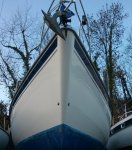
Pics don't do it justice. This was 4 days after the initial waxing (before the second), it's not very sunny and I'm in a shaded corner of the yard, but you can at least play "spot the burgee".
boat0.jpg View attachment 37553

Is it "professional looking"? No way. After waxing, up close, I can see all the imperfections which include:
- scuffs I didn't originally notice but are revealed as dull patches: these need more aggressive compounding
- areas where the gelcoat is just a bit worn. Only a couple of places and not much that I think I can do about it
- bits where I've made repairs and finished with 1200 grit. I thought the all-over compounding would sort this out but I don't think the farecla stuff was that aggressive. In future, compounding then polishing will be part of the gelcoat repair rather than leaving it to be "fixed in the edit" (ie at the "boat cleaning" stage)
- areas where I've sanded around repairs is whiter than other areas, but hopefully this will even out over a couple of seasons
- Slight indentations where I think a previous owner may have sanded repairs a bit aggressively. I fixed the more obvious ones when I was doing the gelcoat repairs, but have found more now that everything is shiny and I can see where the reflective surface is not perfect.
- faint streaks of discolouration that stain removal didn't remove
I think an all-over 1200 grit sand would sort a lot of this, but taking off gelcoat is easier than putting it back and I'm happy enough to leave doing that til another day. Whilst this is nowhere near the standard someone like Marine Reflections could doubtless achieve for a customer, I'm pretty sure it's at least as good as the average yard's "lad" would do and I suspect that's who does more of the boats in the sub-£100k bracket than professional boat cleaning companies. I plan on hauling out next summer and will fix as many of these minor imperfections as I can then (I'm hoping to be back afloat by the end of next week).

I don't think I'll go with farecla's 4 stage thing again. The "surface restorer" seemed to be neither one thing nor the other. Not aggressive enough where I needed compounding and not fine enough for polishing. The "wax polish" soaked cloths quickly and I preferred the 3M paste wax. I also liked the finesse-it so I might look at other 3M stuff, though I'm disinclined based on how unkeen they are on telling me how I can buy the stuff that isn't in the chandler's.

Again: thanks to Marine Reflections and everyone else who advised here and hopefully some of the above might be useful to others experimenting with different polishing routines.
 
- bits where I've made repairs and finished with 1200 grit.

One final question would be....Going down the 3M product route there loads of compounds of various degrees of aggressiveness. The labels and product information I've found don't seem to say what grit-equivalent they are. What's the best one to bridge between 1200 grit W&D sanded gelcoat and the finesse-it polish I have? Can I go straight from Fast Cut to Finesse-it, could I use a less aggressive compound than the Fast Cut then go straight to finesse it, or am I looking at 3 stages of compounding/polishing? Not having the expense and locker space of extra bottles is an advantage (which is why I'm asking rather than just trying it for myself)
 
One final question would be....Going down the 3M product route there loads of compounds of various degrees of aggressiveness. The labels and product information I've found don't seem to say what grit-equivalent they are. What's the best one to bridge between 1200 grit W&D sanded gelcoat and the finesse-it polish I have? Can I go straight from Fast Cut to Finesse-it, could I use a less aggressive compound than the Fast Cut then go straight to finesse it, or am I looking at 3 stages of compounding/polishing? Not having the expense and locker space of extra bottles is an advantage (which is why I'm asking rather than just trying it for myself)

Well done! sounds like you almost enjoyed that?

Yes, you should be able to just jump from a compound that would remove the 1200 scratches such as fast cut or high gloss to finesse it. You would also need to change pad from white to yellow just as you have been doing with your other compounds / polishes.
Provided, the areas do actually have only 1200 'depth' marks to remove and not deeper.
99% of the time the problem lies in more work being required in the sanding prep and not moving onto the polishing correction too early.
Wiping with a black powder reveals the true depth of a suspicious area, powder remains locked in required correction, it may not be 1200's you are trying to polish out.

You are welcome regarding the backing and pads, I'm glad they helped make a difference.

As far as grading goes with products; you really only need to be able to separate coarse / aggressive products from smooth more workable, 'fine' products.
Some work better than others, but provided they are worked with decent pads the results from each are predictable.
You should not need to provide water to mist to a product. If the product is drying early in use, it probably shouldn't be used for that speed of application, or too much is being applied.
 
Last edited:
i've only replied to this thread as it is so useful and is really helpful re my recent question about polishing so I can find it again later
 
Top
