Cloudy diesel

As someone not a million miles from here so beatifully expressed it "The quantities of ptfe particles getting from filler thread to the injectors is going to be very small. Possibly zero." Read more at http://www.ybw.com/forums/showthread.php?477111-Cloudy-diesel/page2#ClJcQwJBEPJ9dlUC.99 :encouragement:

Richard

Yes, but I am happy that my aero bloke is obsessive about this kind of thing, my boat is not a helicopter, but I try to do my best for it.
I've always found diesel fillers are well enough lubricated by, err, diesel.

Water fillers are another matter. Food-safe grease on those!
 
Yes, but I am happy that my aero bloke is obsessive about this kind of thing, my boat is not a helicopter, but I try to do my best for it.
I've always found diesel fillers are well enough lubricated by, err, diesel.

Water fillers are another matter. Food-safe grease on those!
The purpose of a decent coat of grease on the threads is to seal them, rather than lubricate them, although obviously the grease will perform this task too, whereas diesel does not stay around the threads so is a poor lubricant, and a rubbish sealant. Not sure I would use a PTFE loaded grease though. I use a simple GP grease like Castrol LM.
 
Is "silicone grease" the common sealant (usually clear in colour) in the tube, that often just gets called "silicone" -- or something different?
 
I've done all of the tests on the hazy fuel bar one. (Bear in mind that all this fuel has already twice been filtered by through a Racor 30 micron filter on my fuel polishing rig and was treated 5 weeks ago with Marine 16 Diesel Fuel Complete so "Untreated' refers to this fuel which has no additional treatment to the above in this test.)

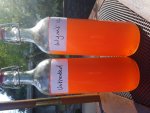
Tests have been carried out on 1 litre of fuel and the treated sample compared visually to "Untreated'. Below, for example, is "Untreated' compared to treatment with 10ml of Wynn's Dry Fuel.

Wynns 10ml.jpeg


1. Wynn's Dry Fuel 10ml/litre
2. Wynn's Dry Fuel 20ml/litre
3. Raised to 25 degrees C
4. Refrigerated
5. Refrigerated then returned to ambient temperature

No treatments have made any visible difference. All that remains is to polish again with a 2 micron Racor filter in the rig. Filter in the post ...
 
Last edited:
I once had some cloudy fuel, it was darker than that with remnants of bug in it.
I left it behind the shed in cans, it separated in time.
But I guess the Marine 16 stuff is preventing this from happening?

I'd be reluctant to use fuel in that state,
But OTOH, the stuff in my car could look like that and I'd never know.
 
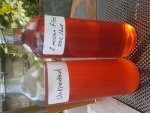
Just to complete this ... the 2 micron filter in the polishing rig has sorted it. (20 litres of fuel circulated through the rig for one hour.)

2 micron.jpg

(Sorry - I can't understand why the image is rotated and can't fix it.)

And this is the rapid reply from Marine 16.

"The hazy fuel is most likely saturated or emulsified, the chemicals do not turn it hazy, indeed DFC contains a very small amount of demulsifier to help fuel separation during normal conditions.

It can happen that the mechanical action of free water and diesel going through a pump will cause it to be hazy, made worse with modern biodiesel that readily absorbs water.

Water from the bottom of the tank should be carefully separated out then, if required, the fuel passed through a fine filter to “polish” it, although polishing is only necessary for fuel that has been stored for a long time. Water is the real enemy of fuel.

Normally the best way is to add a demulsifier. If it’s not too hazy and you have an old engine it would normally cope with some saturated fuel, a modern common rail engine however is a lot more sensitive to fuel cleanliness/quality."


As the secondary filter on the fuel system is 2 microns then presumably the only problem if I had used the hazy fuel is that it might exhaust the secondary filter more quickly.

Anyway ... very good to have a solution. Next time I'll start the polishing with 2 micron unless badly contaminated.

Thanks all.
 
Last edited:
Really interesting thread, thanks for posting. Any chance you can post photos/drawings and parts list of the kit you made up?

That's easily done as I copied the rig recommended by ASAP ...
https://www.asap-supplies.com/media/faq/ASAP12-0246GB-0315_-_Basic_Fuel_Polishing_System.pdf

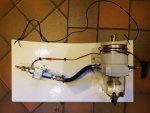
This is how mine looks. The small rubber bungs in the ends of the hose tails mean that I can store the rig in a deep locker without it stinking out the cabin. The 10mm ID hoses are kept in the cockpit locker.

fuel polisher.jpg

Finally, to summarise:

Water, and slimy bug were removed with the Racor fuel polishing rig using a 10 micron filter. The fuel was then treated with Marine 16 Diesel Fuel Complete. It was found to be hazy but the engine worked OK for two hours. Rather than risk it further, all 77 litres were removed using the fuel polisher with 10 micron filter. One litre samples of this fuel were treated as follows:

1. Wynn's Dry Fuel (emulsifier) at 10ml per litre
2. Wynn's Dry Fuel at 20 ml per litre
3. Raised to room temperature
4. Refrigerated
5. Refrigerated and then returned to ambient temperature
6. Polished again with 2 micron filter in the polishing rig (20 litres circulated for 1 hour).

All were compared visually to untreated fuel. #1-5 made no visible difference. The 2 micron filter visually cleared the fuel.

Advice from Marine 16 is that their treatment would not have caused haziness. They recommended a demulsifier (i.e. not an emulsifier as in #1+2) but this was not tried as the problem seems to have been solved.

Conclusion is that the 2 micron filter in the polisher would be better unless the fuel is heavily contaminated.
 
Last edited:
Really interesting, thanks for sharing that!
Is the filter taking out a measurable amount of stuff?
Is it just microscopic water droplets or something else?
 
Really interesting, thanks for sharing that!
Is the filter taking out a measurable amount of stuff?
Is it just microscopic water droplets or something else?

There's no free water at all in the plastic bowl under the filter after 3 hours of polishing so all is held in the filter. I've done the first 40 litres at 20 litres per hour but the third batch is not looking so clear after an hour so I may need to change to a fresh filter.

Edit: It definitely need a change of filter after 40 litres. At around £10 per filter that isn't cheap. In similar circumstances I would now try using a demulsifier first to turn the emulsified water back into free water (which the Racor rig can easily spin out) and reduce the need for fine filtering. There's not too many demulsifiers around but this one looks promising ...

https://www.hydra-fueladditives.com/dehazer-demulsifier-fuel-additives.html
 
Last edited:
Very interesting.

Since the 2 micron filter has undoubtedly removed the cloudiness I assume the the cloudiness is actually suspended particles rather than water droplets which is why Wynn's etc or the 10 micron filter didn't work and why the 2 micron filter eventually became blocked?

The best way to define the problem would be to centrifuge a sample of the cloudy diesel and see exactly what separates out.

Richard
 
Top