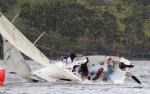
Clipper Ventures Yacht Ichor Coal: MAIB report now out

What I liked about the report was one of the deaths was caused by being hit on the head by a hard part of the sail, we call it the boom.

When commenting on a fatal incident report it is probably advisable to actually read the thing you're commenting on and also carefully consider any idiomatic phrasing.

Section 2.8.6 discusses possible injury mechanisms. I don't know where you are quoting from.
 
Last edited:
The crew member wasn't clipped on when she should have been which is human error on her part.

That's only one aspect of it. Why did nobody else notice that she wasn't clipped on or, if they did notice, why didn't they say or, if they did say, why didn't she then clip on? Effective safety management systems allow for the possibility human error with checks and safeguards.
 
Trying to nail it down to essentials I get two big issues.The crew member wasn't clipped on when she should have been which is human error on her part.The preventer broke which is gear failure.
The rest is all a consequence of those issues.

For me the big point is that in both incidents, the boat was essentially out of the control of the crew on deck, and that compounded individual errors and ensured the worst possible consequences flowed from poor or inexperienced decisions (in the first case, the individual mistake of crossing the mainsheet track was compounded by the boat slewing repeatedly off-heading and onto a run; in the second, the exposure resulting from being overboard was compounded by the prolonged time spent in the water while the crew fought to get the headsails down). Some might say that the boat was racing and therefore "on the edge"; I might be more inclined to listen to that argument from a professional crew in the VOR or even from a private crew in RTIR, but Clipper is in a unique position of taking well-paying amateurs with potentially no experience. I take the MAIB's overall point as being that more professional supervision would lead both to less individual errors by the crew and hopefully less time spent sailing on the edge of, or out of, control. Both of those things need to be addressed in order to make progress in preventing repeat incidents on Clipper boats. I have to say I am disappointed with Clipper's offocial response (https://www.clipperroundtheworld.com/news/article/maib-report-published) which seems to do anything but address the big picture and seems to go to lengths to focus on the minutiae and pull in the MCA, ORC, and even professional fishermen. (particularly amazed to see the danbuoy-AIS, which is an obvious lash-up, being offered as some kind of innovation).
 
It is suprising how many injuries are caused by being hit by the mainsheet and being knocked over during accidental gybes

I have had boats with both and the cabin top mounted traveler is not as effective but definitely a safer option

Regards Don
 
Last edited:
It is suprising how many injuries are caused by being hit by the mainsheet and being knocked over during accidental gybes

I have had boats with both and the cabin top mounted traveler is not as effective but definitely a safer option

Regards Don

I don't think a racing boat with a large cockpit could possibly have a traveller mounted on its coachroof forward of the hatch, though. Looking at the Clipper 70 you would end up with the main sheet roughly in the same position as the kicker.
 
Totally agree with you on that but on a cruiser it is a safer position

Racers have quite a few limitation

This is a photo of my mates Elliott 780 having a bit of a moment

Regards Don
 

Attachments

  • AGAP3 131215.jpg
    AGAP3 131215.jpg
    98.2 KB · Views: 0
Last edited:
It is so desperately sad that these two events have happened when years of experience should have taught us that there are ways to prevent them. But if you don't design out dangers then accidents are going to happen. Everyone knows that accidental gybes can cause serious injury so why not think about how to design out the risk? A piece of rope (the preventer) is a feeble answer. These were nearly new boats and a proper system of protection could have been installed during construction. For example, why not have an alarm that sounds when the boat's angle to the wind approaches 180 degrees? All you need to tell the helms person is 'if you hear the alarm immediately steer away from the boom". What about a hydraulic ram type preventer that is permanently fixed to the deck on each side in such a way that it can be fixed to the boom when needed and immediately released by a release mechanism when not?

The person overboard situation is also in need of original thought. It must be possible to design out many of the risks of them going overboard in the first place. Having looked at the photos of these boats I can immediately think of a few as the crew are clearly very exposed. Even the MAIB recommendation of netting along the guardrails would help.
For many years I taught sailors how to recover a MOB and I stressed that time was of the essence. Whatever the weather, It should be possible to get back to a casualty in the water within ten minutes, probably five. Anything more is dicing with death. The RYA advice on this subject is, in my view, not satisfactory as the procedure takes too long. My answer is to forget the dropping of sails. Start the engine and heave to. Drive the boat back to a position 10 metres upwind of the casualty and stop the boat with astern power. Let the boat drift sideways downwind towards the person in the water, using the engine to stop fore reaching and chuck them a lifesling or rope to pull them towards the boat. If you have returned within 10 minutes, probably 5 minutes, they will still be able to help with their rescue. If they are unconscious then launch a liferaft on the downwind side, jump in, and drag them into that.
Yes, I know there are going to be exceptions and it is all a bit messy but needs must. This procedure will work more often than not, even in 40 knot winds. I have practised it many times.
 
big seas, high winds, too much sail, inexperienced helm. An alarm isn't going to help, it all happens too fast, probably got spun off a wave and gybed before they realised what was going on.

They train for 25 days, in the solent. I spoke to one of the global challenge trainers once, he said they used to go hunting bad weather during training

preventers dont prevent anything, they just give a bit of time when your getting near to the edge
 
Last edited:
What I liked about the report was one of the deaths was caused by being hit on the head by a hard part of the sail, we call it the boom.

I cannot find the phrase "hard part of the sail" in the report. Can you point it out, please?
The word "hard" appears six times in the report, and doesn't appear in Annex A at all. I cannot see the phrase "a hard part of the sail" used anywhere.

Is KellysEye making stuff up?:confused: Shame on him/her if he/she is.
 
>The word "hard" appears six times in the report, and doesn't appear in Annex A at all. I cannot see the phrase "a hard part of the sail" used anywhere.

It was in a Times article on the MAIB report.
 
>The word "hard" appears six times in the report, and doesn't appear in Annex A at all. I cannot see the phrase "a hard part of the sail" used anywhere.

It was in a Times article on the MAIB report.
I see - thanks. So it is the Times' terminology that you liked - not the report itself!
What I liked about the report was one of the deaths was caused by being hit on the head by a hard part of the sail, we call it the boom.
 
© Crown copyright, 2017
You may re-use this document/publication (not including departmental or agency logos) free of charge in any format or medium. You must re-use it accurately and not in a misleading context. The material must be acknowledged as Crown copyright and you must give the title of the source publication. Where we have identi ed any third party copyright material you will need to obtain permission from the copyright holders concerned.

Report on the investigations of two fatal accidents on board the UK registered yacht
CV21
122nm west of Porto, Portugal
on 4 September 2015
and
mid-Paci c Ocean (39° 05.3N, 160° 21.5E)
on 1 April 2016
 
Last edited:
I know several things about Clipper.
Let's start with the bald fact that punters are dead.

One of those "punters" was a friend. The clipper training stresses time and time and time again about not going into the area Andy was in (called "Milton Keynes") , the first time IIRC in the first hour of the first day of training.

The other thing stressed constantly was clip on.

Several posters have expressed how slow.it was to turn the boat. I doubt you have ever been out in such conditions, on such a boat. Indeed one poster thinks it should be done in 5 mins - not really achievable on all but the smallest ocean going yacht.

30 hours out of Cape Town we got hit with a weather bomb, with wind changing from 15knts to 45knts+ in 2 minutes. Getting the main reefed, the staysail dropped and secured, and the yankee 1 changed for the 3 took several hours. Across the southern ocean we got hit with many big squalls, always at night, with wind speeds rarely encountered in the Solent, and again it took a while to reduce sail, even with the off watch called up for extra man power.

Another poster goes on about it being the first time Andy would have had to lead the reef in bad weather in the dark. I can assure you it wasn't.

Both deaths were a terrible accident.
 
Several posters have expressed how slow.it was to turn the boat. I doubt you have ever been out in such conditions, on such a boat. Indeed one poster thinks it should be done in 5 mins - not really achievable on all but the smallest ocean going yacht.

<snip>

Both deaths were a terrible accident.

Wholly agree.

While I welcome the brainstorming and lateral thinking these type of threads generate to help prevent similar incidents in the future they are notorious for some of the daft suggestions by "experienced" sailors.

Who is going to "jump in" to a liferaft at night in 90 knot gusts in the Pacific Ocean? Or for that matter let the enormous headsails flog around in those conditions?

It wouldn't take long for some of the experts on here to wipe out an entire watch.

I think if we are going to learn anything from these tragic fatalities we must focus on,

1) Why Andrew chose/and was allowed to stray into the no go zone and

2) Why Sarah chose/and was allowed to not clip on.


____________________________
 
I've read the report. It makes sobering reading, reminding us that being well offshore in a sailing boat is actually a fairly dangerous place to be. The report is, I think, a well balanced piece. It acknowledges that the Clipper event is aimed at providing a challenge to the participants, examines how the organisation delivers that challenge and then makes some sensible recommendations as to how to minimise the risks to future participants whilst still retaining the essential element of risk and challenge.
On the MOB and recovery, the only observation I'd make is to reinforce what Comrade Red has said. I recently crewed on a 42 foot catamaran from Greece to Barbados: we were hit by entertaining weather on a number of occasions. Getting sails reefed in these conditions wasn't a simple matter: often the boat wouldn't answer to the wheel beyond a certain point of wind even with both motors running. And that was with a roller reefing genoa, not hanked on sails and with powered winches to do the hard work. Don't underestimate the difficulty of working a boat in poor and deteriorating conditions: as the report states, the Skipper was concerned that allowing the boat to be blown back by the wind would damage the rudders, making the situation even worse. The crew had to reduce sail before they could manoeuvre to recover the MOB and that took time: not taking that time would have risked the boat and the entire crew as opposed to the single MOB. Not a nice set of decisions to have to make.
 
When you heave to the sails don't flog. They certainly flog when you try and drop them.
A yacht that is worried about going backwards as it may damage the rudders is not fit for purpose.
Obviously no-one wants to jump into a liferaft in a storm but it would have been in the lee, if the boat was hove to.

The real answer is to design out the risks and I still think this could largely be done. People make mistakes, you need to design out the chance/result of those mistakes where possible. For example, it would appear to me, a daft, experienced sailor, that Sarah would be around today if the guard wires had been laced with netting. The trouble is I cannot see how this could have been done effectively with the toerail design in use.
 
It appears to me that outdoor activities have become domesticated via TV exposure of all kinds, the public has been desensitised to danger. It's basically been forgotten than when we're watching TV the events are controlled and edited and people get the idea that activities like sailing are no more dangerous than a white knuckle ride at the funfair. Nature and the sea aren't so forgiving in reality. A few weeks of training are no substitute for years of sailing experience. I would suggest it's impossible to fully safeguard a large relatively inexperienced crew. In any event however experienced crew are, accidents and deaths will occur, the difference will be though that experienced crew will know what they are letting themselves in for.
 
.... The real answer is to design out the risks .....

It's not the real answer and you cant design out the risks except by not going to sea. The fact is that both the risks were known and understood, both put themselves into the danger zone and set themselves up so that when the boom gybed / yacht healed heavily they experience the consequences, no 'lucky' escape, unfortunately. It is so sad and tragic but the the controls / design / whatever was already in place, they chose not use the controls.
 
Top