
Clipper Ventures Yacht Ichor Coal: MAIB report now out

.... They are there to take part in a race. They are paying to be there, but they aren't there to be taken care of - .... .

That is not correct. You need to consider that the most efficient teams that race around the world, or any other dangerous activity actually take safety very seriously as it is core to efficient operations.

It is a fact that good HSSE leads to high productivity and increased performance (and profit as it avoids loss). You can do your own research if your interested, it is easily verifiable. Although equipment and design does feature in good HSSE, human responses and attitudes is by far the biggest contributor to safe operations.
 
Correct me if I am wrong but I think you will find they only laced up the gap between the two guard wires. That would leave a gap at deck level for someone to be washed overboard.
Mmmm..
You should be able to run a guard wire along the deck though surely and net to that. If that wire is taught enough it should be possible to make the gap small enough to stop someone slipping through?

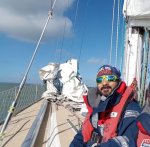
I found this photo:
Alt_Mick_Pattni_11.jpg
It is on the Clipper 2017-18 pages here: http://www.sail-world.com/Australia/Meet-the-Clipper-2017-18-Race-crew---Mick-Pattni/153037

I can't even say if this is a Clipper Yacht but it appears to show a "netted" set of guard rails on a biggish boat.

I think the fact these people were fare paying crew is very important as Clipper Ventures has a duty of care to them whether they are happy to take the risks or not.
That is not correct. You need to consider that the most efficient teams that race around the world, or any other dangerous activity actually take safety very seriously as it is core to efficient operations.
But my point is two fold 1 - the owner / operator of a boat has a duty of care no matter if they are fare paying passengers... they could be employees, paying passengers or scamming a free ride. They have a duty of care. Its generally not good form to injure your own staff, or people going along for free - it doesn't help you win races.
2 - the expected level of risk is very different from a round the world ocean liner cruise, or even a round the world yacht cruise. As a participant, even though they are paying, they completely understand it is a race and races mean pushing things to the limit to try and win. There is an art in trying to find the limit and not exceed it. But these competitors know sometimes they may exceed that limit. I'm not saying that Clipper shouldn't try to minimise those risks. Indeed they should. But I'm saying the fact they are paying to be there is irrelevant. If Clipper decided to have a boat made available to a group of top notch dinghy sailors for free and another to a full crew of professional sailors and pitch all three types of crew against each other I don't think there can be any expectation that the level of risk management should be any different. Perhaps the all paid crew can be expected to know better and not need told... ...but will they have previously practised MOB together as a group in a F9 with a following wind in the dark? If not then I suspect Clipper should still be getting them to practise it. This is why I think the fare paying passenger part is irrelevant...
 
Despite trying to count how many angels will fit on a pin head the situation is as follows, in my opinion:

If yachts set out to race the World's oceans, the hazards of the sea mean that there is a probability that some crew will be injured or will die. That probability will increase if crew are inexperienced. It's really as simple as that.
 
The helmsman may have done 1000's of miles of Clipper experience, but he was not able to keep the boat from gybing.
Teaching people to sail downwind is a difficult thing to do.
The bigger the boat, the harder it is to get the understanding across it seems?
20 minutes in a Laser will tell you very clearly about sailing downhill.
I've seen RYA cruising instructors fail utterly at getting the message across.
People over the age of 14 can be harder to teach too.

Any trained crewperson on a boat should be able to steer through a routine reefing operation?

Steering a very over-canvassed displacement boat down wind in heavy winds close to a run is very difficult to do. It is not something that sailing a laser is going to teach you much about (I have sailed lasers). It also requires substantial physical strength (even on a boat with hydraulic steering such as mine).

The boat is trying to go faster than its water line length will allow. If the boat does not have enough flat sections in the hull shape, it will try to dig an ever bigger hole in the water and will squirm around trying to get out that hole.

The effect is that if you are actually dead on the run, you can gybe with just small effort on the wheel, and just a small amount of turn on the rudder or hitting a small wave will make you gybe or head up the other direction. However, once you start to head up, and effectively start to broach, if takes an enormous effort, and a quick reaction to get back on course. If you are heading for a gybe, only a very quick and significant correction will get you back on course.

In my boat, I have been on a dead run in a F8 (not planned, nor reasonably foreseeable - it was only F5 a few minutes before that) with full sail up.

For the few minutes I was in those conditions (once around Cap Bear, the wind went back down to F5 again), it was very hard work, extremely tiring both physically and mentally.

Physically, so much so, that several times I overcame the pressure limiter valve in the hydraulic steering system. This over pressure valve is there to ensure you do not blow up your hydraulic lines and that valve is rated at 2000 psi.

We hit 9.8 knots speed over ground (measured and the GPS) - against what is probably 1/2 to 3/4 of a knot of current. With a LWL of 44ft 11in!!

If you look at that shape and weight of my boat you will realize that it is not ever going to plane!!

So, if your boat can't plane or surf, you need to reduce sail so that you are not too much above 1.34 * sqrt(LWL).
 
Mmmm..
You should be able to run a guard wire along the deck though surely and net to that. If that wire is taught enough it should be possible to make the gap small enough to stop someone slipping through?

I found this photo:
View attachment 63820
It is on the Clipper 2017-18 pages here: http://www.sail-world.com/Australia/Meet-the-Clipper-2017-18-Race-crew---Mick-Pattni/153037

I can't even say if this is a Clipper Yacht but it appears to show a "netted" set of guard rails on a biggish boat.
.

It may be they have bolted on a continuous toe rail in which case full netting would be possible but having looked again at the Clipper website I am not sure. The photos are confusing. If you look at the photo of the first 'badged' boat in the next race it appears to have the original wooden toe rail with large gaps.
 
*** Give it a try with a fender (bucket attached) as the casualty next time you are out in a F9. I have.
They knew immediately that the poor lady had gone overboard. They should have started the engine and heaved to, without delay,

I really don't think you fully appreciate the conditions they faced.

If the MAIB describe the wind and sea conditions mid ocean as "atrocious" they are not talking about a 41knt gust in the Solent.

You can't just throw a bucket & fender in, it's not like that.

You need to keep the boat moving as much as possible to keep control. When I was doing MOB training on a similar type of boat heaving to was specifically ruled out in heavy weather.

I think the crew by and large did what they could. It's not the sort of thing you can practice in the conditions they had.


_______________________
 
I really don't think you fully appreciate the conditions they faced.

If the MAIB describe the wind and sea conditions mid ocean as "atrocious" they are not talking about a 41knt gust in the Solent.

You can't just throw a bucket & fender in, it's not like that.

You need to keep the boat moving as much as possible to keep control. When I was doing MOB training on a similar type of boat heaving to was specifically ruled out in heavy weather.

I think the crew by and large did what they could. It's not the sort of thing you can practice in the conditions they had.


_______________________

There is a wind strength in any sailing boat where you can no longer tack. The windage of the hull and rig (even reefed down appropriately) is too great compared to the momentum of the boat and the speed it is going.

It looks like they were in such conditions.

What you might be able do to heave to is to winch the head sails across. Note that you have to winch on the windward line as you gradually ease the leeward line. If you simply let go, the sail will be totally uncontrollable and will probably thrash itself and anything it comes into contact with into small pieces.

Similarly there is a wind strength at which any progress against the wind under sail is impossible. This is were a powerful engine comes in very handy - and not and engine which is only powerful enough to push the boat at hull speed in calm conditions.

It seems that the engine on the Clipper Yacht was up to the job.
 
Last edited:
It may be they have bolted on a continuous toe rail in which case full netting would be possible but having looked again at the Clipper website I am not sure. The photos are confusing. If you look at the photo of the first 'badged' boat in the next race it appears to have the original wooden toe rail with large gaps.
If thats the Quindango Photo at the top of this page https://www.clipperroundtheworld.com/news/bts_article/first-clipper-201718-race-yacht-branded its actually a 2015-16 race picture!

The gaps are present in that photo - but I reckon I could string that if need be... unless there needs to be gaps between toe sections for some reason you can connect sections with some low stretch high tension cordage...
 
There is a wind strength in any sailing boat where you can no longer tack. The windage of the hull and rig (even reefed down appropriately) is too great compared to the momentum of the boat and the speed it is going.

It looks like they were in such conditions.

.

The wind itself isn't the problem, it's not going to blow you over. It's the sea state it produces that gives you the problems.

I've had a 45 ton 72' er doing over 18knts under storm sails, trust me momentum isn't the issue either although it may need to be built up.

When we have the No 1 Yankee fully loaded there is approximately two tons of load on the sheet winch.

Good luck easing that...

__________________________
 
Having reread the MAIB report I can see no mention of using the engine to return to Sarah. Why would that be? Are the engines unavailable when racing?
Although the skipper had difficulty tacking, he did manage it on more than two occasions so I still think he could have heaved to.
 
Section 3.1.2 - Pressed MOB button on the plotter, started engine.

Page 39 - with the foresails down and with the mainsheet centred (since they had been on a run and were returning I would take that to mean mainsail directly into the wind - so unless they had magic powers they came back by engine.

The procedure from Clipper says to return under engine. There is no suggestion they didn't but they needed to get the head sails down first.

The engines are available. Use may require reporting to and disqualification from the race, but there was never any suggestion that the race featured in the rescue.
 
It would seem very unfortunate, on the one hand two easily preventable accidents on the other it is a round the world yacht race which must by definition expose a sailor to some peril - where should the balance be drawn. I do think that they need more paid experienced Mates on board to assist the skippers @ £50k per paying crew surely there is enough money in the pot?
Call me cynical but I find it disconcerting that the Directors of Clipper Ventures have for the first time in certainly the last 5 years and possibly longer chosen to give themselves dividends of £2,000,000 and a similar story in the holding Company as well.....
 
That is not correct. You need to consider that the most efficient teams that race around the world, or any other dangerous activity actually take safety very seriously as it is core to efficient operations.

I agree. The most common reported question in Chartered Engineer professional interviews is "Who is responsible for Health and Safety in your organisation?" Candidates whose answer does not start "Everyone ..." are in big trouble.

If yachts set out to race the World's oceans, the hazards of the sea mean that there is a probability that some crew will be injured or will die. That probability will increase if crew are inexperienced. It's really as simple as that.

Well, that's the start. Good safety management then does its best to reduce to as low as reasonably practical (ALARP) both (a) the probability of a serious accident happening and (b) the effects if it does. Good safety management does not say "We might kill a few people. Meh."

From my reading of the report it seems that Clipper Ventures are safety minded, but have previously placed far too much reliance on the single professional on board. Even if that person is up to the job - it may or may not be significant that both fatalities occurred under the same skipper - they cannot always be running things. In the gybing case someone relatively inexperienced was left to manage both boat and crew in atrocious conditions. That probably was not sensible.
 
From my reading of the report it seems that Clipper Ventures are safety minded, but have previously placed far too much reliance on the single professional on board. Even if that person is up to the job - it may or may not be significant that both fatalities occurred under the same skipper - they cannot always be running things. In the gybing case someone relatively inexperienced was left to manage both boat and crew in atrocious conditions. That probably was not sensible.

The same impression as I got.

How safe do you think this is? Check out some of the rolls around 1:39 and 1:52.

 
How safe do you think this is? Check out some of the rolls around 1:39 and 1:52.

It looks a bit unpleasant, but I've never been on one of these things and I don't know how easily and well the risks are mitigated. Of course it's only seven years since a sea cadet was killed on TS Royalist when he fell from the yard - the Sea Cadets tried to blame him for unclipping but the MAIB uncovered sloppy practice and supervision - as there so often is - behind it.

https://assets.publishing.service.gov.uk/media/547c6fb3e5274a4290000045/RoyalistReport.pdf
 
Top