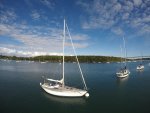
Classic glassfibre yachts

No. That is most definitely not normal. In fact as Commodore of the Owners Association for many years, thats the first time I ever heard of it. Something must have been very badly out of trim. I never had the slightest suggestion of lee helm on mine or any oher Trident I have sailed. Tinker Liz is still going strong, so I will see if I can contact her owner.
I am quite happy to be assured that that is the case. I think, from memory, that JDS's boat had a lifting keel, so maybe it was something to do with the position of the keel involved, or maybe he wrote that the boat sometimes developed lee helm.
 
There's an old saying that any designer can design a good bow but it takes a great one to design a good stern. It is my contention that one necessary qualification for a classic yacht is that it should look as good from astern as from ahead. In this context I will nominate my own HR34 and since the design is about 30yrs old it almost qualifies.'15c (79).jpg
 
Now to be controversial!
Twisters, She's (all), Contessa's, Nicholsons, Marcon Marine boats (Sabre, tomahawk) and many other traditional 'wooden' styled GRP boats had the row away factor. The game changer to me in the late 70's was the Westerly Conway - 36' centre cockpit, walk through to aft cabin and sailed well. Well fitted out and woody down below and a fore runner of modern cruisers? I await the excocets.
 
No. That is most definitely not normal. In fact as Commodore of the Owners Association for many years, thats the first time I ever heard of it. Something must have been very badly out of trim. I never had the slightest suggestion of lee helm on mine or any oher Trident I have sailed. Tinker Liz is still going strong, so I will see if I can contact her owner.

Phew ...... thank you !!

It's good to get confirmation that my memory does still work properly (if only occasionally).
 
There's an old saying that any designer can design a good bow but it takes a great one to design a good stern. It is my contention that one necessary qualification for a classic yacht is that it should look as good from astern as from ahead. In this context I will nominate my own HR34 and since the design is about 30yrs old it almost qualifies.View attachment 124140
HR really got that one right didn’t they ?
“The most beautiful line is a curve” and there are some deftly melded curves there IMO
 
They can be. You have to be sensitive to the sail set up. In common with many boats in the early years of the IOR rule, they had massive headsails, relatively small rudders and much less form stability than modern designs.

The Swan 43 I sail on still has it’s original trim tab fitted to the trailing edge of the keel (most of the class had them glassed in when the rule decided to punish such moveable appendages). We never use it, but I guess the idea was to use it to counteract weather helm and to reduce leeway. I’ve never bought the idea, as sailing along with the trim tab on seems akin to driving along with the brakes on. Olin Stephens must have believed in them as his America’s Cup boats of the era featured them.
The trim tab on the keel was not to alleviate weather helm, but to improve lift of the keel and to counteract leeway by creating what is essentially an asymmetric profile. The tab would have had no more than a 2 degr. deflection and as such would the impact on resistance would have been negligible. The reasoning was that to have an asymmetric keel created a lot less drag than to have the entire hull crabbing sideways through the water to give the keel an angle of incidence.

They were banned because they improved weatherliness and were considered an "unfair" advantage.

The asymmetric dagger boards on the open 60's have a similar effect.
 
There's an old saying that any designer can design a good bow but it takes a great one to design a good stern. It is my contention that one necessary qualification for a classic yacht is that it should look as good from astern as from ahead. In this context I will nominate my own HR34 and since the design is about 30yrs old it almost qualifies.View attachment 124140
This is a challenge I couldn’t resist: Stephen Jones knows how to draw a nice stern and much more. Two Starlight 39‘s in Stonehaven, both on a trip round Britain in 2013

https://www.ossian.be/wp-content/uploads/2013/08/IMG_3218.jpg
 
I reckon a similar question on a car forum could get a pretty good punch-up going. No Astras? What about a Viva? if not, why an Escort?

In cynical mode, I'd say that, while there are definite classics, because they're over a certain age and have that drool factor, as a seller, my old boat is a classic, as a buyer, your old boat is just an aging wreck

I could make a case for my old Snapdragon 24 being a classic, not because of stunning looks, though I quite like them, or sailing performance, but because they packed a full family cruising package into a small, affordable boat that allowed people of relatively modest means to get out on the water. The sailing equivalent of the Austin A30?
 
Going smaller , some of the small grp gaffers I think have given a new if different chapter of interest to trad sail.
Oysterman16 I like , very easy on the eye
 
In cynical mode, I'd say that, while there are definite classics, because they're over a certain age and have that drool factor, as a seller, my old boat is a classic, as a buyer, your old boat is just an aging wreck

This is absolutely correct.

The term “classic plastic” was introduced as a joke!

A classic is any boat designed and built by Fife or Herreshoff.

A few boats by Philip Rhodes, Dixon Kemp, Watson, Linton Hope and Nicholson, but not all of them, may be considered classics.

None of them are plastic, though I think the term “classic plastic” was first introduced in the States (as a joke) to cover the Hinckley Bermuda Forty and the Rhodes 41.
 
This is a challenge I couldn’t resist: Stephen Jones knows how to draw a nice stern and much more. Two Starlight 39‘s in Stonehaven, both on a trip round Britain in 2013

https://www.ossian.be/wp-content/uploads/2013/08/IMG_3218.jpg
I have long admired Starlights but to be honest I haven’t quite got used to the oval cut-outs at the stern. My comment about designing sterns was of course something of a misquote since the original was referring to performance issues rather than looks.
 
Greemble in #34 mentions the Leisure 17, it was perhaps the best of the ‘pocket cruisers’ that came on to the market in the late 60’s and early 70’s, a well mannered little boat which was often the cruising starting point of many of those on this forum.
 
Top