Choosing the right outboard motor amoung these 4.

Look @ the fuel flow .
The supercharger runs all the time ,the extra 50 Hp is more SC pressure throughout the rev range , with of course a an extra squirt of fuel .
That what is happening
That’s a bit disadvantage of SC. They gobble even @ low D speed s .
 
That’s a bit disadvantage of SC
C'mon, that's not a disadvantage, that's just how SC engines are designed.
And remember, we are talking of exactly the SAME engine here.

I tried to answer your somewhat technical objection on prop diameter with some numbers.
But if you prefer, let's go back to first principles, Clarice: simplicity.

In a combustion engine, more fuel/pressure/air means a higher output, AOTBE.
But the 250 and the 300 boat need exactly the same power for any given speed.
I hope you can agree with these assumptions.
If you do, can you explain me where on earth would the higher output get wasted, in the 300 boat?!?
 
C'mon, that's not a disadvantage, that's just how SC engines are designed.
And remember, we are talking of exactly the SAME engine here.

I tried to answer your somewhat technical objection on prop diameter with some numbers.
But if you prefer, let's go back to first principles, Clarice: simplicity.

In a combustion engine, more fuel/pressure/air means a higher output, AOTBE.
But the 250 and the 300 boat need exactly the same power for any given speed.
I hope you can agree with these assumptions.
If you do, can you explain me where on earth would the higher output get wasted, in the 300 boat?!?

It’s on a different propeller exponent curve , ( different engines not the same engine going different speeds in the same boat ) with as you have all ready deduced ^^^ also seems to have a bit more prop slip ,
Have two different engines ( well Hp / rpm / torque graphs ) ,with different props
Bigger Hp vs gobbles more fuel at more / less same real world cruising speeds .
Data is correct .
I don,t find it surprising as said they have propped the 300 for a bit more top end grunt - speed in that particular application .Otherwise try flogging an extra £2200 for nil speed gain @ a boat show :)
 
im not bothered enough to look but I'll bet anyone a beer that if you look at boats.net you'll see that the 250&300 cams have same part number. I doubt a manufacturer would bother with the production logistics of differing cams for a mere 20% bhp difference when software will do the job

I've had a look again, and it looks to me as if Merc came up with a new inlet camshaft when designing the 300, then used that same cam on all the lower powered variants produced afterwards using the same block for commonality. It’s only different if comparing an older 250 to a 300, which isn't the case here.

Older Inlet cam, 892112T02: http://www.mercruiserparts.com/bam/subassembly/32610/11207/140
Newer Inlet cam, 892112T05 introduced when the 300 came along: http://www.mercruiserparts.com/bam/subassembly/32718/13604/140

So yes, you're correct - engines of the same generation have the same hardware - the variables are the boost pressure control and the fuel map, all software.
Verados don't have any kind of Variable Valve mechanism, no idea why this keeps getting mentioned.

.
 
Last edited:
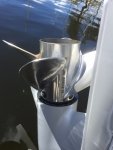
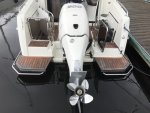
We are running a Mercury Vensura 19” 4 blade propeller & at WOT we are hitting 6000 revs 42kn. I would have liked to get the WOT up to 6200 so I ordered a Michigan Wheel 14-38”x18” Apollo 4 blade & it was terrible lost 6kn top end & fuel burn was well up. If we had the Verado 250hp fitted I am sure we would need to change down to a 17” prop. Parker 7500 CC fitted with the 200hp have the 17” Vensura fitted. Speedo stopped working but will be looked at when serviced in the spring.
Parker 750 CC is 1860kg & engine is 288kg you now have the option for steps in the hull to improve fuel burn & performance.
 

Attachments

  • PROP 1.JPG
    PROP 1.JPG
    74.4 KB · Views: 0
  • PROP 2.JPG
    PROP 2.JPG
    88.7 KB · Views: 0
  • Prop 3.JPG
    Prop 3.JPG
    85.1 KB · Views: 0
Data is correct
Blimey Porto, what else should I do to explain that 2+2=4?
Do you understand that if the above charts/numbers would be correct, an incontrovertible implication is that by simply sticking the 250 prop on the 300, the latter would magically burn less fuel, have a better acceleration, and reach an even higher speed?!?
It's crystal clear that there's some inconsistency in either the 250 or the 300 numbers (or both).

That aside, if your post was meant to address my question about where the higher output/fuel burn of the 300 at 25kts should disappear without being translated in higher speed, sorry, but after reading what you wrote a dozen of times I still can't understand.
 
I've had a look again, and it looks to me as if Merc came up with a new inlet camshaft when designing the 300, then used that same cam on all the lower powered variants produced afterwards using the same block for commonality.
Interesting background.
In other words, the 250 is just a detuned 300 - which makes it even harder to understand how the latter could burn more fuel when producing the same power.

Leaving aside the very obvious commercial reasons for producing and selling detuned engines, I've yet to hear of any engine which is more fuel efficient in its detuned version.
More durable and reliable, maybe (less stressed, etc.). But more fuel efficient? Naah...
 
Blimey Porto, what else should I do to explain that 2+2=4?


That aside, if your post was meant to address my question about where the higher output/fuel burn of the 300 at 25kts should disappear without being translated in higher speed, sorry, but after reading what you wrote a dozen of times I still can't understand.
Sorry thought I did
“ two different engines ( well Hp /rpm / torque graphs ) “

Your “same Hp “ in your post # 62 bottom para is delivered at different rpm s , the tuned 300 presume shifted to the right so it gobbles more fuel to achieve the same Hp ,it’s higher up the range , pistons are going through more cycles .
Each extra cycle uses a tiny bit more fuel - adds up burns more ,

The SINGLE Cam profile is less efficient throughout the Rev range on the 300 , generally , but best efficient at the higher end ,top end to deliver the extra 50 Hp .

It’s more efficient on the 250; in terms of a more even spread of power delivery .
Remember it’s not VVT..Or tuning it around more suited along with different Sc boost pressure curve and ECU mapping to deliver a more efficient fuel return on the 250 .

Clue is on the graphs ( info available ) is the max rpm ,of the 300 I have already alluded to the rpm diff earlier on .

Otherwise prop differences aside are you assuming the incremental difference s from the 4 outboard s are simply just added on @ the end ,a few rpm more ,
The whole lot is shifted to the right with the 300 ,not just a taller graph to reflect the extra Hp .

You see it in cars too ,wash’s out in the road test everyday use .
More so WITHOUT. VVC , With VVC you can spread the torque ,flatten the curve ,shoving some to the left lower down the rpm .
Making the thing a bit more drivable in real world use .
Without ,like here ( superchargerfittment to both does not help consumption difference is exaggerated the higher up the rpm you go ) As you increase Hp you shove it to the right on the graph ,steepen it’s gradient as well as higher by 50 Hp

This means although the tuned version have the headline and marketing grabbing extra Hp and ultimately speed and acceleration, it’s the detuned version that’s more drivable by the av joe on the road .
You see it a lot in Porsche’s and Ferrari’s .
But VVT as said ,helps to minimise the right hand shift of max Hp on the graph .

Without it and a “one cam fits all “ — ok fits two in this outboard 300/250 case then your knackered power delivery wise , with one .Theres only so much sans VVT the ECU (s) can do .

That’s why they have arsed arround with the props it’s the power delivery differences .

Data is correct on all 4 graphs published .

Why would they want it not to be correct , corrupt what they have recorded ?

People will naturally enguire about fuel burn , speed , n range ?
 
Last edited:
Porto, this is getting surrealistic.
Do you have reasons to believe that FP was wrong when he said that the intake camshaft was specifically designed for the 300 and then adapted to the 250, rather than the other way round?

Regardless, I was tempted to reply something along the lines of...
"yeah, after all, considering VVT, Porsche and Ferrari, those numbers are probably correct" :p
Then again, I'm giving you the benefit of the doubt:
Sorry thought I did
“ two different engines ( well Hp /rpm / torque graphs ) “
Which hp/rpm/torque graphs? Are you looking at something different from what was posted here, maybe?
I can neither see power nor torque in any of the "technicolor" stuff I'm looking at.
 
Top