Choosing the right outboard motor amoung these 4.

Go with the Verado 300 we love our one on the back of a Parker 750 CC deep V hull. At wot 111 ltrs / hour at 42kn at 30kn 50 ltr / hour the 250hp & 300hp are the same engine just a software change.

Hi cstewart37,
Your data about Parker 750 CC is quite amazing. Is this your real-world data or it's from the official data sheet?
I don't know the hull type of the Quicksilver 755 but it looks "similar" to the Parker 750 CC.

Is it the hull that makes the top speed difference?

 
Hi Peter,
Fuel burn are real time we are in our second year boating from Inverkip with 60 hours on the Verado. Our fuel burn will be more than the Quicksilver as the Parker 750 CC has a deep V & it's a great boat in the ruff stuff !!!
All the best Callum
 
JFM - We are not talking about cars we are or I,am was reffering to boats .
In a boat the prop slips .
You have completely miss under stood the difference between the throttling of Petrol and diesel .
Applied diesel thinking to the out board petrol fuelling , Flowerpower and my self have politely tried to amend the error with out resorting to derogatory comments .
Fact is this the 300; will gobble more fuel than the 250 @ 25 knots , a normal not unreasonable cruise speed for the Op,s boat .


Provide evidence to be contrary , ps as oppose fling derogatory terms .

What is your explanation of the lower consumption of the 250: @ 25 knots in Flowerpowers post then ?


Surely the difference is caused by the prop? The 300HP will be propped for best fuel efficiency in the cruise at a higher speed than the 250HP which will mean it's not optimally propped at the 250's best cruise speed. I suspect that if you propped the two identically you'd struggle tell which was which until you got to over 200HP, possibly until over 250HP.

As jfm and flowerpower pretty much said at 25 knots you've got the same engine and the same hull being moved at the same speed requiring the same horsepower assuming the prop is the same. Why would the fuel consumption be different (assuming that both boats are propped to achieve best economy in the cruise rather than acceleration)?
 
Why would the fuel consumption be different (assuming that both boats are propped to achieve best economy in the cruise rather than acceleration?
I suspect that the inlet cam profile is optmised to produce more power at the upper end of the rev range, at the expense of efficiency in the mid-range. But it’s also possible that the graphs are not very accurate and/or that they had different props.
 
Surely the difference is caused by the prop? The 300HP will be propped for best fuel efficiency in the cruise at a higher speed than the 250HP which will mean it's not optimally propped at the 250's best cruise speed. I suspect that if you propped the two identically you'd struggle tell which was which until you got to over 200HP, possibly until over 250HP.

As jfm and flowerpower pretty much said at 25 knots you've got the same engine and the same hull being moved at the same speed requiring the same horsepower assuming the prop is the same. Why would the fuel consumption be different (assuming that both boats are propped to achieve best economy in the cruise rather than acceleration)?
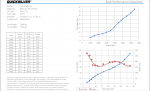
from the graphs, you can see that the 250 and 300 have same prop.
 
Thank you very much for some detail and pictures.

I will check if Parker has a dealer in Taiwan or not. They must make some good boats.

By the way, just curious, the picture that shows your panel is kind of wierd.
The RPM says about 6000 but the speed is 0.

Yes but look at the speed display in the chartplotter display - 42.4 kts sog. Nice.
 
I suspect that the inlet cam profile is optmised to produce more power at the upper end of the rev range, at the expense of efficiency in the mid-range. But it’s also possible that the graphs are not very accurate and/or that they had different props.
im not bothered enough to look but I'll bet anyone a beer that if you look at boats.net you'll see that the 250&300 cams have same part number. I doubt a manufacturer would bother with the production logistics of differing cams for a mere 20% bhp difference when software will do the job
 
im not bothered enough to look but I'll bet anyone a beer that if you look at boats.net you'll see that the 250&300 cams have same part number. I doubt a manufacturer would bother with the production logistics of differing cams for a mere 20% bhp difference when software will do the job

With variable cam., indeed the actual metal bits may well be the same .
But let’s revisit the “ variable “ bit.
The soft ware adjusts the cam actuators , same metal as you infer ,but it’s slide s / moves differently offering a different profile , of the same cam at a different phase of the cycle ,
Thus you can change the overlapping of the valves via a chip with variable cam without changing the part .
You can change the part(s) as well .
For example ( perhaps not in this case - who cares ?)
Different injector s and a more powerful supercharger - bigger air mass flow meter ,?but like you I can,t be bothered digging any deeper .

Sometimes remapping just gains a bit at the top end by extending the max rpm a bit .
That’s unusable ,These days with vario - cams it’s across the useable rev range the x % Hp gain .Hence burn more fuel in everyday use .

I,am thinking high performance petrol engines .
 
Last edited:
im not bothered enough to look but I'll bet anyone a beer that if you look at boats.net you'll see that the 250&300 cams have same part number. I doubt a manufacturer would bother with the production logistics of differing cams for a mere 20% bhp difference when software will do the job

Good idea.
Indeed both the intake and exhaust camshafts have the same p/n (see Ref #18 and 19 respectively):
250
300

Btw, I was curious because, while I'm not so familiar with outboards, I'm sure that Merc did use different camshafts for the HO version of the 496, in spite of the fact that it delivers just a 10% higher output compared to the non-HO.
And the 496 HO was well known for being as fuel efficient as the non-HO, if not better.
In fact, I was impressed by how frugal my Fountain was: by far my best P boat ever in terms of fuel burn (also compared to some a bit smaller!), sipping just 2 litres/Nm or so while cruising at 40+ kts... :cool:

@Portofino: are you sure that the Verado has VVT?
IIRC, that's a popular trick in Japanese outboards, but not actually used by Merc for the Verado.
 
I wasn't sure if it's feasible for me to post the whole data sheet so I did not show the propeller information. However, since there are so many discussions related to the
propeller, here are the complete informations.

250HP.png

300HP.png

Hope these 2 figures come with enough informations for you.
 
300 burns more fuel than the 250 , @ around 25 knots or indeed any real world use age — which what flowerpower and myself have been saying ! All along ,
Doesn’t really matter how it does it who cares ?
Supercharger boost pressure highly likely different here along with the fuel mapping ECU difference .

Point is 300 uses more not the same as the 250 .

Note the prop no,s slight diff too, even that’s not helped get them near to be a negligible difference .

@ MapishM re VVT , bit of digging unearthed Lotus engineers worked on the head and the senior guy @ Mercury for this overall in charge of the project was poached from Porsche ,s engine tech dept .
Lotus mod the Toyota twin VVT cam for there own stuff and VVT runs through Porsche DNA ,from memory the 3.0 L in the 968 being one of the 1st if not the 1st to put that VVT stuff into production - any how who cares ?

Need to see a schematic of the head ,particular the ends of the camshaft to see if there is an actuator .—
There might not be .As said they are magic ing up extra horses by playing with the boost pressure on the supercharger -
And of course squiring more fuel in to match the increase in air .
 
Verado doesn't have VVT. Just another red herring from Porto's shoal. :)

Who cares point is the 300 uses more fuel than the 250
See ^^^^
Just interesting discussion of a possible explanation .
Graphs reveal all .
If I understand your and MapishM thrust is that they will be the same or even the 300 use less ?
That’s wrong
 
If I understand your and MapishM thrust is that they will be the same or even the 300 use less ?
That’s wrong
Can't speak for jfm (though I'd be surprised if he wouldn't agree with the following), but fwiw my own points are that:
1) you can't say the opposite, pretending it's a fact, based only on some obviously unaccurate charts, and
2) in principle there's no reason why at normal cruising speed there should be any difference in fuel burn between the two engines (bar very minor effects of different tuning), because two identical boats identically loaded will always demand the same power at any given speed, regardless of the engine inside them.

Btw, the latest attachments from peterjaw strengthen my previous comment on the chart inconsistencies even further, because according to them the lower power engine, with a one inch shorter prop, should make 25kts with a slightly lower rpm.
Which is an utter nonsense, as I'm sure you'll agree.
 
Can't speak for jfm (though I'd be surprised if he wouldn't agree with the following), but fwiw my own points are that:
1) you can't say the opposite, pretending it's a fact, based only on some obviously unaccurate charts, and
2) in principle there's no reason why at normal cruising speed there should be any difference in fuel burn between the two engines (bar very minor effects of different tuning), because two identical boats identically loaded will always demand the same power at any given speed, regardless of the engine inside them.

Btw, the latest attachments from peterjaw strengthen my previous comment on the chart inconsistencies even further, because according to them the lower power engine, with a one inch shorter prop, should make 25kts with a slightly lower rpm.
Which is an utter nonsense, as I'm sure you'll agree.

250 has a bigger dia prop ,it’s not just a bit lower pitch ,that’s explains it for me .
They have obviously pratted about with dia and pitch ( as any other maker does btw )
Result is the 300 burns more , in this case ! —- :confusion::confusion::abnormal: that’s what the op was queried.
You will also see the 300 can attain a slightly higher rpm ,with its smaller dia and bigger pitch = greater top speed .
Let’s face it from a marketing POV it would look silly slower .
Spend £2200 extra and go slower — that’s not gonna work .

There’s no reason to challenge the data ,it’s there in Technicolor ,:encouragement:inc provisos at the foot .
 
250 has a bigger dia prop ,it’s not just a bit lower pitch ,that’s explains it for me.
...
There’s no reason to challenge the data ,it’s there in Technicolor
The fact that it's all there in technicolor is EXACTLY the reason for challenging those numbers.
Isn't the highlight of marketing BS one of our favorite sports, here in the asylum? :rolleyes:

Let's summarize the assumptions, as reported in the charts posted by peterjaw:
- Two identical boats, same weight, same engine (bar 50hp tuning difference), same gear ratio, same type of prop.
- The only difference is one inch less pitch and 0.3" more diameter on the 250 boat.

Now, let's look at the numbers at 5000rpm.
According to them, the 250 boat achieves 25.9 kts vs. 25.5 of the 300 boat, in spite of the shorter prop.
I previously called this an utter nonsense because, in my simple mind, I thought that you would have agreed without any further analysis.
But now you are saying that the higher 0.3" difference in diameter "explains it for you".
Otoh, you are well aware that the one and only possible reason why a larger diameter alone could make a 1" shorter prop go faster at the same rpm is a reduction in prop slip.

So, I did the math: according to the charts numbers, at 5k rpm the 250 boat should be running at a 17% prop slip, and the 300 boat at 24%. Which leads to the following considerations:
1) the absolute values of these numbers (even the lower one) are high enough to conclude that either they are wrong, or the hull/engine combo is awfully inefficient.
2) a 7% reduction in prop slip due only to a 0.3" larger diameter is so unrealistic to be beyond a joke (remember, other than pitch and dia, it's the same prop type, number of blades, material, etc.).
3) if, against all odds, we should believe that these technicolor numbers as correct, I have the ultimate solution for the OP: get the 300 engine and stick the 250 prop to it.
He'll have higher speed and lower fuel burn, what's not to like? :cool:
 
Top