Choosing the right outboard motor amoung these 4.

I still need to feed those 50 horses even they don't work all the time.

Do I have correct understanding?
Not really.
When comparing two identical hulls with the very same load, they will always use the same power at any given speed, regardless of the difference in the max power available.
If the 300hp engine has a higher output (hence higher fuel burn) at any rpm, then by definition it's capable to spin a longer prop, which means that it will run at a slightly lower rpm to keep the same speed - again, using the same power and burning just about the same fuel.
Actually, with the boat a bit fouled and/or loaded, it's not unreasonable to expect the higher power engine to actually burn a tad less than its detuned version, due to the increased prop slip, but that's hair splitting.
Besides, don't forget that fuel burn is NOT the most relevant component in the total cost of ownership of any pleasure boat, in spite of the attention given to that by most boaters.

All that said, the Quicksilver 755 has a rather sedate and wide hull, designed for practicality rather than performance - which explains the (relatively) low top speed even with her max engine power.
So, you can as well forget my previous comment about the boat possibly being underpowered even with 300hp, go for the 250, and waste the price difference in booze...! :encouragement:
 
I can't find any figures, but with a more aggressive inlet cam and a different fuel map on the 300, I'd expect slightly more fuel to be burnt at the upper end of the rev range for any given engine speed vs the 250. Exactly how this translates to mpg and range will depend on the prop and the boat.
Yes it is capable of burning more fuel, but on an identical boat in identical conditions the 300 will burn the same as the 250 (bar any thermal efficiency differences due to the different cam profile, which will be very small and not necessarily negative). Reason being that the fuel injectors will ultimately inject the same volume of fuel once the helmsman has set the throttle so that the boat is doing the same speed. As Mapism says in #21

For Q755, I must say I'd get the 300
 
I thought petrols and diesels behave differently with regards throttling .
Ones trying to contain an explosive / highly volatile mix - t,others compressing air heating it and trying to squirt a none volatile oil into it with the expectation that with enough temp from compression it burns ?

Both injection pumps are different ,
Does the petrol one work the same , I mean can you overload it ? In the same way as theoretically a diesel ,
I,am aware modern diesels these days via electro twackery can mitigate true overloading .

I think the petrol injection system of the 300 will rpm / rpm squirt more fuel as flowerpower infers than the 250 .
All things being equal , like gearing , prop size etc .<<<< which we know nothing about ,just assuming .

Now we know the boat is not a high performance rib , in a not so “ badarssey “ area , where the consequences of a running out of fuel could be severe , in the sense you are @ near the bottom of the food chain if you enter the water .

I would err on the side of caution / range etc and go for the 250 .
I think it will be more durable , less susceptible to dodgy fuel , and desirable from a gang of thieves .
 
Yes it is capable of burning more fuel, but on an identical boat in identical conditions the 300 will burn the same as the 250 (bar any thermal efficiency differences due to the different cam profile, which will be very small and not necessarily negative). Reason being that the fuel injectors will ultimately inject the same volume of fuel once the helmsman has set the throttle so that the boat is doing the same speed.

The only way to know for sure would be to run some back to back tests, but the cam profile and the fuel map will affect the efficiency of the engine at higher revs.
I agree with the overall conclusion - live a little: have 300 horses on the back of your boat :)

I have added the phrase "Dockside Badassery" to my vocabulary.

.
 
Last edited:
Go with the Verado 300 we love our one on the back of a Parker 750 CC deep V hull. At wot 111 ltrs / hour at 42kn at 30kn 50 ltr / hour the 250hp & 300hp are the same engine just a software change.
 
I think the petrol injection system of the 300 will rpm / rpm squirt more fuel as flowerpower infers than the 250 .
All things being equal , like gearing , prop size etc .<<<< which we know nothing about ,just assuming .
Diesel/Petrol anginas are different in that generally diesels are governed by reference to the helmsmans request for a specified RPM (which request is what the "throttle" stick does) whereas petrols are throttle-controlled (air flow rate governing). That's a big deal in engine and efi design but is a mere detail in relation to this question. Contrary to what you say, if 300 squirts in more fuel than 250 the revs will rise and the boat will go faster (or some excess fuel will be unburnt, which the efi wont allow). But for the same boat speed, which is what you have to assume to make a sensible comparison, the fuel squirt-in will be identical if the engines are identical other than software.
 
Last edited:
No, if it squirts in more fuel the revs will rise and the boat will go faster. But for the same boat speed, which is what you have to assume to make a sensible comparison, the fuel squirt-in must be identical if the engines are identical other than software.

They're not ... inlet cam is different.
Fuel map will be allowing different mixture / spark timing at any given setting ... check out how the fuel octane requirements become increasingly stringent as you go "up" the power output range for the 2.6L block.
Also, props don't come in infinitely small size increments. Chances are, you'll end up either slightly above or below the optimum load curve.

It's fairly obvious that to push the boat at any given speed requires the same amount of power. But for instance, as an extreme example, if I had a Variable Valve Timing system that was manually controllable, and I wound the setting for "exhaust" to open the valves much earlier, it might make a fantastic noise on overrun with 3ft of flames coming out of the back. Not a particularly efficient use of the fuel, though.

http://www.boats.com/reviews/the-outboard-expert-mercury-unveils-two-new-verado-models/#.Weo2iNenH-g
 
Last edited:
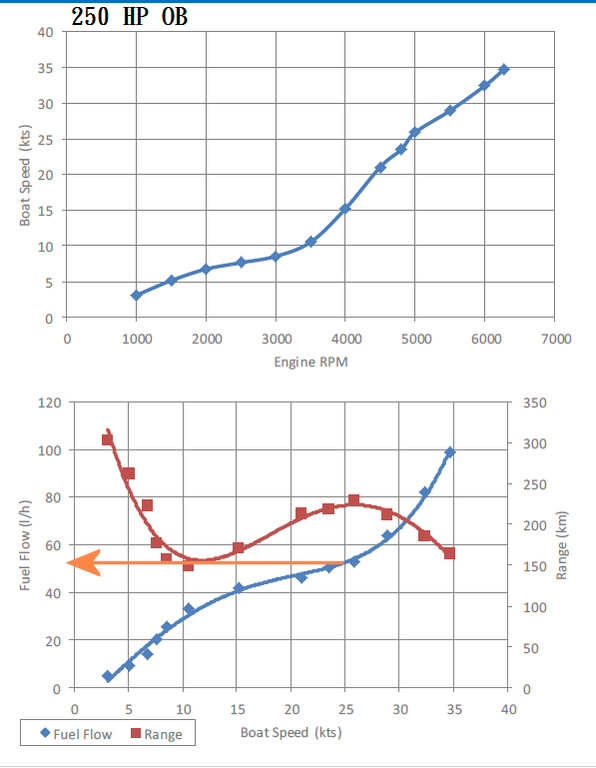
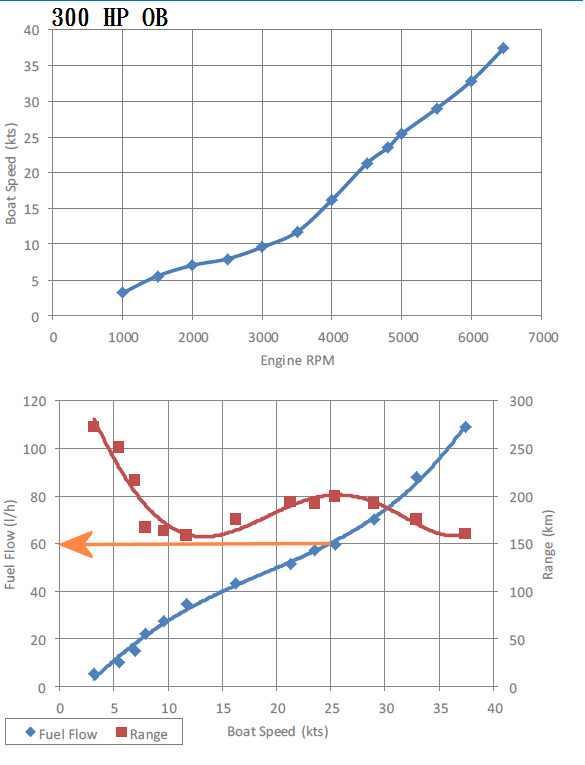
Also check out the actual published test data.
Let's take a reasonable cruising speed ... 25kts?
I'll admit it's not a big difference in the grand scheme of things.

YwMCka.png


jKcVUJ.png
 
Also check out the actual published test data.
Let's take a reasonable cruising speed ... 25kts?
I'll admit it's not a big difference in the grand scheme of things.

YwMCka.png


jKcVUJ.png

Yup me and thee are on the same wave Lenght :encouragement:

Confirms this from my post 24 ^^^

“I think the petrol injection system of the 300 will rpm / rpm squirt more fuel as flowerpower infers than the 250 .
All things being equal , like gearing , prop size etc .<<<< which we know nothing about ,just assuming .”

It’s because petrol and diesels throttle in different ways , often confused on here .

Hope fully this may help understand the graphs above ?

Petrol under load
Suppose a petrol engine is currently running at a constant speed. After some time, it is required to increase the speed of the engine, so one will just open the throttle slightly more .
When more throttle is opened, the engine suction is allowed to suck more quantity of Load (air+fuel), which burns and produces more amounts of energy in the form of heat .
Due to the increase in the volume of exhaust gases in the same clearance, the cylinder pressure i.e. force acting per unit area of piston head will be also be increased.
Force is mass*acceleration; the mass of the piston is constant, it means there is an increase in the acceleration of the piston and hence the speed, and consumption .
So with nodoubt, it can be said that 'The speed of the engine increases due increase in the load (air+fuel) on the engine".*
So does the boat speed .
With a diesel when you open the throttle a bit more you ask the fuel pump only ( no air valve ) to squirt more in .
If the propeller has extracted all it can ,through pitch issues , excess weight , fouling or any combination ,then the engine con not increase its speed .Here you have too much fuel ,unburnt an imbalance of the fuel air mix ,there’s a tendency for a rise in EGT ,s and damage .The air valve if you like on a diesel is fixed - fully open @ all times .How ever modern EDC and CR engines will cut the fuel flow a bit to mitigate the damage .
How ever no rise in boat speed .
 
Last edited:
I suspect the difference in the power is achieved by increasing the supercharger boost, where that happens on the power curve will affect the consumption
 
Also check out the actual published test data.
Let's take a reasonable cruising speed ... 25kts?
I'll admit it's not a big difference in the grand scheme of things.
]
FP we're not really disagreeing. I already said that if there were gas flow differences (due to cam profile) then that could affect thermal efficiency. You say the cams are different; another owner says only the software differs. I don't know which is correct.
But beware just taking the graphical data at face value. At 20kts the difference is close to zero; at 10kts difference goes the other way. Then look at the noise in the data and see the error range. Then consider that the data might come from trials on different boats, or on the same boat a couple of days apart, in which case conditions could easily differ enough to affect fuel flow by a few %. Then consider that if the data is ecu derived the the measurement is of injection period not fuel volume injected, which is a derived value requiring calibration, and so on. Indeed the 250/300 curves are remarkably different shapes. You can easily get a difference of this order
If the cam/gas flow differs then that could explain the difference and we both agree that. If the gas flow cams) is identical you surely have to conclude that the difference is caused by data quality, don't you? No worries anyway.
 
Yup me and thee are on the same wave Lenght :encouragement:

Confirms this from my post 24 ^^^

“I think the petrol injection system of the 300 will rpm / rpm squirt more fuel as flowerpower infers than the 250 .
All things being equal , like gearing , prop size etc .<<<< which we know nothing about ,just assuming .”

It’s because petrol and diesels throttle in different ways , often confused on here .

Hope fully this may help understand the graphs above ?

Petrol under load
Suppose a petrol engine is currently running at a constant speed. After some time, it is required to increase the speed of the engine, so one will just open the throttle slightly more .
When more throttle is opened, the engine suction is allowed to suck more quantity of Load (air+fuel), which burns and produces more amounts of energy in the form of heat .
Due to the increase in the volume of exhaust gases in the same clearance, the cylinder pressure i.e. force acting per unit area of piston head will be also be increased.
Force is mass*acceleration; the mass of the piston is constant, it means there is an increase in the acceleration of the piston and hence the speed, and consumption .
So with nodoubt, it can be said that 'The speed of the engine increases due increase in the load (air+fuel) on the engine".*
So does the boat speed .
With a diesel when you open the throttle a bit more you ask the fuel pump only ( no air valve ) to squirt more in .
If the propeller has extracted all it can ,through pitch issues , excess weight , fouling or any combination ,then the engine con not increase its speed .Here you have too much fuel ,unburnt an imbalance of the fuel air mix ,there’s a tendency for a rise in EGT ,s and damage .The air valve if you like on a diesel is fixed - fully open @ all times .How ever modern EDC and CR engines will cut the fuel flow a bit to mitigate the damage .
How ever no rise in boat speed .
Porto, you've just googled and cut and pasted, without understanding. Just cos something is on the internet doesn't make it right. Virtually every sentence of that tech explanation is Mickey Mouse or wrong. The idea that piston mass is relevant is pure comedy- has it occurred to you that in a car ( which makes the point more clearly) the piston is mechanically linked to the whole 1 tonne of car, so that the mass of the car is way more relevant than the 0.5kg of piston? Ffs. And in an EFI engine the fuel flow rate isn't controlled by engine suck- it's controlled by the ECU. Good going getting EGT into the argument though:encouragement::encouragement:
 
Fook ur takin this to far go for the 300 up and have a ball !!!
Any of you are more than welcome to have a run in or boat at 42kn in Inverkip
 
JFM - We are not talking about cars we are or I,am was reffering to boats .
In a boat the prop slips .
You have completely miss under stood the difference between the throttling of Petrol and diesel .
Applied diesel thinking to the out board petrol fuelling , Flowerpower and my self have politely tried to amend the error with out resorting to derogatory comments .
Fact is this the 300; will gobble more fuel than the 250 @ 25 knots , a normal not unreasonable cruise speed for the Op,s boat .


Provide evidence to be contrary , ps as oppose fling derogatory terms .

What is your explanation of the lower consumption of the 250: @ 25 knots in Flowerpowers post then ?
 
Technicality's aside, the 300 top trumps the 250 on dockside badassery.......Nuff said :cool::encouragement:;)
 
Technicality's aside, the 300 top trumps the 250 on dockside badassery.......Nuff said :cool::encouragement:;)

My thoughts, exactly.
My brother was never keen on an inboard, because nobody could see how powerful your engine was from the outside.
 
In a boat the prop slips .
You have completely miss under stood the difference between the throttling of Petrol and diesel .
Applied diesel thinking to the out board petrol fuelling...
The mention of a car was meant to make it easier to grasp that the mass of the piston is irrelevant, but it didn't work. The fact that you think prop slip somehow supports the notion that piston mass is relevant means we're miles apart on the physics/engineering. I'm not misunderstanding the diff between petrol/diesel fuelling, nor am I just googling junk off the net and pasting it on here, and I've commented on the data above. No worries- let's leave it there! :)
 
Fact is this the 300; will gobble more fuel than the 250 @ 25 knots
Mmm... It's rather a presumption based on some awful graphs than a fact, I reckon.

Just look at the speed/rpm graphs, according to which the 300hp engine should spin at 5000rpm to keep the boat moving at 25kts, while it would take a tad less to the 250hp engine.
Now, this could only make sense if the boat would be (MUCH!) lighter with the 250hp engine, which as I understand is not the case.
Therefore, those graphs are BS, and I see no reason why we should take the other two as Gospel truth.

And in a sense, your request to jfm to provide evidence that at 25 kts the 300hp engine does NOT burn more fuel than its detuned version is a paradox: leaving aside possible but VERY minor differences due to the fact that the two engines are almost identical but not tuned in the same way, there's no reason on earth why their max output should affect the fuel burn when producing a power well below that.
So, from a logical viewpoint, the burden to prove the opposite is yours, I'm afraid.

I'm not commenting on the debate about the petrol vs. diesel differences because I can't for the life of me understand how relevant they are, in this context.

All that said, I'm amazed at how the contributors to this thread are focalizing in a rather radical way on either alternative.
Folks, are you REALLY thinking that one choice is right and the other is wrong? Imho, we are firmly into the hair splitting league...

Not that it's the first time here in the asylum, of course... And it won't be the last! :rolleyes: :D
 
Last edited:
Wow, after one night sleep and I receive so many valuable information.

Appreciate for all your input to my empty brain about the OB.

From all the information above, I think for "badassery" and some "when-needed" situations, I will need to get
the 300HP; otherwise, get the 250HP and go buy some bottles of beer from the price difference.
 
Top