Choice of Sextant?

Normal service will be resumed imminently!
Just checking back over the sights I've taken over the last few months and I find that my sun sight intercepts are a lot closer than for the stars. Jupiter, you can put to one side, since it was only 7.5 degrees altitude, but I was still over 3 Nm's out with Altair - right in the middle of the 30 - 60 degree sweet spot. Sun shot intercepts a couple of hours either side of noon are typically around 1 Nm or less. Is this a horizon problem in the dusk? There was some haze, but it seemed to me that the horizon was reasonably well defined. I am a self taught navigator - so the finer points of sextant use may be new to me!
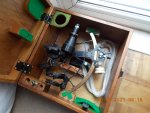
 
Exhibit A:

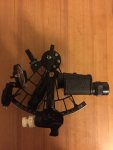
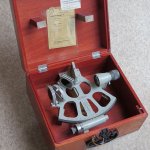
C. Plath no. 40128, aluminium frame, Zeiss 6x30 telescope. A delight to use.

44BA2B3D-6FFA-475F-9998-06D6559FFF2A.jpeg

Exhibit B.

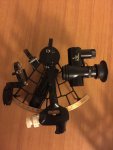
C. Plath no. 58465, bronze frame, with artificial horizon attachment. You get the celestial body and the bubble to coincide. You can vary the size of the bubble to help with this, by rotating the knurled end of the tube above the eye piece.

I havebeen able to establish that my garden is in East Suffolk.?
b240458E4-C5CF-4BF7-9140-1208E710BEA4.jpeg

Both of these sextants are nice but both are let down by the rubbish electric light switch.

The saving in weight of the aluminium one really does help.
 
Last edited:
Kukri when I did my YM Ocean theory at the Little Ship Club in London I managed to position Big Ben about 15 miles East of Greenwich, using an old Kelvin Hughes, I now have a really nice Freiberger Drum which I find a joy to use.
 
As another says - the Light fitting on sextants are crap !! On ships we just left batterys out of the handle to make the unit a bit lighter ...

OK .. onto :

neil_s ......
Normal service will be resumed imminently!
Just checking back over the sights I've taken over the last few months and I find that my sun sight intercepts are a lot closer than for the stars. Jupiter, you can put to one side, since it was only 7.5 degrees altitude, but I was still over 3 Nm's out with Altair - right in the middle of the 30 - 60 degree sweet spot. Sun shot intercepts a couple of hours either side of noon are typically around 1 Nm or less. Is this a horizon problem in the dusk? There was some haze, but it seemed to me that the horizon was reasonably well defined. I am a self taught navigator - so the finer points of sextant use may be new to me!

Each person actually has a personal error - which unless you really check - no-one usually bothers with. But it can be apparent when on ship and as we used to do ... noon would be primarily 2nd Mates job .. with 3rd Mate also taking it .. along with any cadets. I've had 5 people doing morning and noon sights on some ships. You start to find a common slight difference.
Yes Horizon can make a difference ... usually cooler climes give a better horizon line ..
I know for myself I had a personal error that was small enough to ignore - the error was when doing stars ... never found out why ... but as I say it was negligible but I was aware of it.

Accuracy of the Noon of course depends on the speed used to run up the morning sight lines ... the Noon Latitude is most accurate of all ... but based on the intersection of the run up morning sights - the accuracy of Noon falls away.
Stars of course had less error from running up the individual sight lines ... due to the short intervals between.

An interesting exercise I used to enjoy when I was 2nd Mate and on the 12-4 watch ... moonlight stars .... surprisingly accurate in fact ...

Wish my Brother would give the 'Mate' back !!
 
thank you for those comments, Refueler - very helpful. Hmmm - moonlight stars - I'd like a go at that. I also like Kukri's artificial horizon attachment - I did see that they were developed so that U boat navigators could take their star sights when it was fully dark. It always happens to me that the stars you want to shoot only come out when the horizon is no longer visible! Here's my Tamaya ----------

DSCN0635.JPG
 
That Tamaya is a very early one when they were copying western instruments.

Appears you've lost the second monocular .. should be in the 'hole' at top ...

Looks like the Horizon shades have taken a knock .... they should be flat against each other ....

For anyone interested ...............

This is my Father using a Bubble Sextant on one of the B17's used in the movie 'War Lover' ... he navigated one to UK from USA / Canada and then I was a very young child when he took me on it at Gatwick Airport before he navigated it back to Canada. (The book 'Without the Flak' is rubbish and my Father binned it when he read the fiction guy wrote about those three B17's).

SRhSFbq.jpg


Here's the B17 at refueling stop ... (picture is distorted as its a clip from the 8mm film he made on board ) ..

QTKemBx.jpg
 
Just to add to photo's of sextants here's my 'Zeiss' Freiberger. haven't used it in anger for about 5 years now but do take it out to practice with a couple of times a year.
I don't don't do the long distances away from land much now so it lives in it's box, not un-loved but just unused.
I am however loathed to sell it.
IMG_2467.jpg
 
... Each person actually has a personal error - which unless you really check - ...

How would you know and be able to check that? Do you compare against a GPS position? Or are you talking about the declination, again, how would you know? I am trying to understand how small errors can be established from a device that is subject to independent variables. I guess you could measure an angle against a known object height and compare it to the angle measured, but at sea? Curious.
 
How would you know and be able to check that? Do you compare against a GPS position? Or are you talking about the declination, again, how would you know? I am trying to understand how small errors can be established from a device that is subject to independent variables. I guess you could measure an angle against a known object height and compare it to the angle measured, but at sea? Curious.

Its optical .. not the positional.

I know I have a slight error when sighting ... its apparent when a number of you are all taking same sight .. as when taking noon MP as example. Its rare to all have exactly same and in the case of many of my years as a Merch Officer ... sights were daily at sea ... so the repetition of similar error across those people will give indication of personal error.
As I say it was only a tiny amount and significantly less than 1' ... it was in "'s ... so it was ignored for practical reasons. Many in fact didn't bother to even know if they had any personal error. I did - because then and still today - Nav is one of my passions. I much preferred Nav to cargo work ...

I only mentioned it because of the other guys post where he asked about his observations.
 
Top