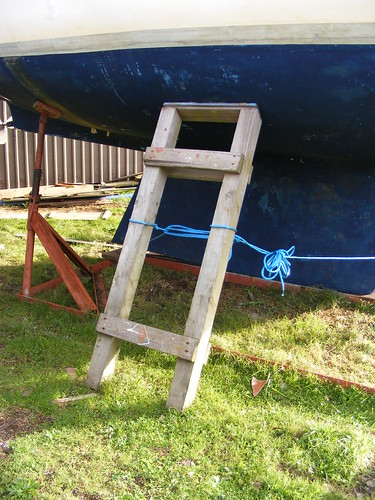
Chocking up a fin keel yacht

IMGP2722.jpg


This is what I use, the extra supports and webbing back up the legs. The supports on their own will hold up to a 6 ton boat.

 
Excellent set up there bendyone.
I have seen cradles fail in high winds esp with the mast up. The keel tends to start to creep to one side as the whole boat rotates in the cradle. At some point, maybe as the boat falls off it's chocks, something gives and it goes over. For this reason I knock in stout steel pegs at ground level (or I did before they were nicked, must get some new ones).
 
Oil drums and cradles

Oil drums are unsafe because a knock can make them collapse under load. Try standing on two empty baked bean tins - OK. Now bend the cans a bit and repeat - they are likely to collapse. Drums would be much safer if filled with water and sealed; but then they would rust - and be impossible to move.
Our boat sits on a 4 point support cradle and in fact is moved about on that cradle - sfely twice a year for the past six years. The boat is 33 ft. long and weighs 6 tons. Most of the weight is carried by the keel onto the spine of the cradle. Obviouslry the boat is stoutly constructed at that weight. You might have to think a bit harder about a modern light weight boat and the strength where the pads meet the hull.
I have seen a smallish bilge keeler "shuffling it's feet" when up on the hard at Torquay in a gale - and also boats toppling at Plymouth after a storm. If your hard is at all exposed then mast removal is the safest option. In any case if you store the mast on the boat then you have a good basis for using a tarp for winter shelter.
 
Again check with insurance. Many companies (certainly a lot that insure the actual yards) have outlawed oil drums. It's starting to go the same way with wooden props, as you can't load test wood, wheras you can with a metal cradle. Do make sure any bolts are a)the right size and b) in tight. But some shapes of hull just don't like sitting in cradles. Definately wedge the keel to stop it moving sideways.

Regarding dropping legs, what we used to do was drop one leg at a time and put a wooden prop in nearby as a temporary replacement. Its a faff but it's safe, and picking a boat up that has fallen over can be a right PITA.

With the wooden props, check they're not rotten. If in doubt, don't use it. When puting the props in, don't be afraid to give them (and wedges etc) a bit of a whack with a mallet. If they fall out with that, they probably need to be tighter. And as many have said, they can and do move so keep an eye on them.

Having said this, if she is lightweight (and I think she might be) wind up the cradle legs etc together as you can easilly move the hull by mistake. And then have to start again.
 
From memory in the Baltic/Sweden they put the boat on two steel beams which are just wider than the boat, then using lorry 5 ton ratchet straps the boat is strapped to the ends. Strap fixed to one side of the boat, over the deck and down to the end of the beam. Repeat for the other side and the other beam. Sometimes fitted around the mast base and down to the beam end. Sounds as though it's very secure and cheap. (as long as no vandals around with a knife to slash the straps.....!)
 
Feeling 326

My yard has chocked my Feelig 326 in a cradle for the past 3 years, with the mast down, but there should be no problem with individual supports as long as they are strapped together. The weight will be aft, but how much depends upon how full your water and fuel tanks are.
I took my rudder out one season to replace the lower bearing. Had a new one made at a local engineering company. I had it made about twice as long as the previous one, which presented a problem when I came to put it back in at the beginning of the season. The Rudder stock was about 50mm out of alignment at the top bearing, because the glassed in tube was not true. After a bit of encouragment it all went back together. Now, the rudder is quite tight to turn, which has good and bad points - the good being that I can leave the helm for minutes at a time and go below, without using an autopilot.
One final point, if your rudder stock is electrically bonded to the rest of the boat, make sure you remove the wire/braid connection first - makes the job a whole lot easier, and less embarrassing :~
 
Insurance

I've checked through my policy docs and can find no specifics concerning what the boat sits on whilst ashore. I'm with Bluefin RYA/RNLI. I've emailed them to check if they need to know when its hauled out.
 
Hmm, having read this thread, I'm starting to feel a little insecure about this slightly minimalist arrangement below! This boat is nearly 10 tons and still has the mast stepped. I hope it lasts until the transporter arrives in 10 days. Eek!

(Still, it's been like that for about 5 months, I believe...)

Steve.
 
I wouldn't worry too much - I have seen a lot worse. Although she could do with some wedges at the top as you can see the top face of the props are not in total contact with the hull. But if she has been sat there for 5 months....

A lot safer than some of the boats you see on trailers on the motorway. Sit a boat on straw bales/tyres and not strapped down anyone?!
 
You need to climb inside the cockpit locker and have a look around the back where the rudder sits. The wire/braid bond will be obvious because the glassed in tube is not the full height from hull to deck.
 
Steve I think you have good reason for concern. We banned that sort of mickey mouse setup years ago in our club after a few interesting events. Why anyone would trust a many-thousand quid boat on a few bobs worth of firewood defeats me. At least boatyards use wedges and usually crossbrace the supports. If anyone used that sort of thing in a factory or building site the H&S Brigade would have a field day.
 
Yeah, I haven't got any experience of chocking boats up, but I do know a fair bit about joinery, and it does seem sort of common sense to stick some stretchers in and give the shores some kind of independent integrity. It's a bit of a balancing act otherwise. Maybe I should give the boatyard a ring and have a word about it. There might just be a hurricane in the next week before the transporter picks her up.

Cheers,

Steve.
 
Devil's Avocado

At least boatyards use wedges and usually crossbrace the supports. If anyone used that sort of thing in a factory or building site the H&S Brigade would have a field day.

So just playing Devil's Avocado for a moment... Why does one need a wedge if the prop is perpendicular to the hull at the point of contact as appears to be the case in some of Steve's props above?

Also, in my search for suitable props, my local timber yard have offered me 4"x4" pressure treated gate posts at a very good price (£3 a pop). But you only ever see round posts in boatyards, is there any reason why they wouldn't use square posts?
 
So just playing Devil's Avocado for a moment... Why does one need a wedge if the prop is perpendicular to the hull at the point of contact as appears to be the case in some of Steve's props above?

Also, in my search for suitable props, my local timber yard have offered me 4"x4" pressure treated gate posts at a very good price (£3 a pop). But you only ever see round posts in boatyards, is there any reason why they wouldn't use square posts?

No reason not to use square. I have seen a lot in action. I doubt your gateposts would be long enough though.
The best props I have seen are without doubt those in my present yard. I have followed this thread but have put off chipping in with this, for fear of having to explain it. Here goes:
Imagine two 6ft props fixed apart with pairs of stretchers (maybe 2ft 6in wide) near the top and bottom. You have now, what looks like, a small, fat ladder. Angle the top of your two props at maybe 10 / 20 degrees and fix across a piece of timber (good ply is ideal) of maybe 5/8" thickness.
You now have an ideal prop. It does not need to be wedged, holds itself in place and as the boat settles or rocks, tends to reset. It cannot fall away sideways. Roughly nailed up its ok, cut joints if you require Swan/Rolls Royce quality.
A mixture of these and conventional props would work well. Also excellent when moving props, cradle arms, as a back up to legs etc. Tie in pairs under the hull for extra peace of mind.
 
and fix across a piece of timber (good ply is ideal) of maybe 5/8" thickness.

Sounds good Doug but you lost me at the "fix across a piece of timber". Would be good to see a photo.
There are a number of different arrangements appearing in our yard now. I'll post some pictures once mine is standing on its keel.
 
This timber (ply- whatever) is nailed/fixed on the end grain of the props. So if the props are 5in this piece would measure 5" * whatever the width of the "ladder" is.
This is part of the beauty of the system, because this piece is relativly thin it is has some give. Thus it tends to wedge securely in position and is also kind to the hull. ( just be careful of those nail heads, if you have used them.
 
Thanks Doug,

Very useful photos, and I'll be sure to block my keel so it can't slip!
I have the crane booked for 4 Dec so once its out the water I'll put some photos up on here.

Cheers,
Eamon
 
Top