Checking potential collision course?

But I don't go around saying that 2 + 2 can often make 5, depending on the situation.

oh ,for goodness sake, no ones saying that, a man of your age should know better than that. Now point me at some decent diagraming softwate and I;ll give you a diagramatic expanation of the theory behind this. Its actually quite complex actually in theory .. in practice its simple. The examples shown so far at the far end of the non working spectrum where in a practical situation you'd see a fast moving boat on a potential collision course and slow down for a couple of minutes to avoid.
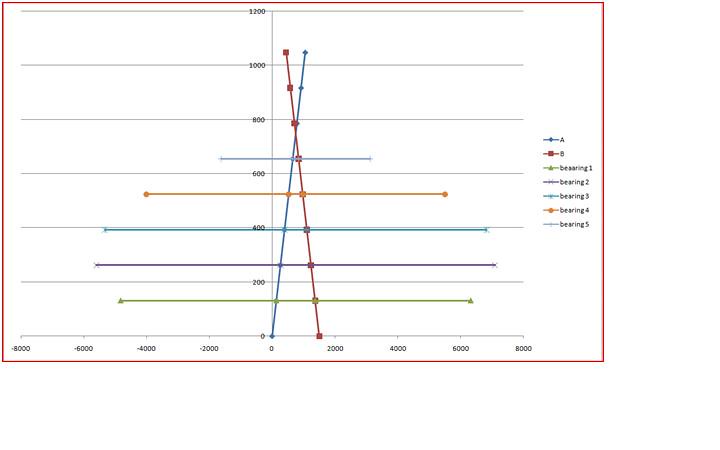
 
I've already drawn you a pretty picture, and it works whether the boats are 2 yards or 2 miles away, and whether they're travelling at 2 knots or 200 knots.

Another way to describe it might be to say that the boats and the shore are in different frames of reference.
 
I've already drawn you a pretty picture, and it works whether the boats are 2 yards or 2 miles away, and whether they're travelling at 2 knots or 200 knots.

Another way to describe it might be to say that the boats and the shore are in different frames of reference.

I'll admit that I've been teaking a few noses here and I'm guessing that we're all losing the will to live on this topic. Could we just all agree that a. No single method is foolproof b. We use the methods that work for us and c. None of us are stupid enough to follow any single method to the point of collision and that we'd take avoiding action first and work out what went wrong with the predictive method post the event.

Chris

Ps who cares, we beat the Welsh last night, bring it on!
 
I'll admit that I've been teaking a few noses here and I'm guessing that we're all losing the will to live on this topic. Could we just all agree that a. No single method is foolproof b. We use the methods that work for us and c. None of us are stupid enough to follow any single method to the point of collision and that we'd take avoiding action first and work out what went wrong with the predictive method post the event.

Chris

Ps who cares, we beat the Welsh last night, bring it on!

Know what you mean as I've got as far as

=((D6*SIN($F$5-90)+(E5-(I6*COS($H$5))))^2-(I6*TAN($H$5)-D6*COS(F5-90))^2)^0.5

on my excel model now ;-)
 
Now point me at some decent diagraming softwate and I;ll give you a diagramatic expanation of the theory behind this. Its actually quite complex actually in theory .. in practice its simple.
Try Paint if you are using a Windows PC (it's part of the Windows package) or Paintbrush if you're on a Mac (part of the Mac OS). Or download Inkscape which works on either.

It's quite simple in theory. The crux of your problem is that for some reason you have set out to prove something that isn't true!

Know what you mean as I've got as far as

=((D6*SIN($F$5-90)+(E5-(I6*COS($H$5))))^2-(I6*TAN($H$5)-D6*COS(F5-90))^2)^0.5

on my excel model now ;-)
Talk about making a simple thing complicated!
(1) The classic test for risk of collision is if the compass bearing of the other vessel is constant.
(2) The bearing of a fixed object can only be constant if your track (CoG) is directly towards it or directly away from it, or if you are stationary. In any other situation, the bearing of a fixed object must be changing.
(3) Something that is on a constant bearing (eg a vessel with which you have a risk of collision) cannot stay "lined up with" something that is on a changing bearing.
 
Last edited:
Let's all stop now!

and of course with compass bearing, it's worth reiterating:

such risk [of collision] may sometimes exist even when an appreciable bearing change is evident, particularly when approaching a very large vessel or a tow or when approaching a vessel at close range​
 
It's quite simple in theory. The crux of your problem is that for some reason you have set out to prove something that isn't true!


Talk about making a simple thing complicated!
(1) The classic test for risk of collision is if the compass bearing of the other vessel is constant.
(2) The bearing of a fixed object can only be constant if your track (CoG) is directly towards it or directly away from it, or if you are stationary. In any other situation, the bearing of a fixed object must be changing.
(3) Something that is on a constant bearing (eg a vessel with which you have a risk of collision) cannot stay "lined up with" something that is on a changing bearing.

You've made your point quite a few times ... saying the same thing over and over and iover again does'nt reinforce an argument, it just sounds childish.

Now let me get on with my spreadsheet of time and motion vector analysis, I'm actually learning a lot both technically and with regard to relative bearing changes. I might even share the results of my analysis with you at some point.
 
OK spreadsheet constructed , some very interesting results. If you want a copy of the spreadsheet to tear to bits then PM me with your email address. I'm going out in 10 minutes for a couple of hours and will try and publish some screenshots then of the XY graph and bearings and perceived ground move when I get back.
 
You've made your point quite a few times ...

See posts:-
45; 53; 58; 62; 70;
74; 87; 88; 90; 96;
100; 102; 104; 107; 112;
118; 124; 127; 135; 137;
147; 156; 158; 159; 161;
164; 169.

... saying the same thing over and over and iover again does'nt reinforce an argument, it just sounds childish.
 
Tim ,dear, all your argument is based on one single scenario with inadequate analysis. I gave you the chance to climb out your hole and even told you how to do it, you failed to pay any intention and resorted to a few snide remarks.. screen shots are on the way
 
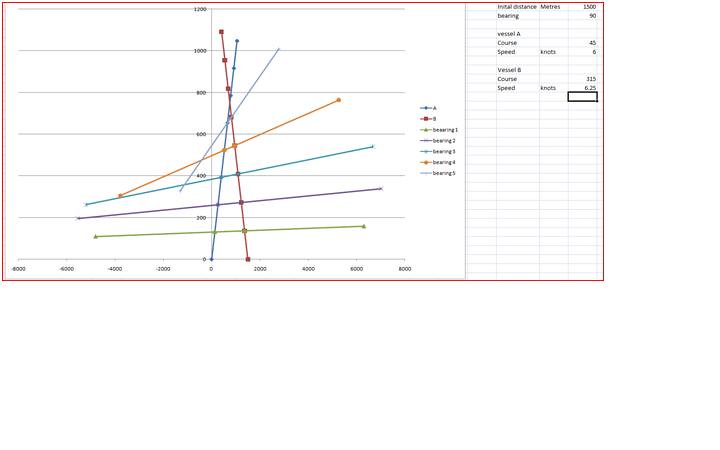
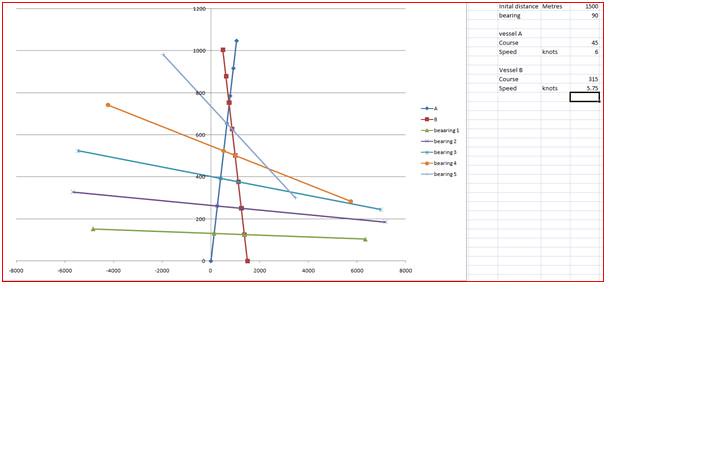
Firstly couple of points scale of x is not the same as y so the 45 and 315 courses look a bit sharper i'll fiddle with that later

here is collision course with equal speeds initial distance 1500 meters

5418532922_7fa0994d7d_b.jpg


NOW 2 with 0.25 KOTS Difference

5417928649_fa354cfeb6_b.jpg


5418532960_f9fa3c774e_b.jpg


Draw your own conclusions

BTW I can model any course or speed combination!
 
Tim ,dear, all your argument is based on one single scenario with inadequate analysis. I gave you the chance to climb out your hole and even told you how to do it, you failed to pay any intention and resorted to a few snide remarks.. screen shots are on the way
As you say, I have explained why a vessel that is on a collision course must appear to move against the background several times. I am not prepared to repeat myself. The explanation I have offered applies at any speed and at any crossing angle, and is so simple that it does not need complex analysis.

I see that the diagrams you have produced so far appear to show that in a collision situation, the bearing is steady, and in a non-collision situation it changes. This is hardly earth-shattering news. Nor is it likely to come as a surprise to many people to learn that in a near miss situation, the bearing changes more quickly as the range decreases.

What is conspicuously lacking from your diagram is the landmark that -- according to your theory -- is somehow supposed to be on bearing 1, then on bearing 2, then on bearing 3, then on bearing 4, then on bearing 5. despite being fixed!

Here (my image attached) is your example (but with undistorted scales and the addition of a fixed mark.): it shows two vessels, one making a ground track of 045, the other making a ground track of 315, both at speed 6 knots. They are heading for a collision at T=0.

At T=-18minutes they are about 2.5 miles apart. The bearing of the other vessel is 090. The bearing of the buoy is less than 090 (how much less depends on the range of the buoy)

At T=-12minutes they are about 1.7 miles apart. The bearing of the other vessel is still 090. The bearing of the buoy is 090

At T=-6minutes they are about 0.8 miles apart. The bearing of the other vessel is still 090. The bearing of the buoy is greater than 090 (how much more depends on the range of the buoy).

The only way the bearing of the buoy can remain constant in this scenario is if it is at infinite range. At any lesser range, the other vessel will appear to be "overtaking" the buoy.
 
Last edited:
"They have eyes to see but do not see and ears to hear but do not hear"

The reason for the multiple extended bearing lines in my diagrams are so that one can judge the effect on the background at various distances so actually your comment is wrong, the effect on the land is there.

My modelling of lots of scenarios shows the method , not to be infallible in all situations(but no one said it is), but an extremely useful tool. As others have said the further away the vessel, the further away the land needs to be. The closer the vessel the less relevant the distance of the background land is. The diagrams also indicate the very small bearing changes at distance which will be difficult to pick up in a small boat using a hand bearing compass.

I offered to make the spreadsheet available to you, so you could examine in detail, but you never took up that offer.


As I said earlier draw your own conclusions as to whether there is a theoretical justification for what many experienced sailors do in practice. I think there is based on the scenarios I've tested.

Spreadsheet attached.
 
Jimi - the file format is xlsc. What program created that - my excel wont open it and neither will lotus 123.

FWIW ( and I'm a YM instructor not that that proves omniscience :D ) I use a handbearing compass for moving boats but when racing I am happy to use the land transit method for clearing marks and thats in the tides of the Bristol channel. And thats the approach I teach.
 
Last edited:
Jimi - the file format is xlsc. What program created that - my excel wont open it and neither will lotus 123.

FWIW ( and I'm a YM instructor not that that proves omniscience :D ) I use a handbearing compass for moving boats but when racing I am happy to use the land transit method for clearing marks and thats in the tides of the Bristol channel. And thats the approach I teach.

Its XLSX Bosun_Higgs. It opens in Excel 2007 both the PC Version and the 2008 Mac version.
 
At T=-18minutes they are about 2.5 miles apart. The bearing of the other vessel is 090. The bearing of the buoy is less than 090 (how much less depends on the range of the buoy)
r
Any example that starts at T -18 minutes and 2.5 miles apart is rather missing the point.

I can't think that any small boat owner becomes concerned about collision with a vessel of similar size 2.5 miles apart. On a busy day in the Solent that could mean trying to track hundreds of vessels which is just not feasible.

The transit approach works well over shorter distances and times, say within a couple of hundred metres and a couple of minutes or less from CPA. At quick check of only a few seconds should give you a good idea whether you are going to cross ahead or behind.

In fact given the problems taking accurate hand bearings from a small boat I should think it is more accurate.

Or to put it another way - for what proportion of encounters with small boats do you actually bother with the hand bearing compass?
 
Any example that starts at T -18 minutes and 2.5 miles apart is rather missing the point.
OK. Here's another diagram, starting at T-18 seconds and 77m apart. Or is it T-1.8 minutes and .25 miles apart? The scale is (almost) irrelevant.
I can't think that any small boat owner becomes concerned about collision with a vessel of similar size 2.5 miles apart.
The OP wasn't about dinghies on gravel pits, or even about a summer weekend in the Solent (much the same thing, really!;) . It was about "vessels" -- no size limit, no location.
The transit approach works well over shorter distances and times, say within a couple of hundred metres and a couple of minutes or less from CPA. At quick check of only a few seconds should give you a good idea whether you are going to cross ahead or behind.
Indeed it does.
... where distances are very short, and the decision to duck, tack, or stand on is being made over a matter of seconds and at a range of a few yards. Under those conditions, it's fine, because the bearing of a landmark (even one that is only a mile or so away) cannot change very much at sailboat speeds over a few seconds.
Over such very short times (generally) low speeds and short distances, the chances are that the "landmark" is going to be so far away that its bearing changes very little.

As I have said before (see above) I have no difficulty accepting the landmark idea as a simple rule of thumb under those circumstances. But trying to produce some kind of mathematical "evidence" to dupe people into believing that it holds true in the big wide world outside the Solent is dangerous and irresponsible.
 
Last edited:
OK. Here's another diagram, starting at T-18 seconds and 77m apart. Or is it T-1.8 minutes and .25 miles apart? The scale is (almost) irrelevant..
The scale is relevant - because the validity of the method is all about the relationship between the distance to the "landmark" and the time over which it is being monitored.

For the method to work the distance has to be sufficiently large that the bearing can be considered to be be "constant" over the time being measured
 
Top