Chartplotter at the binnacle

Bottlewasher

New Member
Joined
11 Nov 2025
Messages
3
Visit site
Hi all,
This may have been discussed before but it is my first post. In process of upgrading my trusty pioneer 10 to a boat with a wheel, binnacle and compass at the binnacle.

I am looking to mount a chart plotter at the binnacle but I have two concerns, firstly the proximity to the magnetic compass, only 3-5cm, and secondly the depth of some Chartplotters to fit in a suitable panel.

Does anyone have any recommendations for chartplotters, 7-9”, that can be mounted onto a panel at the binnacle?
Thank-you
 
Welcome to the forum.

There is no easy answer to your question. All 3 of the major manufacturers offer 9" chart plotters that essentially do the same thing, but have their own individual pros and cons in terms of operating systems and chart choices. Before you decide on the basic type though you need to consider what you want it for and whether you are going to integrate it with other electronics such a echo sounder, wind instruments, logs, autopilot AIS radar etc plus whether you want to also have a display down below. This pbo.co.uk/gear/the-garmin-chartplotter-7-other-options-97141 is a recent review of the basic entry level mainly stand alone plotters which will help you get started on the "jargon". Your budget will of course affect your choices.

There really is no substitute for looking at the specs and understanding what each product offers. You don't say where you are located but most of the big chandlers have good displays of the main brands and usually fairly knowledgeable people who can talk you through the products and show you how they work. You also need to consider where you sail, type of sailing and how you navigate.
 
Most plotters today are quite slim compared to before ... and reality - access to rear connections for dismounting is advised. So depth is then not so much of a factor.

Regarding proximity to compass .. that's a common problem - but you are saying 3 - 5cm ... that is very close ...

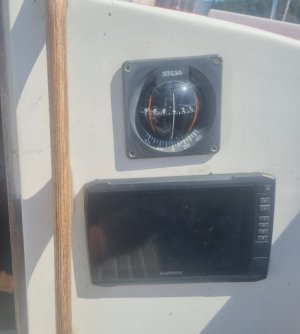
This is a bulkhead mounted plotter with compass next to it ... separation about 10cm :

Conq plotter - compass.jpg

I have another bulkhead compass on the other side of companionway ... and the two read about 10 deg different !

I suggest that difference is due to the plotter ... BUT ... it is not a constant difference ... that is the average ... as the boats head changes - the amount will vary ... but as most boat compasses are 5 deg marked ... its roughly +/- 5deg change.

Will I correct it ? No. Despite my ability as an ex professional Ships Navigator to do such ... I basically compare the compass (both) to the track made on the plotter ... if the plotter goes down for any reason ... I have the compasses to steer by and maintain the desired heading.

I could do Deviation Cards for both ... but that plotter on and off makes that stbd compass change its errors.... not by much - but it does. I may do Cards later - just out of interest !

My setup and your binnacle setup are common and we all find ways to live with it ..
 
A suggestion, to be dismissed at will, is to mount the plotter at the forward end of the cockpit. Then use a tablet, mounted on a Railblaza type mount, at the helm when necessary. Rarely do we helm our boat, we leave that to the A/P in good/fair conditions. Having the plotter visible to those operating forward of the binnacle is very advantageous.
 
Last edited:
Thanks for all the feedback, food for thought. I live in Argyll and although there are chandlers at the marinas the choice on view is never as good as at the bigger chandlers.

Living with the deviation at the helm and having a second steering compass on the bulkhead looks like my best solution.

Thanks again
 
Thanks for all the feedback, food for thought. I live in Argyll and although there are chandlers at the marinas the choice on view is never as good as at the bigger chandlers.

Living with the deviation at the helm and having a second steering compass on the bulkhead looks like my best solution.

Thanks again
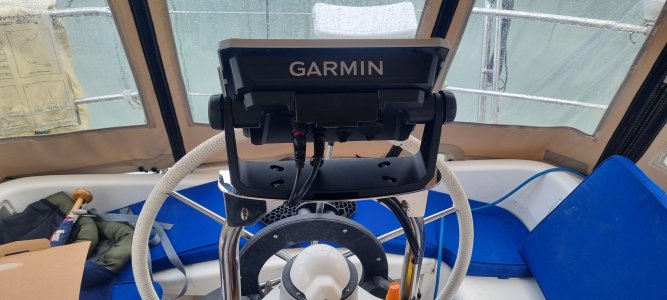
Plotter at the helm are often fitted into pods but i fitted this one for a customer. Local stainless company made the bracket up. The plotter is a 9" Garmin Echomap, it can be removed from the back of it's bracket in seconds.


20240612_163808.jpg

20240612_163834.jpg
 
Plotter at the helm are often fitted into pods but i fitted this one for a customer. Local stainless company made the bracket up. The plotter is a 9" Garmin Echomap, it can be removed from the back of it's bracket in seconds.
I have an old Standard Horizon chart plotter fitted in a similar fashion, which I remove when we get back alongside. With the element and other newer chart plotters how waterproof are the cable connections/back of unit. I keep thinking of an upgrade, which I never quite get round to.
 
Thanks for all the feedback, food for thought. I live in Argyll and although there are chandlers at the marinas the choice on view is never as good as at the bigger chandlers.

Living with the deviation at the helm and having a second steering compass on the bulkhead looks like my best solution.

Thanks again

Bear with me, the compass may not be as essential as you think.

Do you have an autopilot? If you do then they are much better at steering a course than a human, in fact, because they can follow a track set by the chart-plotter, they don't get pushed off that track by tides or leeway, which is what happens if hand steering a purely magnetic course. If the compass course calculations have taken tidal flow and leeway into account then the course to steer will deliver the boat to the destination, but over the ground, the boat will not travel in a straight line, so hazards to port and starboard of the steered course can be a problem. Following a track set by a plotter eliminates this issue, the destination waypoint is chosen on the chart, and the combination of plotter and autopilot compensate in real time for tide and leeway, ensuring the boat really does follow a straight line to the destination.

Confession: I haven't steered a compass course in years, the last time I did it was probably my parents Albin Vega on a night sail to Coll as a teenager - but they didn't have GPS back then.

Connecting the plotter to the autopilot is one of the most useful features you can have on a modern boat. Pick a waypoint and let the autopilot follow a track to that waypoint, it won't be affected by tides, leeway, or anything really. They are easy to interface with each other and the plotter will send cross track error and bearing info to the autopilot which will just do it's job.

The compasses on my boat are a backup, interesting to compare with what the electronics think is magnetic north, but if the electronics fail, then they get switched off and then can't interfere with the compass. The electronics don't have any permanent magnets in them, or large lumps of ferrous metal, so interference is as good as non existent when they are switched off, which is the only time I would be steering a compass course by hand, with a real compass.

IMO Don't bother with a backup compass on the bulkhead, but do network the Plotter with the Autopilot.
 
Last edited:
I have an old Standard Horizon chart plotter fitted in a similar fashion, which I remove when we get back alongside. With the element and other newer chart plotters how waterproof are the cable connections/back of unit. I keep thinking of an upgrade, which I never quite get round to.
They don't seem to give any problems, the one in the pics above has been fitted for almost a year. I've fitted others that have been there for 2 or 3 years,
 
Bear with me, the compass may not be as essential as you think.

Do you have an autopilot? If you do then they are much better at steering a course than a human, in fact, because they can follow a track set by the chart-plotter, they don't get pushed off that track by tides or leeway, which is what happens if hand steering a purely magnetic course. If the compass course calculations have taken tidal flow and leeway into account then the course to steer will deliver the boat to the destination, but over the ground, the boat will not travel in a straight line, so hazards to port and starboard of the steered course can be a problem. Following a track set by a plotter eliminates this issue, the destination waypoint is chosen on the chart, and the combination of plotter and autopilot compensate in real time for tide and leeway, ensuring the boat really does follow a straight line to the destination.

Confession: I haven't steered a compass course in years, the last time I did it was probably my parents Albin Vega on a night sail to Coll as a teenager - but they didn't have GPS back then.

Connecting the plotter to the autopilot is one of the most useful features you can have on a modern boat. Pick a waypoint and let the autopilot follow a track to that waypoint, it won't be affected by tides, leeway, or anything really. They are easy to interface with each other and the plotter will send cross track error and bearing info to the autopilot which will just do it's job.

The compasses on my boat are a backup, interesting to compare with what the electronics think is magnetic north, but if the electronics fail, then they get switched off and then can't interfere with the compass. The electronics don't have any permanent magnets in them, or large lumps of ferrous metal, so interference is as good as non existent when they are switched off, which is the only time I would be steering a compass course by hand, with a real compass.

IMO Don't bother with a backup compass on the bulkhead, but do network the Plotter with the Autopilot.

Why bother with a compass ? Why not just reference the sun or stars position in the sky for orientation ?

Your post is fine for promoting autotrack from a plotter ... but its fine until power on board fails ....

I have actually had a situation where battery bank died .... meaning running engine to top it up every 2hrs or so ... on an 18hr rough passage ... the tiller-pilot was first victim of the banks problem .. so hand steering except while engine charged up battery bank .....
A combo of plotter display and compass was order of the day ... (this was on the same boat as the two compasses already mentioned).
I could not run engine continuous as the fuel level was not sufficient having not been able to top up tank in departure harbour. we had ample fuel if engine was not required for passage ....

As they say : Sh** happens.
 
Why bother with a compass ? Why not just reference the sun or stars position in the sky for orientation ?
But he didn't say not to bother with a compass, he said:

"The compasses on my boat are a backup, interesting to compare with what the electronics think is magnetic north, but if the electronics fail, then they get switched off and then can't interfere with the compass."
Your post is fine for promoting autotrack from a plotter ... but its fine until power on board fails ....

I have actually had a situation where battery bank died .... meaning running engine to top it up every 2hrs or so ... on an 18hr rough passage ... the tiller-pilot was first victim of the banks problem .. so hand steering except while engine charged up battery bank .....
A combo of plotter display and compass was order of the day ... (this was on the same boat as the two compasses already mentioned).
I could not run engine continuous as the fuel level was not sufficient having not been able to top up tank in departure harbour. we had ample fuel if engine was not required for passage ....

As they say : Sh** happens.
 
But he didn't say not to bother with a compass, he said:

"The compasses on my boat are a backup, interesting to compare with what the electronics think is magnetic north, but if the electronics fail, then they get switched off and then can't interfere with the compass."

That comment about Sun / Stars was actually in jest ... taking his point step further !
 
A suggestion, to be dismissed at will, is to mount the binnacle at the forward end of the cockpit. Then use a tablet, mounted on a Railblaza type mount, at the helm when necessary. Rarely do we helm our boat, we leave that to the A/P in good/fair conditions. Having the plotter visible to those operating forward of the binnacle is very advantageous.
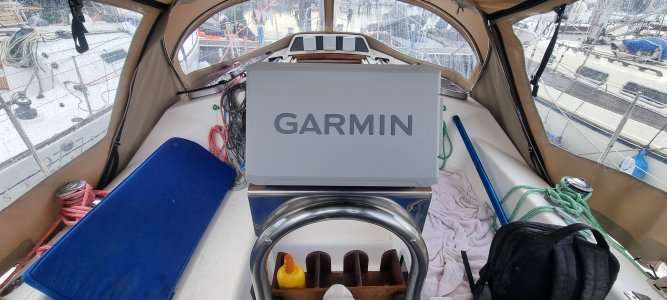
This is the set up on my boat. A 15 inch Raymarine at the front of the cockpit under the hard spray hood and a rugged Android tablet at the helm. Has the advantage that everyone in the cockpit can see the chart and AIS at all times including when using autopilot plus the tablet is close by the helm and more detailed when manoeuvring. There is also built in redundancy of two completely stand alone systems( except a common ais feed).
 
Fwiw, I wish my plotter was mounted under the spray hood rather than at the helm. On passage I rarely am actually at the helm as more exposed and auto pilot steers effectively.
My previous boat was a sail boat. I fitted the plotter at the helm, in a pod. But, paired it with WIFI to a tablet that sat under the sprayhood, best of both Worlds.
 
Top