
Charging 3 Batteries, Combine 2, Wiring Diagram, Alternators?

CaptainBob

Well-Known Member
Joined
7 Nov 2007
Messages
1,477
Location
North Yorkshire
www.yacht-forum.co.uk
My boat's charging circuit is as follows. The big "Shaft" on the left is the prop shaft driving an alternator which is used, via split diode and some switches, to charge a standalone "nav/comms" battery and/or the house battery when sailing and the prop is spinning.

Owner previous to me also added a VSR as you can see in the black additional wiring, which connects the house to the nav battery if house battery is over 13.6V and hence means the mains batts charger also charges the nav/com batt when house and eng bat are high enough.
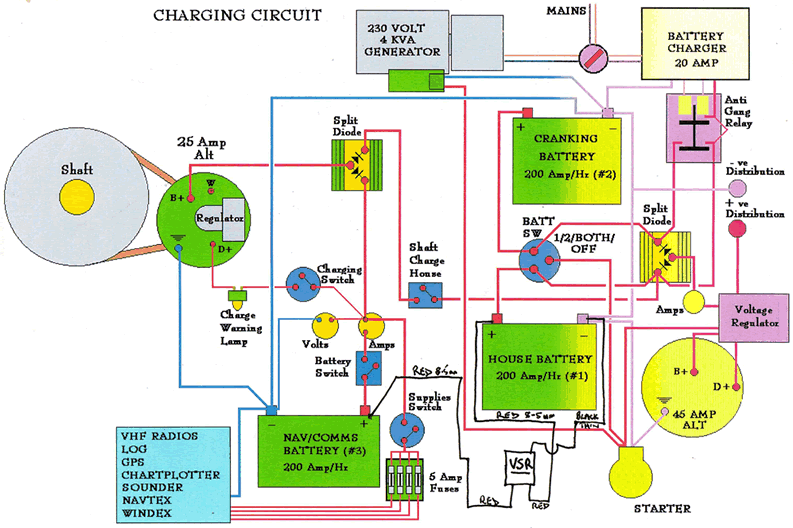
charging.gif


What I'm considering doing is combining the house and nav/comms battery into one single bank. I'm going to be working on the boat on a laptop on a daily basis and I fancy having access to 400Ah of house battery rather than just 200Ah without having to add another battery.

I figure it will work if I modify the circuit to the following (remove split diode and vsr and shaft charge house sw and "supplies sw":

charging2.gif


But to do this I'll have removed the diode between the shaft alternator and the batteries it's charging which will increase the voltage available from it but will allow a back-current to the alternator. Unsure if that's an issue or not.

Thoughts on my plan, and on the removal of that diode, much appreciated.
 
Lovely diagrams but some possible simplification suggestions:

(1) Where are the ins and outs - what generates and what consumes?

(2) 1-2-both-off, charging switches and split diodes - could they be replaced by VSRs?

i.e put all the inputs (inc genet) together then charge batts on appropriate (start/nav/house) priority.

(3) All three batteries are 200aH - does that really match the modelled consumption? - could you parallel them altogether for one almighty house bank and then add smaller (AGM?) start & nav/comms batteries?
 
Thank you :) The first one came with the boat so I can't claim responsibility. Thanks for your post also. Some things I hadn't thought of.

In answer to your questions:

1. Ins and outs, gens and consumers...

25 Amp Alternator is used as a generator, driven by the propshaft.

45 Amp Alternator is a generator, driven by the engine. Needs to be isolated (I think) so it can't simultaneously be trying to generate power when the shaft alternator is also doing so.

"Starter" is the main engine starter motor.

I think the rest is self-explanatory?

2. VSRs. Maybe but I like to have options and I like the simplicity of good old switches. Don't VSRs also draw some current all the time? And could potentially break - more likely than a good old switch?

3. Probably not. It's a massive 6.2 litre engine though so it must take some turning over when it's cold! Not sure I have room for another also.
 
Thank you :) The first one came with the boat so I can't claim responsibility. Thanks for your post also. Some things I hadn't thought of.

In answer to your questions:

1. Ins and outs, gens and consumers...
25 Amp Alternator is used as a generator, driven by the propshaft.
45 Amp Alternator is a generator, driven by the engine. Needs to be isolated (I think) so it can't simultaneously be trying to generate power when the shaft alternator is also doing so.
"Starter" is the main engine starter motor.
I think the rest is self-explanatory?

Right, but I'm getting all holistic - there are things that generate, things that store and things that consume.

If house bank is flat, why would you not want to fill it ASAP, from whatever is generating - if start & nav are both full?
(Assuming nominal figures - I'd really stick some battery monitors in to see what's really happening, but I've no idea how the engine alt and shaft alt might interact)

I await correction, but alternators will only generate (& consume motive power) when their field is excited *and* there is somewhere for that current to go. Modern gubbins can automagically switch them out if not required.

2. VSRs. Maybe but I like to have options and I like the simplicity of good old switches. Don't VSRs also draw some current all the time? And could potentially break - more likely than a good old switch?

3. Probably not. It's a massive 6.2 litre engine though so it must take some turning over when it's cold! Not sure I have room for another also.

Ah, Ok, so hand-cranking isn't an option ;->

I'll let Vic & others comment on current draw of VSRs; I'd argue in favour of simplicity (& BFO isolator switches *only*) - where are you going to add solar or wind gen in future?
 
Alternator

All alternators used for charging a DC cicrcuit have built in diodes usually 6 to rectify the AC generated into DC. This means that DC can not flow back through the alternator when it is not charging.
Use your multimeter on current range to bypass the isolation/splitter diode and confirm if current will flow back and be wasted if diode is removed.
good luck olewill
 
I would leave as is but fit a switch so I could switch the nav gear to the house battery if the nav battery was discharged.

This is because smaller batteries charge up more quickly, so for example, the shaft alternator maybe a usefull source of charging for the nav battery, but with your modifications, it would be trying to charge both batteries.

Or, if the nav battery is discharged, switching the nav gear to the house battery will allow all the charging current from whatever source to charge the nav battery first.
Ie, you always have 2 backups for the nav battery - house and in an emergency, the starter battery.

With your mod, you could end up with two flat 200ah batteries which would take longer to recharge to a useable level.

So leave as is but change the nav supplies switch for a changeover type so you can switch from nav to house battery.
 
Top