Chargers, Inverters and Combi's - In need of a complete solution

crossy

Well-Known Member
Joined
10 Jun 2010
Messages
178
Location
Bradford on Avon, Boat in Poole
www.horizoncharterboats.co.uk
Dear Forum,

I currently have an ancient Newmar HDM 220-12-40 charger on the boat (silver thing emitting an irritating hum) which I assume was fitted at the time of construction in 1997. It doesn’t do an effective job of keeping the batteries charged (they never seem to get above 12.3V) and the fridge alone will drain the battery bank overnight and send the low voltage alarm singing at around 4am (you can usually set you watch by it!).

I also have various Sterling inverters dotted around the boat, which I would ideally like to replace with a more robust/seamless solution while I am at it.

I have three banks of batteries, 2 banks of twin 140AH for engine start and one bank of again twin 140AH for the domestics. There is also a separate battery for generator starting but that is wholly taken care of by the genset and is currently not charged by the mains charger.

I was hoping to get a charger/inverter combi unit but unfortunately both the Mastervolt and Victron combi’s only charge 2 banks or the third is a nominal trickle charge. Speaking to Victron they have suggested that I buy a separate charger (for the starter banks) and then an inverter combi for the service bank but this pushes the price up considerably.

Newmar have a slightly different option as their 40amp charger has three equal outputs which could deal with all the batteries leaving me a slightly less expensive inverter to buy rather than a combi unit.

So the questions:
1) What do you guys with 3 or more banks of batteries do, multiple chargers or are there other products I have missed?
2) Is there a preference between Victron and Mastervolt for charger and/or inverter?
3) Are the more modern Newmar 3 stage chargers worth looking at?

Apologies, I’m sure this has been done before but looking for some up to date info for a neat solution.

Many thanks,
Andrew
 
My starter gets charged by the engine, so doesnt need/have a connection to a charger.

Having said that, I have a Sterling 2500W Pro Combi S, and a separate 25A charger that was on the boat when I bought it, so I could connect the 25A charger to the starter if I chose.
 
Have a search on Google for charge 3 batteries with 2 alternators and it should bring up diagrams of split charge systems. Essentially you use an ACR between battery banks, you could have it configured multiple ways.. but you must already have some kind of split charge, unless like us you have 3 alternators (don't ask.. but I'll be removing soon..!)... Blue sea have some good info buried in their website.

I know I say alternators but principle is the same

Steve
 
I've fitted a victron multiplus to my present boat and my previous boat. It is a real nice piece of kit. Especially the shorepower limiter and the option to combine shore power with inverter output if the shorepower connection is less than 16 amps.
 
A domestic bank of 280ah is very small for what sounds like a power hungry setup. How silent is the genset? Modern ones are so good you can use them almost all the time. Anyway, a fridge will chew up your domestic bank in a day and as you're running multiple inverters you're just expecting too much from it. Forget charging the starter batteries, that's what the engines are for so get a simple 25ah battery charger for your domestic bank. 280ah only gives you about 120 useable amps, so do a useage audit and you'll see what the fridge dies at 4am!
 
I have a Stirling smart charger, charging 3 banks, domestic (2x140), engines (1x huge), and genie (1xsmall). I don't understand not charging the engine starter batteries. What happens when you leave the boat for several weeks? The domestics re just about enough to keep the fridge/lights going overnight, but we have a generator, and need to use that if we want 240V, or need to top up the batteries. So we don't have any inverters.
 
I've fitted a victron multiplus to my present boat and my previous boat. It is a real nice piece of kit. Especially the shorepower limiter and the option to combine shore power with inverter output if the shorepower connection is less than 16 amps.

+1

my advice for OP:
I would connect the 2nd engine bank, and domestic bank in parallel permanently, so you have double domestic capacity.
and then install a Victron Multiplus (charger invertor)
or a Victron Quatro (same like multiplus + connection for genny, all in one box, and automatic switch over)

the Victron can charge the domestic bank, and the second output can charge the engine bank.
than I would add a small extra charger for the genny bank.

I would also install a battery monitor such as Victron BMV702 or BMV712,
which shows the charge status of the batt's, and can give alarm or auto start the genny when you go below a certain charge

If the voltage on your batt's is permanently below 12,3V (depending model) they need to be replaced;
below 12,3V you begin to have severe damage to a battery

I'm in favor of Victron but
similar systems are available from Mastervolt, no personal experience,

if you do the investment, stick with Victron or Mastervolt ,
nothing else compares with them regarding know how, reliability and features.
 
I've fitted a victron multiplus to my present boat and my previous boat. It is a real nice piece of kit. Especially the shorepower limiter and the option to combine shore power with inverter output if the shorepower connection is less than 16 amps.

+1 for the Victron. I use one on my house batts & a seperate 30A 3 output charger for both start & gen batts. All works like a charm.
 
Thanks all for the replies.

a fridge will chew up your domestic bank in a day and as you're running multiple inverters you're just expecting too much from it. Forget charging the starter batteries, that's what the engines are for so get a simple 25ah battery charger for your domestic bank. 280ah only gives you about 120 useable amps, so do a useage audit and you'll see what the fridge dies at 4am!
Looking at the monitor the fridge uses around 6amps which over 10 hours or so should only be 60 amp hours and then inverters are generally only used for mobile phone charging and the TV/wifi router. Max drain should only be around 8amps. That said, as my batteries never seem to get above 12.3v I would say they are probably knackered but i'm not going to replace them again until I get the charging side sorted.


I've fitted a victron multiplus to my present boat and my previous boat. It is a real nice piece of kit. Especially the shorepower limiter and the option to combine shore power with inverter output if the shorepower connection is less than 16 amps.

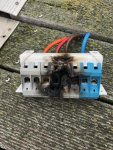
To be honest I was leaning towards the Victron but the fact that it only has 2 outputs at full power and then a trickle charge put me off a bit. Boosting a low input shore power is a boon though as we have found quite a few marinas in France this year only seem to give you 6 amps. In fact we nearly caused a fire in Camaret this year when we drew more than 6 amps through one of these suppliers and it didn’t trip out.

IMG_2204.jpg

+1

I would connect the 2nd engine bank, and domestic bank in parallel permanently, so you have double domestic capacity.
and then install a Victron Multiplus (charger invertor)
or a Victron Quatro (same like multiplus + connection for genny, all in one box, and automatic switch over)

the Victron can charge the domestic bank, and the second output can charge the engine bank.
than I would add a small extra charger for the genny bank.

Thanks for the info Bart, really useful. I hadn't thought of connecting the domestic and one of the start banks but the more I think about it the better this idea is. It will still give me the redundancy I need (I have a parallel solenoid if required) but as you say, doubles the capacity.

I have checked and each bank has 125AH batteries a full bank of 4 125AH would give a full 500AH which I would assume would need a minimum 50AH charger/inverter. Therefore a VMC-12/1200/50-16 would I guess do the trick. Would it be worth going for the next size up 70A charger (VMC-12/1600/70-16) to give me a bit of spare?

It might be worth adding a separate charger for the genny but i'll look at that as a second step later.

I would also install a battery monitor such as Victron BMV702 or BMV712,
which shows the charge status of the batt's, and can give alarm or auto start the genny when you go below a certain charge
I currently have a mastervolt monitor which shows me voltage and charger/discharge rate which I guess should do the job. I do believe however that the newer Victron chargers actually have bluetooth connectivity which allows you to get more granular information straight to a laptop and/or an iphone app which sounds interesting. Would certainly save buying more kit, running more cables etc.

Thanks all for the input, very much appreciated.
 
Last edited:
I have checked and each bank has 125AH batteries a full bank of 4 125AH would give a full 500AH which I would assume would need a minimum 50AH charger/inverter. Therefore a VMC-12/1200/50-16 would I guess do the trick. Would it be worth going for the next size up 70A charger (VMC-12/1600/70-16) to give me a bit of spare?

It might be worth adding a separate charger for the genny but i'll look at that as a second step later.


I currently have a mastervolt monitor which shows me voltage and charger/discharge rate which I guess should do the job. I do believe however that the newer Victron chargers actually have bluetooth connectivity which allows you to get more granular information straight to a laptop and/or an iphone app which sounds interesting. Would certainly save buying more kit, running more cables etc.

Thanks all for the input, very much appreciated.

be carefull:
when you have 2 x twin 125Ah 12V battery's, you have 250Ah capacity at 24V not 500Ah !

its alway's better to have some spare capacity for the charger / invertor,
fe I have a 1600W model in my 26ft Karnic ! (use it sometimes for the water cooker)
 
I don't know the mastervolt battery monitors,
the Victron BMV measures and integrates all currents that go in and out the battery bank,
so you have permanent indication of the charge status (%) of the bank.
the BMV712 is a new model (that will soon be availabe) it has a build in internet interface
 
regarding genny batt,
I assume this is 12V not 24V,
I have the same in Blue Angel

I've placed a small 12V charger for topping up batt's in winter,
if the boat / genny is used regularly, you don't need that,
you alway's have a emergency solution with a jumper cable (I have a manual switch)
to the "middle" connection of a twin 12Vbattery, 24V bank

actually this genny batt is also the 12V supply for some nav equipment, camera's and alarm,
long ago, I had a occasion where the 12V was drained while beeing on the boat, and long time no genny use.
 
be carefull:
when you have 2 x twin 125Ah 12V battery's, you have 250Ah capacity at 24V not 500Ah !

its alway's better to have some spare capacity for the charger / invertor,
fe I have a 1600W model in my 26ft Karnic ! (use it sometimes for the water cooker)

Good point, I will ensure they are connected in parallel not in serial!

I don't know the mastervolt battery monitors,
the Victron BMV measures and integrates all currents that go in and out the battery bank,
so you have permanent indication of the charge status (%) of the bank.
the BMV712 is a new model (that will soon be availabe) it has a build in internet interface

I currently have a Mastervolt BTM-III which has a shunt on the neg side of the domestic bank which then shows me the current voltage, current in/out of the bank and a %age indication of charge state. It also shows me the voltage only on the two engine start banks.

It will be interesting to see what the latest bluetooth interface on the new Victron range shows you. I'm guessing a more complete readout showing charge phase etc.

One thought that came to me last night regarding your suggestion of combining the domestics and one of the engine banks is that I will need to route the cabling in such a way that the two seperate isolators for the engine and the domestics still operate as designed to ensure that I can run the domestics whilst ensuring the engines remain isolated. Should be straight forward enough though if I route the combined battery bank to a sufficiently rated buzz bar and then two feeds out to the two isolator switches (a sort of Y split if that makes sense?).

Whilst I am at it i may replace the old-fashioned handled isolator switches (which admittedly I kind of like as there is very little to go wrong) with remote soleniods to reduce the heavey duty cable run, I assume this is what modern boats have?

is this the orriginal setup from your 7.5m merry fisher ?
quite a number of batt's ?

No, we have a 40' Sunseeker of 1997 vintage these days.

Regarding the genny battery, yes this is 12V and I tend to run the genny from time to time in the winter for a few hours just to keep it in working order and charge the bat.

Thanks again everyone for all the replies and Bart for all that detail. All help and suggestions much appreciated.
 
Last edited:
I currently have a Mastervolt BTM-III which has a shunt on the neg side of the domestic bank which then shows me the current voltage, current in/out of the bank and a %age indication of charge state. It also shows me the voltage only on the two engine start banks.
.

basically the same like a Victron BMV7xx, so no real need to replace...
(long ago, Victron and Mastervolt had some common background)
 
One thought that came to me last night regarding your suggestion of combining the domestics and one of the engine banks is that I will need to route the cabling in such a way that the two seperate isolators for the engine and the domestics still operate as designed to ensure that I can run the domestics whilst ensuring the engines remain isolated. Should be straight forward enough though if I route the combined battery bank to a sufficiently rated buzz bar and then two feeds out to the two isolator switches (a sort of Y split if that makes sense?).

Whilst I am at it i may replace the old-fashioned handled isolator switches (which admittedly I kind of like as there is very little to go wrong) with remote soleniods to reduce the heavey duty cable run, I assume this is what modern boats have?

your plan should work, or even more simpler, just place a link cable between the two banks, on the + terminals.
but than you can investigate your complete battery cabling, so that all battery's from a bank are charged / unloaded at the same rate, wiring resistance is equal, ....
and that would mean opening another can of worms, ;-)

you can find a long thread one or more years back with posts from "Annageek",
thread title was something about fridge power supply..
with very knowledgeable info on how to wire a battery bank.

edit: here is a link to that thread, unfortunately the drawings are gone
http://www.ybw.com/forums/showthrea...sumption-of-a-fridge/page7&highlight=annageek

I wouldn't change Original isolater switches if they are good,
DC wiring is a art, ones you start changing something, you might want to replace everything...
 
Last edited:
Sorry I haven't replied for a while but back to it now.

your plan should work, or even more simpler, just place a link cable between the two banks, on the + terminals.

Unfortunately both the engine start banks are on the starboard side of the boat at the rear of the engine room and the domestic bank is on the port. Therefore, linking the battery banks across the stern of the boat would create a bank with half the batteries on one side and half on the other if that makes sense. I'm not sure whether this is technically good practise or not but doesn't feel right.

If I switched one of the banks with the domestic (ie, the one NOT to be connected with the domestics) then they would be located physically next to each other but then this would create a very large cable run from the port hand side to the isolators on the starboard and then back to an engine (say Stbd).

This could be solved by remote solenoids but as you say, can of worms.......

Thanks for the input, i'll report back once i have implemented in the winter.

BTW, thanks for that thread, really useful, will finish reading it later on today.

Andrew
 
A quick progress update.

I have ripped out the old newmar charger and in it's stead have installed a Victron multiplus charger/inverter (C12/1600/70) along with a digital multi control for the service bank. For the engine start banks I have installed a smaller 30a bluepower charger which has also allowed me to put a permanent float charge onto the generator battery.

While I have been very happy with the unit the only real drawback I found was that the Multiplus only has a single AC output which means we will have to be careful when engaging the inverter to ensure we turn off anything high draw, such as the water heater. The Mastervolt on the other hand does have 2 AC outputs but would have cost me another £500 (ish) and would have been slightly more difficult to install due to physical size (it was a tight squeeze).

The domestic batteries are now always maintained at 13.2v (they never got above 12.1 volts before) and when in bulk charge mode output 14V. This did result in a few odd side effects to start with (such as a strange humming from the fridge compressor and the toilet macerator sounded much more beefy) but this is largely because I suspect the batteries have never been properly charged!

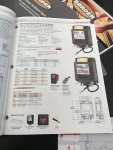
Next step is to find a way to combine one of the start banks with the domestics which is my next challenge due to location. With the domestics being on the port side of the boat and the 2 starter banks being on the starboard side switching one of the starter banks over will result in an unacceptably long cable run from battery to switch to starter motor. While chatting to the very helpful folks at Barden was at the boat show in September it was suggested that these remote solenoids could be a neat solution.

IMG_2961.jpg

This would allow me to move the port start bank across to the port side of the boat and conversely move the current domestic bank over to the starboard side ready for combining with the starboard start bank. Has anyone on here replaced hard wired type switches with remote solenoids, or better still, does anyone have any experience of these blue sea solenoids?

I have one remaining niggle with the proposed set up which is the possibility of draining the combined bank to the point I couldn't use it to start the starboard engine. Now, while I do have redundancy in a remote solenoid already installed for combining the start banks which I will re-use, i'm still not entirely comfortable relying on it. Therefore I was toying with the idea of installing a VSR of some sort between the stb start bank and the domestic bank so that when the voltage drops below a minimum level the VSR isolates the start bank. I'll have a chat with Barden in the week about this but do others on here have an opinion about whether this is necessary or not?

TIA,
Andrew
 
Has anyone on here replaced hard wired type switches with remote solenoids, or better still, does anyone have any experience of these blue sea solenoids?

I have one remaining niggle with the proposed set up which is the possibility of draining the combined bank to the point I couldn't use it to start the starboard engine. Now, while I do have redundancy in a remote solenoid already installed for combining the start banks which I will re-use, i'm still not entirely comfortable relying on it. Therefore I was toying with the idea of installing a VSR of some sort between the stb start bank and the domestic bank so that when the voltage drops below a minimum level the VSR isolates the start bank. I'll have a chat with Barden in the week about this but do others on here have an opinion about whether this is necessary or not?
Yes, all my batts are connected using remote latching solenoids with manual overrides. Not Blue Sea. They're excellent. It means you can isolate from the helm yet keep high current cables short. This is standard OEM Fairline fit out.
Then I have the remote Blue Seas (without man override) for my underwater lights (which draw 60amps at 24v on full blast) and they're excellent relays, and feel like they're of very high quality. Reassuringly expensive. Only downside is the ugly Carling control switch that comes in the box but you can bin that and replace with a nicer halo-LED touch switch or similar.

Regarding your batteries, I don't see the problem in relying on the combining solenoid. They work ok. It's best to wire it so the relay coil can be powered from either batter with port battery (in your case) as the default.
 
Top