Change and decay in all around I see.

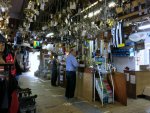
There was a chandlers in Dover I visited some years ago, as usual I forget the name. I wanted some lamp wick, and having failed to get any at the smart new chandlers a few doors away I tried my luck. The old boy in a brown dustcoat, who I have been told died a year or two later, got a stepladder and ascended to an extremely high shelf and brought down a large box, in which there was a large section of wicks of all sizes, from which I chose a foot or two of the right size for not many p. I think the old boy's son carried on the business for a while.
Like “ Georges “. at Kelvin bridge , Gt Western road in glasgow ,, he had everything
 
I remember what I used to do on arrival at a strange place, or even a place that I knew quite well. I used to row ashore, fill the water container, look at the boatyard and any interesting boats, visit the village shop, or, given a fair sized place the High Street, look at the church and anything else of tourist value, and of course look in at the chandlers, before the regulation pint at the pub.

There was usually something interesting in the chandlers. I’ve still got some of Tony Ward’s excellent linen tea towels, and every chandlery in Britain seemed to sell those red cotton trousers…

These days it’s just church and pub.

At Ramsholt, there has only ever been:
- Pay respects to George ( the harbour master, not a seal, here)
- Church ( round tower but interesting Georgian internals, candle lighting only)
- pub.

The real Kirby Creek enthusiast, like John Passmore (“Old Man Sailing”) and I, and others here, having paid his respects to George ( a seal, not a harbour master, here) will do the route march into Kirby le Soken where there is a pub, a church and a shop…

… John Passmore stored for a voyage to
the Azores via Rockall from that shop, during the first lock down, which was a bit keen, and no doubt the hiking kept him fit.?

But in most places boatyards and chandleries have gone.
 
Last edited:
At Orford there has only ever been:
- Pay respects to George ( the harbour master, not a seal, here)
- Church ( round tower but interesting Georgian internals, candle lighting only)
- pub.
That sounds like Ramsholt rather than Orford? Orford has two pubs, a castle, a church with a square tower and several shops.
 
The chandlery across the bridge at Treguier. Stockholm tar and everything you could ever need from children's peche a pied equipment to indestructable fisherman's oilskins via wichard shackles. and miles of cordage.
Yes. A great place:
channel'14 a (120).jpg
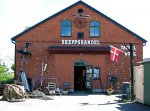
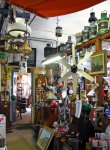
In a similar vein, and also full of stuff reclaimed from ship-breakers in Bangladesh, is this one in Ystad, southern Sweden:

559.jpg
561.jpg
 
Well never sailed in racing with a Single Handed dinghy ; so can someone please explain how a novice gets the Low Down on Tactics , proper tacking procedures , responds to a quiet word in their ear abouit tactics when racing etc etc without being on a 2 person Dinghy ?

Guess that a Trainer in the fast Rib belowing out info is actually spreading the word arround , so not directed necessarily to the right person ?
 
Well never sailed in racing with a Single Handed dinghy ; so can someone please explain how a novice gets the Low Down on Tactics , proper tacking procedures , responds to a quiet word in their ear abouit tactics when racing etc etc without being on a 2 person Dinghy ?

Guess that a Trainer in the fast Rib belowing out info is actually spreading the word arround , so not directed necessarily to the right person ?
I'm not sure that my Firefly crew ever imparted any information to me, but he was very good at doing what I wanted. When at school I raced on Sundays in the 'adult' races and I think I gleaned a lot from this as they were a crafty bunch. I also had a friend who had a N12 14 hundred and something which was one of the new wider breed that was faster than the Firefly, as they had been on the same handicap before.

I think that in the right environment a sailor can learn as well in a single-hander. After all, that chap Ben Something-or-other didn't do badly.
 
I think that in the right environment a sailor can learn as well in a single-hander. After all, that chap Ben Something-or-other didn't do badly.

Yes Ben did pretty well. But i do wonder why most kids who start learning this way just give up & go do something else. Some will always succeed but too many fall by the wayside.
 
Going back to the OP, I think this is, down to the naivety of the so called environmental lobby. They prevent change on the doorstep. Nothing can bappen where they can see it so industry, innovation and wealth ceration is moved out of sight. The global environment is still affected, probably more so as activity is transferred to places that have almost no environmental protection, but the greenies can feel smug about themselves.
 
Yes Ben did pretty well. But i do wonder why most kids who start learning this way just give up & go do something else. Some will always succeed but too many fall by the wayside.
:) I agree in principle but it can work both ways. I wonder how many children give up sailing because they are fed up with being shouted at by their sailing companions. I certainly know teenagers who were less than impressed with their fathers’ skippering and went off to chase boys/girls instead.
 
I'm going to go against the flow of this thread and say that in my opinion the death of the small boatyards and chandlers was an inevitable result of the democratisation of sailing. When leisure yachts were owned by "gentlemen" the cost of having a man do all the necessary jobs on your boat over the winter was a pittance. Now that worker quite rightly expects to have a pretty similar lifestyle to the person who owns the boat, which is why their hourly rates are quite so eyewatering (and similar to what many of us would charge in our chosen fields). If nobody is getting more than the bare minimum done by professionals then there isn't a very large market to support lots of them.

I also used to teach dinghy sailing in Optimists and Toppers at Kukri's current club! I would have been extremely unimpressed when I was learning to sail dinghies there as a child if I had been forced into a Cadet. I'm no evangelist for the RYA scheme but it gets many things right.
 
I'm going to go against the flow of this thread and say that in my opinion the death of the small boatyards and chandlers was an inevitable result of the democratisation of sailing. When leisure yachts were owned by "gentlemen" the cost of having a man do all the necessary jobs on your boat over the winter was a pittance. Now that worker quite rightly expects to have a pretty similar lifestyle to the person who owns the boat, which is why their hourly rates are quite so eyewatering (and similar to what many of us would charge in our chosen fields). If nobody is getting more than the bare minimum done by professionals then there isn't a very large market to support lots of them.
...


I suspect you have the right of much of it there.
How do things fare in other countries?
 
Yew well . my training was mainly being done as a Lightweight Crew aboard a N12 during races , and the Skipper really wanted to win ; well recall how he used to lean in towards me and say , or really whisper , 'when I next shout 'lee oh' dont move' , stay as you are ; realised it was a 'tack tic' to get the Dinghy ahead onto another tack , we just tightened the sails and sailied past them , the look on the other Dinghys crew face as we sailed pased them was a picture , as she hd been watching us like a Hawk , and relaying the Skippers commands to her Skipper ; so would suggest from experience that in competetive sailing Skpper or Helm and Crew have to work together as a team , cannot see how sailing Single Handed when learning can give such important information .
 
I forced our children into a Cadet. I don't remember them complaining much, and they both enjoyed sailing with us to this day. This picture in the Deben was taken a month after our son became diabetic.
74-77 (93) copy.jpg
 
I also used to teach dinghy sailing in Optimists and Toppers at Kukri's current club! I would have been extremely unimpressed when I was learning to sail dinghies there as a child if I had been forced into a Cadet. I'm no evangelist for the RYA scheme but it gets many things right.

However you were once or twice called upon to crew in a N12 at the club and no doubt you learnt a lot from the legendary helm....
 
I'm going to go against the flow of this thread and say that in my opinion the death of the small boatyards and chandlers was an inevitable result of the democratisation of sailing. When leisure yachts were owned by "gentlemen" the cost of having a man do all the necessary jobs on your boat over the winter was a pittance. Now that worker quite rightly expects to have a pretty similar lifestyle to the person who owns the boat, which is why their hourly rates are quite so eyewatering (and similar to what many of us would charge in our chosen fields). If nobody is getting more than the bare minimum done by professionals then there isn't a very large market to support lots of them.

I also used to teach dinghy sailing in Optimists and Toppers at Kukri's current club! I would have been extremely unimpressed when I was learning to sail dinghies there as a child if I had been forced into a Cadet. I'm no evangelist for the RYA scheme but it gets many things right.

My recollections of sailing fifty years ago tell me that it was rather more “democratic” then than it is today! I remember lots of smallish wooden boats, and some small GRP boats, kept on moorings, accessed by way of a dinghy, kept either at a boatyard or at a club, and laid up ashore at a boatyard. A Twister was a big boat; Blackwater sloops, Deben four tonners and Folkboats were common, and the Westerly Centaur was starting to become the most popular boat in Britain.

People did their own maintenance, scoured “Practical Boat Owner” for ideas for improvements, and called in the yard for an hour or two for difficult bits.
 
Possibly could be related to the idea of leisure and the “week end” becoming an established time.Working at Hillyards in the late 1960s certainly no boatbuilders had the slightest interest in actually sailing,except the foreman who built his own boat and on the wages at the time a hillyard nine toner would be a dream.Probably it was grp and the cheaper labour force that made yachting more attractive.There are other factors like a generation inheriting,like my father who was fifty at the time and having paid off the mortgage could thing about buying a boat
 
Top