Chain Rust Prevention (but then easily removed)

I use a simple test to evaluate abrasion resistance of the galvanised coating.

I hang 200mm lengths of the chains under test from a piece of galvanised rod. I hang the rod, with about 12 samples, evenly spaced, off the transom of our catamaran. Our catamaran is on a swing mooring in 10m of water. The cat is constantly moving. Tides are a mere 2m and I ensure the samples are on the seabed 24/7. I've run a few tests and a I try to use one common sample, so the same chain, in every test. I retrieve the samples weekly and weigh for weight loss and when I see that the gal has worn through to the steel I can compare the samples based on weight loss. After the gal has worn the weight differences become less useful as once thew gal has gone the steel then abrades (except it is corroding and abrading simultaneously).

Abrasion is a function of the gal thickness, the more gal the longer it takes to wear through to the underlying steel, but see below. Once the gal has gone the steel then wears. Abrasion is also a function of steel hardness, the harder the steel the more abrasion resistance and higher abrasion resistant steel is commonly higher strength. As you are using a G70 chain it is over twice the strength of G30 chain and will last longer - it will wear less.

Ignoring the detail, its all in a series of articles in Practical Sailor, but I can remove the gal coating off most HDG chain on their wearing surfaces within a matter of weeks. the test does not simulate wear at the crown but simply evaluates wear caused by the chain sweeping the seabed. I was amazed that in such a short time that sufficient gal would be removed such that the chain,. when left in a bucket of seawater, would commence corrosion - they rusted.

The idea that people complain about a few years for life of chain looks, in actual fact, to be good life!

Most people's experience of chain corrosion is based on using their yacht at the weekend and gal will last 'for ever'. If those same people now live aboard then they will be disappointed because the gal will last much less, maybe a few years maybe more. Americans, on Cruisers Forum, complain of the poor life of Peerless, which may (coincidentally) be the same life as Maggi - I don't know. But my tests suggest that 2 - 4 years is good.

But galvanising is an alloying process and if the steel is inadequately cleaned the gal coating does not adhere well to the substrate - and can flake. Additionally if the galvaniser tries to develop too thick a coating the thick coating will also peel. There are mechanisms that will result in a poor coating and Vyv has a test that idientifies the result (his twisted link test). The gal on Maggi's chain, or the samples I have tested, did peel or fl;ake, again all reported in articles (on chain strength) in Practical Sailor.

Jonathan
 
I suggest you contact Spencer Inc in New Jersey. They Thermal Diffusion Galvanise for the US army and Navy. The process they use is the Armorgalv process, but there are at least 2 other processes and a number of operators of each process.

I've had my own rode coated using the Armorgalv process, send me a PM with an email address and I'll send an article giving chapter and verse. Armorgalv (and I believe the other processes) gives a harder coating and offers opportunity for a specified galvanised coating thickness. The US Navy specified 80 microns, I did not know their specification and I specified 100 micron coating. My rode is based on a 6mm x G80 from Gunnebo (now owned by Crosby). More recently a G100 x 8mm chain was coated, to replace a G40 x 10mm chain for a 50' cat being built in Thailand.

I believe Specers have been Armorgalv coating G80 and G100 chain (maybe G120). They may also have been coating metric chains. However they would be able to source metric chain and coat for you.

I have run abrasion trials using the, my, Armrogalv coasted chain, the 8mm Armrogalv coated chain vs a selection of hot dipped galvanised coated chain and I can confirm that the Armorgalv process has a longer life - in my tests. It also has the advantage of 'self' polishing - and looks (after use) like black stainless, so towers less and carries less mud. The 6mm chain abrades at the same rate as 8mm chain - size does not matter. HDG coated chain, 6mm, 8mm and 12mm (I'd runout of 10mm) also wore at roughly the same rate -size does not matter. But the thickness of the coating DOES matter - less coating - the underlying steel shows through more quickly.

Jonathan

Peerless make, what they call, G70 - but its more like a G55. They simply take their regular G70 and galvanise it. They make both in metric and imperial sizes. Because they use their regular G70 feedstock its marked G70 - hence they call it G70 - but its 'gal G70'. Its UTS is lower than that of Maggi but the WLL are similar, because they use different safety factors. Another source for gal G70 is Campbell (I think you can source through the likes of Defender or 1st Chain. Again its simply a galvanised G70 transport chain. I found Campbell to be better than Peerless - but that might have changed. Campbell, part of Apex tools only make to Imperial sizes (again that might have changed).
 
Last edited:
Dave,

pdf of article, Armorgalv coating of a 6mm x G80 chain to replace a 8mm G30 chain, sent. If anyone wants a copy - simply send me a pm with your email address. The article comes from Cruising Helmsman. There is a similar article in Practical Sailor but I don't have a copy - if you are a subscriber it would be easy to abstract.

In addition to Peerless, Maggi and Campbell (and my Armorgalv route) there is possibly another option for a high tensile chain. Gunnebo (now owned by Crosby) make a G80 galvanised chain for Aquaculture. I don't have a link but its on their website. It appears to be made from a G120 chain and then simply galvanised. G120 is a bit of an orphan as though it is sold and listed as being 'metric' the wire from which it is made is bigger (fatter) than the nominal size implied. Normally an 8mm chain is made from 8mm wire. G120 wire is about 9mm but made to an 8mm link size. It may or may not fit a conventional windlass gypsy. I have asked Maxwell (who made our windlass and were closely involved when I changed from 8mm G30 to 6mm G80) and they said the only way to know is - try it. Unfortunately the local Gunnebo distributor in Australia is not motivated and has not bothered to get a sample - so I don't know - but it is an option to investigate. I may progress this - I'm intrigued.

My Armorgalv chain worked out cheaper than buying anything from a chandler (cheaper than buying a conventional HDG G30 of 8mm). I had investigated making a complete rode, chain, connectors (Omega links) hooks, Boomerang and since then bridle plates for a bridle/snubber. I then had everything that matched, all the pieces were sized to fit each other and all Armorgalv coated and all tested. The chain was coated to be as strong as HDG 8mm x G30 that it replaced and all the components were stronger. I was lucky, there is an Armorgalv facility 200km from me and they were strongly motivated to extend their portfolio. There is at least one converter in the UK, a number across Europe and many in America. Since then another rode has been made from Chinese G100 chain - completely successful. The Armorgalv process is used by the US Navy and Army specifically because the Armorgalv coated chain is more abrasion resistant than HDG. It also has the advantage you can specify coating thickness desired - accurately. The process is conducted at a lower temperature, its a sintering process - below melting point, than Hot Dipped Galvanising and is well suited to galvanising high tensile steels. I actually had my chain coated at an even lower temperature than 'normal' - its all in the article.

There is a follow up article to be published 'soon' in Cruising Helmsman and Practical Sailor- I'm not an editor and though articles are submitted and accepted - I never know how they will be fitted into a schedule. The unexpected benefit has been that the Armorgalv coated chain polishes to look like black stainless, smooth and shiny. It does not tower and is easier to clean than conventional HDG. There are a number of tricks we learnt - if you wanted to do it yourself - send me, another, email :). You do need to test for strength, lots of people will do it, and if you use Spencers in America - they can test for strength, on site. Bodycote (spelling) in the UK run the process they too might be able to test for strength. I think Gunnebo, they are Swedish, have a licence for Armorgalv though they make no mention on their website.

Dave

To use G70, or any other of the variants I list, you would need a snubber - a decent one. What have you been using?

If you use smaller HT chain your are sacrificing catenary (because you are saving weight and in our case - money) and you sensibly replace the loss of catenary with a well designed snubber or bridle.

Jonathan
 
The 10% loss of diameter seems to be a rule of thumb used by the lifting industry who are much more safety conscious than anything we see in the leisure marine industry. If its 'good enough' for the lifting industry it will certainly be good enough for us - whether its G30 or a galvanised G70. I assume as the 10% figure is published by reputable chain makers then they are comfortable with the safety factors.

But there are caveats.

It is very unlikely that you will abrade an anchor chain and loose 10% of the wire diameter without there being significant corrosion. In fact if you have lost 10% of diameter I'd expect to see flaking of the developed rust and measuring the links need the rust to be cleaned off down to bear metal, and examination of the impact of corrosion of the welds, individual welds, over the length of the portion in question.

I have not heard of chain breaking - but I have heard of welds failing. I have heard of chain stretching - such that it no longer fitted the gypsy (which would be a considerable inconvenience - but you would not lose your yacht).

There is a phurphy that HT chain is 'brittle' - this is yet another internet truth - that isn't. The extension to break of Maggi, Peerless and Campbell G70 chain is 'better' than some G30 from the same manufacturers. I know I've measured it. All chain is proof tested to either 2 x WLL or 1.5 x WLL and beyond Proof Load you would expect chain to stretch, permanently. If you are using a sensible snubber you should never subject your chain to WLL - let alone Proof Load.

If you have flaking rust - on part of the chain I would not bother to measure at all - I'd cut it off.

To have flaking chain implies that the gal has worn and the flaking portion is unused and likely constantly soaked in salt water. The chain needs to be able to breath, sitting on a perforated base to allow the chain to dry, it should be regularly washed with fresh water - and locker lid/hatch lifted whenever possible to allow the chain to dry. You also need to ensure the drain holes for the locker are correctly located and not blocked.

Jonathan
 
What are the general thoughts on stainless steel chain? I've encountered it a couple of times on other boats, and when I replaced my chain a few years ago was surprised it wasn't as expensive as I expected (didn't do it because was planning to sell the boat).
I know there are issues with SS corrosion when immersed for long periods, but I rarely anchor for longer than 36 hours
 
A thought about the weakened length of chain after end to ending. If in a situation where all the chain is deployed, not all of the weak chain will be in the water, a bit will be over the gypsy and still in the locker and probably about 5 or 6 mtrs of it will be from the gypsy to the water, therefore using a 10 or 12 mtr snubber none of the weak chain will be under load.
Your thoughts?
 
A thought about the weakened length of chain after end to ending. If in a situation where all the chain is deployed, not all of the weak chain will be in the water, a bit will be over the gypsy and still in the locker and probably about 5 or 6 mtrs of it will be from the gypsy to the water, therefore using a 10 or 12 mtr snubber none of the weak chain will be under load.
Your thoughts?
The chain I propose to reverse has lost its galvanising but I don't think it's weakened. Whilst it has surface rust, its is not flaky and whilst I have yet to get the vernier out I'd be surprised if had lost some of it thickness. This is why I want to act now. The chain is currently hanging ashore having been washed with fresh water. Hopefully when I get back to the boat it'll still be "good".

You're right though, my snubber is 11+m long and with the gypsy at the mast there would be little of the used chain under load. Next seasons cruising plans (if they happen) will see me mainly in water 3m deep so lack of scope is not an issue.
 
With 100m of chain and the worn chain in the locker, meaning you will only deploy 70m (of 8mm chain). However if you feel the need to deploy 80m than you will be 'using' 10m of the worn chain and that 10m is the ultimate fall back should your snubber fail.

We use a bridle and so far we have had 2 arms, from different bridles, fail.

If your snubber has sufficient strength and is new enough you haver no real issues - it should last a long, long time - but if it has sufficient elasticity to be a truly effective snubber then its strength will only be a fraction of the strength of the chain. There is a chance therefore that your snubber (assuming elastic) has a finite life and should be considered sacrificial or an item requiring retirement at some point, like sails, sheets (and anchor chain).

If you assume sacrificial then your ultimate fall back might be a compromised portion of chain (I'd get the micrometer out when you are freed up from lockdown).

I describe a worst case scenario that frankly I would manage, by not needing to use 80m of chain in a hurricane, so - simply be aware and ignore the fear factor.

Jonathan

None of this has anything to do with corrosion nor galvanising but as the thread has drifted to snubbers and you are in lockdown - here is some diversionary prose:

How to: Dealing with Snatch Loads in an Anchorage

Anchor Snubber Tips

Know how: Expanding your Anchoring Repertoire

The art of snubbing, in the nicest possible way - MySailing.com.au

How to boomerang your anchor right back at you - MySailing.com.au

and also

Know how: Ground Tackle
 
There is a lot of cheap stainless made into variety of products readily available. Some of it is gorgeous as well as being cheap. One of the problems is that some stainless is made with scrap that has not been cleaned and contains unusual contaminants that were never in the original, say, 316 specifications. Think of the number of rare earth magnets that are now causal thrown away - phones, computers and small motors just to mention a few. The effects of small levels of exotic contaminants (and some less exotic) maybe unknown. These contaminants may not affect the visual appearance but may affect more critical aspects (like strength, not suggesting that appearance is not critical). This stainless may be perfect for a stainless sink but might be less applicable in a shackle or chain.

I'd be very cautious of cheap stainless chain - for this reason. If I really wanted stainless chain I would invest some of the saved money in having it tested for yield point and strength. Normal, or good, 316 has a strength of 590 mpA, its actually quite strong (G30 chain has a minimum strength of 300 mpA), but it has a yield of 290 mpA and might extend 50% at failure - its very stretchy. Stretchy with high strength is arguably 'good' - because you know when you have over stressed it.

But the cheap stainless is an unknown quantity. Ask for sight of a test certificate and if it is not available - wonder why not (the chain is meant to be a safety device) and if still committed - have it tested independently.

The alternative is buy Cromox - and then you know exactly what you are getting. You can also buy components within the Cromox range that will match the chain for strength - and you can sleep soundly at night - albeit with a slimmer wallet.

I have tested cheap stainless chain, cheap and less cheap, shackles. Some of the cheap shackles have come from reputable sources. The common characteristic is the ability to deform. Some of the shackles I have tested, from reputable distributors, like Tecni (but no brand name) have not met specification. Because the steel elongates I have found that the shackles don't snap but that the clevis pin and eye deforms such the the clevis pin squeezes through the enlarged eye. Thus though the steel has a high UTS its low yield and the application in which it is used is incompatible.

I do wonder where I see unbranded stainless shackles being used in combination with correctly sized G40 chain and big anchors. Makes no sense.

Jonathan
 
Last edited:
There is a lot of cheap stainless made into variety of products readily available. Some of it is gorgeous as well as being cheap. One of the problems is that some stainless is made with scrap that has not been cleaned and contains unusual contaminants that were never in the original, say, 316 specifications. Think of the number of rare earth magnets that are now causal thrown away - phones, computers and small motors just to mention a few. The effects of small levels of exotic contaminants (and some less exotic) maybe unknown. These contaminants may not affect the visual appearance but may affect more critical aspects (like strength, not suggesting that appearance is not critical). This stainless may be perfect for a stainless sink but might be less applicable in a shackle or chain.

I'd be very cautious of cheap stainless chain - for this reason. If I really wanted stainless chain I would invest some of the saved money in having it tested for yield point and strength. Normal, or good, 316 has a strength of 590 mpA, its actually quite strong (G30 chain has a minimum strength of 300 mpA), but it has a yield of 290 mpA and might extend 50% at failure - its very stretchy. Stretchy with high strength is arguably 'good' - because you know when you have over stressed it.

But the cheap stainless is an unknown quantity. Ask for sight of a test certificate and if it is not available - wonder why not (the chain is meant to be a safety device) and if still committed - have it tested independently.

The alternative is buy Cromox - and then you know exactly what you are getting. You can also buy components within the Cromox range that will match the chain for strength - and you can sleep soundly at night - albeit with a slimmer wallet.

I have tested cheap stainless chain, cheap and less cheap, shackles. Some of the cheap shackles have come from reputable sources. The common characteristic is the ability to deform. Some of the shackles I have tested, from reputable distributors, like Tecni (but no brand name) have not met specification. Because the steel elongates I have found that the shackles don't snap but that the clevis pin and eye deforms such the the clevis pin squeezes through the enlarged eye. Thus though the steel has a high UTS its low yield and the application in which it is used is incompatible.

I do wonder where I see unbranded stainless shackles being used in combination with correctly sized G40 chain and big anchors. Makes no sense.

Jonathan
My re- galvanised chain is reaching the end of its life, ten years now I think, so no complaints. I did look at Cromox but a 60 metre length of 8 mm from Jimmy Green, probably not the cheapest available, would be £2300. Highly unlikely for me.
 
My re- galvanised chain is reaching the end of its life, ten years now I think, so no complaints. I did look at Cromox but a 60 metre length of 8 mm from Jimmy Green, probably not the cheapest available, would be £2300. Highly unlikely for me.

Vyv,

You split your time between Greece and the UK. The 10 year life is not 3,650 days, or nights, at anchor. If you had to guess how many years life does that 10 years equate to? And if you can answer - how much of those, reduued years, or nights, might be a Med moor - where the chain is subject to minimum, or less, abrasion.

Thanks

Jonathan
 
Vyv,

You split your time between Greece and the UK. The 10 year life is not 3,650 days, or nights, at anchor. If you had to guess how many years life does that 10 years equate to? And if you can answer - how much of those, reduued years, or nights, might be a Med moor - where the chain is subject to minimum, or less, abrasion.

Thanks

Jonathan
Jonathan,

The chain has spent the whole of its life in Greek waters. In the 10 years we have spent around six months aboard in six or seven of them, three months in two, two months in one and missed one altogether. We don't do a great deal of Med mooring, maybe 10% of the nights? In the winter the chain hangs from a rope across two cradle uprights, so largely dry.
 
I asked the question of Vyv because my assessment is:

No-one, or most people, have any idea at all how long the galvanising on their chain lasts. Most people only use their yacht at weekends and soon lose count of the number of days at anchor. Because they don't use their yachts through winter, in the UK, chain lasts, or the gal last - for ever. The issues only arise when the weekend yachtsmen decides to live aboard and they take that idea - of the chain gal lasting forever. Based on my tests the idea that the gal will last forever is totally unrealistic.

I refer to the abrasion tests I did where I could wear off the gal in a matter of weeks by allowing chains to continually drag on the seabed. I frankly found the wear rate extraordinarily high.

The OP is suggesting he has lost the galvanising off the first 30m of his chain, after continual use for 2 years, and is now going to end for end it - which should give him another 2 years. Noelex in the past has said his chain lasted 4 years and reinforces this by suggesting his chain and that of Dave, the OP, has a similar life. Both Dave and Noelex have used Maggi chain, G70, and Dave suggested he thought it would last longer .Noelex has been highly critical of Maggi. Noelex has also suggested that the poor life is in some way a function of G70 and or the fact that when you use G70 you down size - thus he suggests high wear is a function of smaller chain.

Vyv also bought Maggi chain and the gal did not last (its becoming a common theme) and he had it regalvanised in the UK ( I vaguely recall he took it home and returned it by car (but my ideas might be slightly or largely wrong).

Vyv has now had 10 years life from his regalvanisied chain and suggests the gal is reaching the end of its life. Vyv also says he is happy with the 10 year performance - and an interpretation is that the second galvanising is better than the first.

If we look at the detail of Vyv's 10 years we have

6 months per year for 6 years = 3 years
3 months per year in 2 years = 0.5 years
2 months per year in one year = 1/6th year
0 months per year in one year

Being generous this equates to 4 years, over 10 years, but then we need to reduce this further by 10% as maybe 10% of the time on a Med moor where abrasion will be minimal. I am assuming, possibly incorrectly - and one should never assume - that Vyv end for ended his chain to even out wear.

But lets stick with the 4 years - none of this is an exact science.

Part of life expectance is how the chain is cared for in the locker - poor housekeeping will reduce chain life geometrically. Vyv's practice mom hanging his chain up, like laundry, when his yacht is on the hard should give him a more dependable life.

Unsurprisingly the life of Vyv's galvanising is almost identical to that of Noelex and Dave the OP. Vyv has said he is happy, Noelex and Dave are disappointed and add to the criticism of Maggi.

I have made around 6 tests of about 50 samples representing Peerless, Campbell, Maggi, PWB (Australia) and Armorgalv with sizes of 6mm, 8mm, 10mm and 12mm (or their imperial equivalents) and covering G30, G40, G43 and G70. Their are differences but the differences are gal removal in 5 weeks or 6 weeks (not 5 weeks or 10 weeks). The best galvanising is Armorgalv (and this result is supported by tests the US Navy/Army have run). Galvanising quality does vary, there is evidence of flaking from some suppliers, and gal thickness varies from 60 - 100 micron (for chain even from the same supplier) - basically when you buy from the chandler - its a lottery. The advantage of Armorgalv is - you can specify gal thickness and achieve that thickness accurately and the gal coating is harder (more abrasion resistant) than conventional galvanising.

Having praised Armorgalv - if life of HDG is 4 years then the life of Armorgalv will still only be 5-6 years.


In the absence of further information both Noelex and Dave have achieved a galvanising life that would be expected, criticism of Maggi is unfair, and possibly grossly unfair. There is no evidence that G70, somehow, has a higher gal abrasion rate than (Vyv's) G40, there is no evidence that Vyv's galvanising has lasted longer than Maggi's. Based on my tests there is no evidence that the galvanising on 6mm chain will wear more quickly than 12mm (and I conducted a specific test to check this).

My thesis is based on Vyv's post, above, Noelex posts in the past, Dave's evidence as defined in this thread, my own abrasion tests (which are largely documented in Practical Sailor) ands tests conducted by the US Navy/Army. There are other tests conducted that clearly show (unsurprisingly) that abrasion is a function of the galvanised coating thickness and further tests that show increased hardness results in better abrasion resistance.

I am the first to admit - evidence from Vyv, Noelex and Dave might be totally accurate - but is hardly statistically robust 3 people are not enough.

However to repetitively criticise a company, to make unfounded statement over G70 and chain size - look unfounded - in the absence of further information.

Additional information would be welcome and criticism of my conclusions (anticipated) - would possibly allow us a better understanding of galvanising life.

Jonathan
 
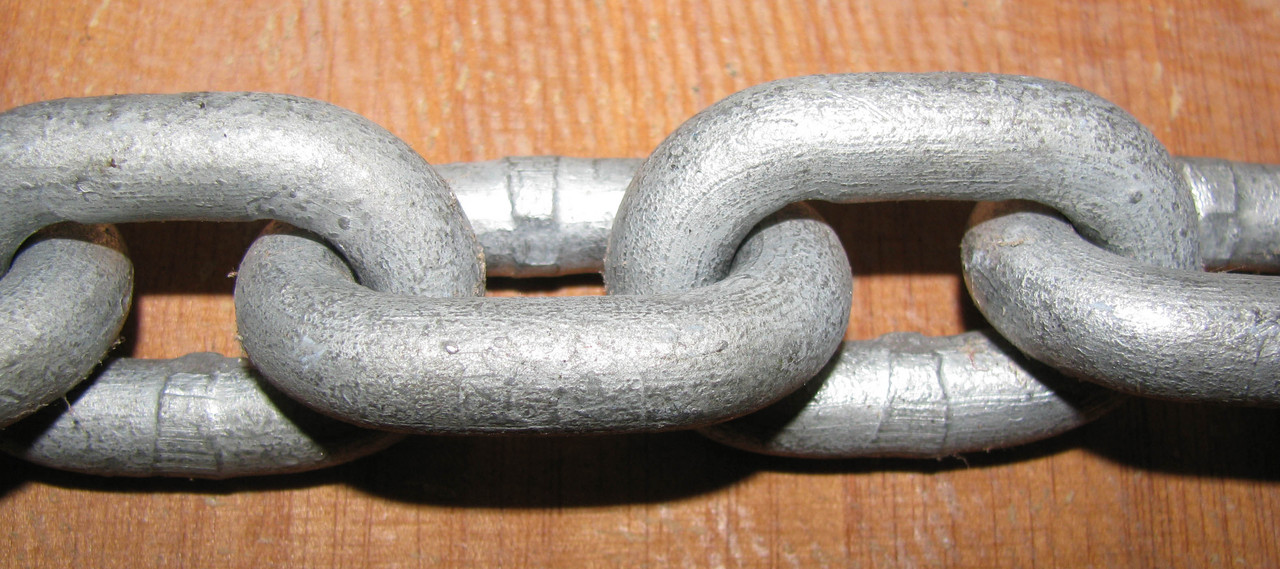
Interesting analysis. My main comment is that the original galvanising on new chain was totally defunct after three six month seasons, and was really ready for retirement after two. This is not the actual chain but it is a very typical production chain from which the molten zinc has largely been removed by a centrifuging or shaking process.

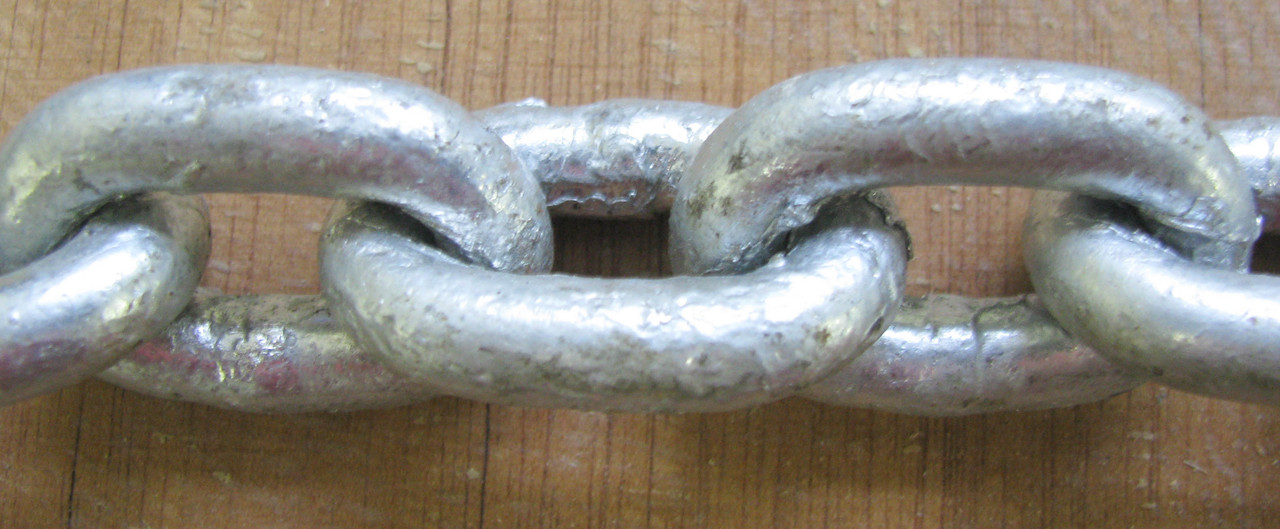
By way of contrast, this is my regalvanised chain as applied by BE Wedge. I do not have the precise thickness figures to hand but from memory the zinc was more than twice as thick as that on the specification production stuff. This one, in pretty much exactly the same service, lasted three times as long.


Looking through my files I came across this from Andrew Bebbington in 1999:
Last time I had this done was for a 50m length of 3/8" rusty chain which was going to be written off.

After pronouncing it sound, Medway Galvanising Co. of Sittingbourne charged £108, which I think was just over one-third the price of new calibrated chain.

The charge is by weight rather than length. The chain must not have been painted or galvafroid treated, any paint marks must be carefully removed.

The chain still looks good after 4 years, though it has been much used. Regular use probably helps.

Leaving it in a rusty puddle at the bottom of the anchor well is rarely good news.
 
I stand to be corrected but:

Galvanising is an alloying process where the molten zinc and iron based object, to be coated, inter act and form a series, 3 I believe, layers of a Fe/Zn alloy. Each layer has a different hardness but each layer is harder than the underlying steel (though once you coat a G70 (or higher) steel the underlying steel will be harder than the alloys.

Any surface zinc is soft, very soft, and looks pretty when new. For engineering product, bits say for a bridge, the zinc may (I don't know) add to the performance of the galvanised coating. It has been suggested to me that the soft zinc external coating protects the harder inner layers of the Zn/Fe alloys from impact.

Most galvanisers are catering to the engineering industry where abrasion is minimal (there will be exceptions).

For anchor chain the external zinc coating will soon be abraded, by the seabed - and quickly lost, (quickly in terms of the life of the chain). Consequently one should not be beguiled by the external appearance in the chandler - the fact it is shiny is pretty meaningless. Zinc costs money and removal of zinc, for an anchor chain will improve the efficiency of the galvaniser for not much negative impact on the life of the chain. The major limiting factor on life of an anchor chain (assuming all care is taken when it is stored in a locker) is the thickness of the alloyed layers and their adherance to the underlying steel (the links of the chain). Steel that has not been prepared, for galvanising, it has not be effectively cleaned, can result in the galvanised coatings peeling (or flaking? - peeling and flaking are 'technical' terms in the industry). Remnants of paint can cause this issue. Additionally - it is known that the thicker the layer of alloy the greater the resistance to abrasion, but too thick a coating can also result in flaking (or peeling?) There is this a balance between too thin, poor life (abrasion) and too thick, poor life (flaking/peeling).

Based on my understanding the outer layer of pure zinc and appearances of the new chain is not relevant. This is especially underlined as if you go to a chandler and inspect a few buckets of chain you will often find the top layers of chain are dull, oxidised, zinc - but its bright and shiny underneath. Its all the same chain, all galvanised a the same time under identical conditions. Appearances are deceptive.

I am not in any way denying Vyv's experience with his original Maggi G40 chain and am not defending the short life of its galvanised layer. I am suggesting that a 4 year life, of daily anchoring, does not appear grounds for complaint.

I think there may be someone who contributes to the forum who knows much about galvanising - possibly he will stray into this thread and contribute ...... and correct my errors :)

Jonathan

Edit - I measure galvanising thickness using a coating thickness meter - it sadly does not differentiate between Fe/Zn alloys and pure zinc.. If the zinc is thick - you are getting less alloy (and less life) for your £. Much engineering product is focussed at a gal coating of 70 microns - its not much (when you think about it) - and 4 years life actually seems quite good, considering :)
 
Last edited:
I'm no metallurgical expert, but I do have a lot of experience of anchoring. I would suggest that, for the same vessel, smaller lighter chain will be abraded more rapidly than larger heavier chain. Why? Simply because the lighter chain will move over the sea bed more.
 
I am not too convinced by the abrasion argument. In light winds the chain will barely move on the seabed. In fresher winds much of it will be off the bottom, other than the final few metres that will be very mobile. However, oddly enough, it is the centre section of my chain on which zinc loss is maximised.
 
I'm no metallurgical expert, but I do have a lot of experience of anchoring. I would suggest that, for the same vessel, smaller lighter chain will be abraded more rapidly than larger heavier chain. Why? Simply because the lighter chain will move over the sea bed more.


I think this is a significant factor.

Looking underwater it is quite easy to see that if the installed chain is in relativlty thin for the boat size this will move around seabed more than similar sized boats that have selected thicker heavier chain.
With the same force, thinner, lighter chain has less mass and less grip on the substrate so is not surprisingly dragged back and forth more easily. In strong wind the chain will lifted but for most of the time at anchor a large portion the chain is on the seabed and if it moving the galvanising will be subject to abrasion.

Often boats switching to G70 chain reduce the chain diameter and I think this is at least part of the reason why boats switching to G70 chain report a significant drop in the lifespan of their chain.
 
Abrasion is a function of mass (in water) and area. Smaller chain has less surface area, but less mass. Large chain has larger surface area and more mass. Do the maths.

I've done the tests - small chain loses galvanised coating at roughly the same rate as larger chain - the big difference is the thickness and quality of the gal - not the chain size. I've tested two chain from different chandlers from the same supplier PWB, of the same size both G30 both 6mm (I had a surfeit of gal 6mm) and I tested different qualities from the same supplier, BBB, G30, G43 and 70 (Peerless and Campbell). I also measure gal thickness for each - the variation in gal thickness has much greater influence than does changing size or quality.

When you buy chain its a lottery. Vyv has a test for gal adherence which he published a good few years ago. I wonder if anyone did the test before they bought their new chain?

Intererestingly people say one reason they use large chain is because it stays on the seabed longer and the 'friction' (lets call it abrasion) is 'better' To suggest light chain somehow also suffers more abrasion seems contradictory.

I'm with Vyv - the extra movement of light chain in light wind is offset by the simple fact that it lifts off the seabed and has no abrasion vs heavier chain has less movement in lighter wind and does move on the seabed for longer as the wind increases. Again I've tested it - it takes very little wind to lift 6mm chain, all of it, off the seabed

But I underline - light chain wears at the same rate as bigger chain - but gal quality is much more important than chain weight and link size.

You do the tests - and prove me wrong.

I think Noelex you will find that Vyv's G40 chain was as poor as anyone's G70 chain from the same supplier. Other people from the same supplier have commented that G40 chain has had a poor life. - its not size, its not the G number - its the quality of the galvanising.

I also agree with Vyv that its not the section of chain nearest the anchor that suffers the most abrasion but further 'back' call it nearer the middle. I deduce that the middle actually sweeps more than the portion of the chain nearest the anchor and the portion 'beyond' the middle is lifted more often. It depends what sort of depth you might anchor at but the section say 10m to 30m suffers more abrasion than the first 10m or the section beyond 30m.

However I do note that the first few links of the chain, that portion closest to the shackle and anchor suffers the most corrosion - which I would attribute to the proximity of an assortment of different alloys - anchor shank, shackle (maybe) swivel and chain. This is not an issue as you simply chop the first few links off every 2-3 years (and in a 100m rode, or our 75m - its nothing).


I'd like to see that DATA, that contradicts the tests I have done (as it suggests my tests are wrong and I'd like to correct those errors) for the concept that small chain wears more quickly than large chain - we have had daft ideas promoted previously where people claim one anchor is as good as another - without understanding the design flaws despite their looking at the self same anchor daily. We have had people claim large anchors work at short scope - but never seen any data. Guessing is not a FACT in my book. To me some of these ideas are Fake News (and dangerous) - in the absence of any corroborative data. Repeated requests have been made for DATA to no effect - but this does not stop the unsubstantiated claims being repeated. Repeating Fake News and shouting it louder does not make it any more correct - though it might bolster the ego of the guru.

Jonathan
 
Last edited:
Top