Chain Plates

Scuppers1

New Member
Joined
27 Sep 2020
Messages
7
Visit site
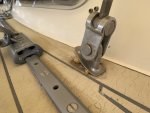
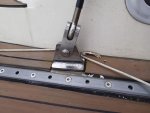
Hi all. My chainplates were new in 2002, I have just pulled them as they needed re-bedding due to the odd leak down below. As they are now out I was wondering if anyone could recommend a way to get their integrity checked? I have heard X-ray could be an option.....

Look forward to hearing from you all.
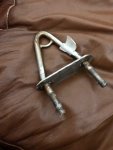
EF9595EF-8D2A-4D34-A316-19F568832C06.jpegWith thanks
 
I'd have a look for a firm specialising in non-destructive testing in your area and ask them. Dye penetrant used to be the standard cheap testing method but I'm not up to date.
 
I'm no metallurgist but the trouble with SS is that it work hardens with age and then they can just break with no warning. Sounds like gunshot when they go. Don't ask me how I know. As others have said best to buy new.
 
I'm no metallurgist but the trouble with SS is that it work hardens with age and then they can just break with no warning. Sounds like gunshot when they go. Don't ask me how I know. As others have said best to buy new.
As you say in your first sentence. 'Work' in this context means plastic deformation, which is not a problem here. If/when these fail it will be due to stress corrosion. X-ray will cost you around £100. Just not worth it. Replace but use plenty of sealant to keep the water out.
 
The problem is knowing that the replacements are any better than what you're replacing.
At least you know the tried and tested ones are basically strong enough.
Is it possible to replace with something which is stronger by design?
 
Bed them in with butyl tape, don't use sealant. Butyl tpe never hardens or goes off, so is much better for all deck fittings. I've bedded my leaking chainplates with it and they've been dry for many years since.

If there's any doubt replace the fittings with new. Not worth faffing about with testing which may, or may not, prove reliable
 
X ray not cheap nowadays, if you can find a friendly NDT company they may do it for you but will be £100-£200, we pay £1000 min per day for on site weld testing
 
I would clean them and remove any rust stains and inspect for any cracks etc and if ok rebed them using butyl strip as a sealant,if in any doubt replace them for peace of mind.
 
If it helps I just had one like that go. I heard of another boat have there’s go and they lost the mast. I’ve been told by various people that those U bolt arrangements are not ideal and to replace with a decent chainplate.
Bascially some water got in a cause crevice on mine. I’m replacing them all with something like the second


EB27379E-9649-489C-831C-01500F9C8DE6.jpeg


09F8D198-098B-4C64-95C5-487AD5979E5E.jpeg
 
As said replace them if there is any doubt about their reliability. Probably easier to replace with more over sized fittings.
Re X ray this would be almost useless unless you know exactly where a crack is likely to be. Xray can detect a loss of material of no less then 5% of the meaterial in the path of the emitter to the detector (photographic) plate. So a shot where the path is perpendicular to the crack will not show up the crack. A shot near to aligned to the crack will show it up. Depending of course on the progression of the crack. You would use a beam perpendicular to the threaded part. But a very close crack would still be hard to see.
Dye penetrant inspection might seem most practical. This requires cleaning the surface of the metal and spraying a penetrating liquid across the surface. The penetrant is then wiped or washed off. Hopefully leaving penetrant in the crack. This residue is developed ie made more obvious by a powder whch draws out the penetrant which can be seen or often shown up under UV light. Works well on very smooth metal but any roughness can look like a crack. You must not sand the surface smooth as this can cover a crack. In OP case this would be hopeless as failure is most likely in the valleys of the threaded part so hard to wipe off penetrant.
Most practical NDT is the mark 1 eyeball. ie a very close examination under magnification. But no guarantees.
I would suggest OP consider using saddle for chain plate. ie a loop of SS with holes each end. Ronstan Stainless Steel Narrow Saddle 5/16 , $7.99 | Whitworths Marine
it would be necessary to try to find even bigger saddle than this. Use then bolts to attach. Fit the fattest bolts with rolled thread you can as failure at the thread is the most likely. ol'will
 
Mine are similar to 1st pic and 37 yrs old. Mine are angle so the hoop is in line with the shrouds. Hoop and rigging is 8mm. Don't know if that's good or bad.
Are most the failures due to the chain plate not being angle, therefore suffering from an unfair angle ?
 
8mm wire chain plate and 8mm rigging seems wrong to me.
The rigging is in pure tension (one hopes!), while the wire of the chain plate is under bending forces.
Proper chain plates made of actual sheet/plate material normally have several times the cross section of the rigging.
 
Evening all - wow, lots of ideas - all of which are gratefully received. Many thanks to everyone who helped to keep me shipshape.
 
), while the wire of the chain plate is under bending forces.
Are you reffering to mine? my chainplate wire is at the same angle as the rigging so no bending forces ?

Why do many solid section chainplates that come through the deck have a loose plate around them rather than a decent welded solid plate which would be a much better seal against water ingress ?
 
Are you reffering to mine? my chainplate wire is at the same angle as the rigging so no bending forces ?

Why do many solid section chainplates that come through the deck have a loose plate around them rather than a decent welded solid plate which would be a much better seal against water ingress ?
The loose plate is just there to seal the hole the chainplate goes through.

Wire chainplates are not straight, where the wire angles at the deck it is bent. Where the wire forms a loop at the top, it is bent.
Unlike the stress in a rigging wire, the loaf on a wire chainplate is not evenly distributed across the wire.
Therefore the chainplate needs to have several times the x-section area of the rigging to have the same fatigue life.
Also the process of making a chainplate from a nice piece of straight wire leaves a lot to be desired in terms of the material properties.
Bending, welding, get your stresses here.
There are a lot of boats out there which seem to have acquired rigging as fat as the chainplate 'U'.
In dinghies, general practice is that M5 u-bolts are marginal/inadequate for 3mm shrouds.
One boat I had, the manufacture was pushing an upgrade of the shroud anchor points to M8, due to failures of M6.
 
Top