
Chain locker question

Thanks to all who posted, esp. Rossynant for the tips and suggestions on the actual chain locker itself. I think 100m of chain is not excessive if you are cruising in difficult grounds where it may be necessary to drop the hook in, say, 20m of water. A tide of 6m would use up 100m of chain with only a 4:1 scope under those circumstances.

...
There is a 120l water tank on the port side which has no effect on the boat trim, even when full. There's currently no counterbalancing weight whatsoever on the starboard side of the
...

100m of 8mm chain in 30m depth (23m charted, 6m tide, 1m freeboard) will be lifted by 190kgf of horizontal loading. That will be about 25kn of wind (steady wind speed) on a 10.3m boat at 30° to the wind.

100m of 8mm chain weighs between 140kg and 150kg in air (120kg to 130kg in water), so it seems to match your water tank quite well.

Best of luck with the cruise...
 
This is what a pile of 50 metres of 8 mm chain looks like. Top to bottom about 18 - 20 inches, I think.
IMG_2934_zps166a52bc.jpg

A money no object solution is to buy stainless steel chain, which piles considerably less. Strength and other properties pretty similar to galvanised steel but about x4 cost.
 
This is what a pile of 50 metres of 8 mm chain looks like.

That pile looks to have a certain amount of support from the shape of the bows, though? I can't imagine something like that standing up on its own on the chandler's floor. Still, the shape I was envisaging for a chain locker in the OP's new position was about three or four feet tall, and quite narrow, which would fit such a pile quite well.

Pete
 
I don't think it is being supported forward to a great extent as the bows are fairly plumb. The chain is fresh back from regalvanising, so probably abnormally rough. I laid it all out on the pontoon to mark the lengths with cable ties and intended stowing it using the windlass, recently refurbished. However, it failed to operate so I did it manually instead, lowering maybe 18 inches at a time. The photo is what I found when I checked below.
 
I don't think it is being supported forward to a great extent as the bows are fairly plumb

Even a vertical wall can support something leaning against it. The washing-up pile next to the sink in our student house was in the corner of two walls, and the pile attained spectacular heights that would not have been possible on a flat table. :D

Pete
 
This is what a pile of 50 metres of 8 mm chain looks like. Top to bottom about 18 - 20 inches, I think.
...snip...
A money no object solution is to buy stainless steel chain, which piles considerably less. Strength and other properties pretty similar to galvanised steel but about x4 cost.
Nice pic.

Yes, I did toy with ss chain up to the point that I priced it. £2k5 for the chain alone is too much though, that's as much as I expect to pay in total for anchor, chain and windlass. And, am I wrong in thinking that it's preferable to have an ss anchor with a ss rode ? If so that's another £1k1 or so extra on top...

Boo2
 
Boo - I'm very interested to hear what you decide is the best option here. I expect to be making an offer on a UFO pretty soon and (assuming that all works out) plan to do a bit of work on her to improve the anchoring situation. It would be good to understand where you get to.
And to hear any other UFO buying tips!
 
Hi,

I thought I'd show today's progress. First pic shows all the holes drilled and the windlass offered up. Thankfully all 7 holes are in the right place, I didn't take a pic from below so you'll just have to take my word for it :p. The holes for the fixing studs have now been filled with epoxy & microballoons filler ready for final drilling, the two 60mm holes for the chain and the drive shaft have been painted with epoxy. This double drilling palaver is to ensure the balsa core won't get damp if water makes an ingress past the fixing bolts.
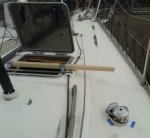
The observant will see that there are 2 laths taped together and fixed above the deck hatch. This was to allow the position of the bulkhead to be transferred to the deck by placing the ruler between the laths and marking the deck. It may not be apparent but the fore and aft position of the windlass is fixed by the bulkhead and the lateral position fixed by the position of the fillet between the coachroof and deck. This method permits the two separate restrictions to be combined.

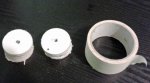
The second pic shows the deck cores after I'd managed to knock them out of the hole saw using a screwdriver and hammer. Upper laminate is 5/16" and lower is 1/8", core is balsa end grain at 1/2" thick. One core shows where I drilled a small test hole before going for it with the hole saw, this was not in the ideal place so I moved it about an inch to get the final position as I wanted.

Thanks to all for the interest and the replies and tips,

Boo2

windlass_offered_up.jpg

cores.jpg
 
Top