Centaur with osmosis

Lenster

N/A
Joined
23 Apr 2016
Messages
20
Visit site
I have my Centaur hauled out and on my land waiting to have osmosis treated. I am going to do the job myself (mostly) and not in any rush. The surveyor who took the moisture readings identified that the levels were rather high. So while she is out I am going to do a full restoration and get her back to looking good again.

Soooo options on getting the osmosis treated were

Fully treated by a professional - not affordable
Do minimum and take a scraper/grinder and dry it out.. not a fan
Do a peel - get a quote for someone to come out and do this .. waiting on a quote
Do a peel and hire a Gelplane type tool ? looking around but not found any yet
Do a peel and buy a Gelplane type tool and re sell it - think this may be a good idea
Media blast by a professional - quoted at £1400 - its an option but if the osmosis has gone down to the laminations then this wont be enough so unsure yet..

grateful for some thoughts on this ?

regards

Lenny
 
Absolutely do not do anything dramatic/expensive/really hard work to a Centaur based only on "high moisture readings". The boat is at least 45 years old and it has taken that long for some moisture to get into the glass/resin hull. If there are visible blisters (and you don't say there are) open them, clean out and fill.

Centaur hulls were "overbuilt" compared to most modern boats, despite the easily fixed "keel attachment/flexing" issues on some boats. You could ignore high moisture readings and the hull would probably be still seaworthy in another 45 years time. A professional "full osmosis treatment" would cost as much as the value of the boat (possibly more) and would not actually increase it's resale value by a tenth of that cost.

Who was the surveyor? Did he actually suggest a gelplane level treatment? Getting the gelcoat off is the cheap/easy part. Putting back an sound epoxy replacement is the expensive/difficult part.

And to really put you off: I know owners who had a pretty 30-footer classic long-keeler "full osmosis treated" by a well known boatyard based ONLY on high moisture readings. Ten years later they came to sell the boat and the surveyor whom I know found the epoxy replacement was "soft" - I attended and agreed - it had about the consistency of the rind of Parmesan cheese - you could dent it with your fingernail if you pressed really hard. Clearly either the quality, mix or the application of the epoxy had been horribly wrong. Despite the owners going back to the yard that had done the work they refused even to consider fixing it, except at a HIGHER price than their standard per foot charge for an osmosis treatment, as it would be ".... difficult to get back to a sound bit of glass." A very nice old boat instantly lost almost all of it's value. The sale went ahead, but at a hugely reduced price. That was a one-off, and most osmosis treatments do work at least for a while. You will find some 1960s Nicholson 32s that have had more than one osmosis treatment in theuir lives. Also some that have had high moisture levels ignored and are still happily sailing.

Buy a recent edition of Hugo du Plessis's book - https://www.amazon.co.uk/Fibreglass...sprefix=fiberglass+boast,stripbooks,77&sr=1-4 and read it before you do anything.

Or read my own text -https://www.yachtsnet.co.uk/osmosis.htm
 
"Rather high" would make me think I wouldn't bother doing anything drastic. Just pop and fill the holes. You will not get your money/time back on a Centaur.
The problem is that there are a LOT of blisters so I thought that would actually be more work than planing them.
 
The problem is that there are a LOT of blisters so I thought that would actually be more work than planing them.
There would have to be an awful lot of blisters to make it more work than planing. There are a couple of English tradesmen in Port Napoleon who do that work that I was looking at - they are so precise it is amazing. I think if you were to buy/hire a gel planer it would take you a few boats to get to their standard. You might end up bodging it. Bodge factor for just doing the minimum is very much lower.
 
Absolutely do not do anything dramatic/expensive/really hard work to a Centaur based only on "high moisture readings". The boat is at least 45 years old and it has taken that long for some moisture to get into the glass/resin hull. If there are visible blisters (and you don't say there are) open them, clean out and fill.

Centaur hulls were "overbuilt" compared to most modern boats, despite the easily fixed "keel attachment/flexing" issues on some boats. You could ignore high moisture readings and the hull would probably be still seaworthy in another 45 years time. A professional "full osmosis treatment" would cost as much as the value of the boat (possibly more) and would not actually increase it's resale value by a tenth of that cost.

Who was the surveyor? Did he actually suggest a gelplane level treatment? Getting the gelcoat off is the cheap/easy part. Putting back an sound epoxy replacement is the expensive/difficult part.

And to really put you off: I know owners who had a pretty 30-footer classic long-keeler "full osmosis treated" by a well known boatyard based ONLY on high moisture readings. Ten years later they came to sell the boat and the surveyor whom I know found the epoxy replacement was "soft" - I attended and agreed - it had about the consistency of the rind of Parmesan cheese - you could dent it with your fingernail if you pressed really hard. Clearly either the quality, mix or the application of the epoxy had been horribly wrong. Despite the owners going back to the yard that had done the work they refused even to consider fixing it, except at a HIGHER price than their standard per foot charge for an osmosis treatment, as it would be ".... difficult to get back to a sound bit of glass." A very nice old boat instantly lost almost all of it's value. The sale went ahead, but at a hugely reduced price. That was a one-off, and most osmosis treatments do work at least for a while. You will find some 1960s Nicholson 32s that have had more than one osmosis treatment in theuir lives. Also some that have had high moisture levels ignored and are still happily sailing.

Buy a recent edition of Hugo du Plessis's book - https://www.amazon.co.uk/Fibreglass-Boats-Construction-Blistering-Maintenance-ebook/dp/B00UFPPBKO/ref=sr_1_4?crid=2PCQ1N92F3C3R&dib=eyJ2IjoiMSJ9.QZTAS2huZykAAlLXBigrgeNgyAojJ3kHXdKpylpGgLz_aF8JN-8od6uvldYRQ3c4Zziip5JsBJwrJOypSZqSdKBdlf-e1Ms2-Hx6WMSZnS4aup5UxiZ-B4lr6Dk8X246nkeCSwCZz7bPvEemk6uIhhX0LNJ4gFx2eFXt1EcGHtg-dK0y-AamfM3L82SsMD-X7ttB0mI1ovkQNmqSEB2HTD-mqswIi2KPxoExL-8PXsE.s9sfnBOS5KudaWMxPPujPoJOU5Dp_lYFu55ix3QlvQ4&dib_tag=se&keywords=fiberglass+boat&qid=1767201007&s=books&sprefix=fiberglass+boast,stripbooks,77&sr=1-4 and read it before you do anything.

Or read my own text -https://www.yachtsnet.co.uk/osmosis.htm
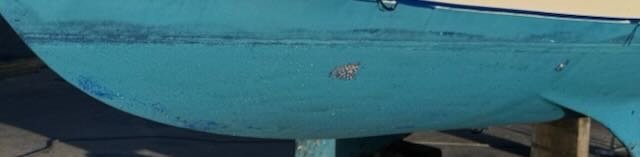
Thanks for the feedback here, the advice I got from Tim the surveyor was to media blast and dry her out which is one of the options above but at £1400 for the media blast I thought that was a lot of money for what could be a part solution. However, I fully understand the caution that has been outlined here by all of you regarding taking on the restoration work to this extent. I added a pic below to show just how many blisters there are.. I have decided that this boat is going to stay with me for a long time and warrants as much work as I can put my time to while she is out.. as an engineer in aviation, I have a habit of taking things to the extreme so I thought I would reach out and take in some advice. I will take a look at both references before taking any decision... I guess my thought process was based on the fact that there seems to be a lot of blistering and therefore I was at the more invasive end of intervention ...
 

Attachments

  • IMG_3710.jpeg
    IMG_3710.jpeg
    17.6 KB · Views: 90
My dad osmosis treated his Finnsailer 35 in the garden - it had a severe dose of the osmosis pox.

He hired a plane and chewed off the gelcoat down to the mat, washed out all the exposed mat and let it thoroughly dry out - the process took ages. It would have been a lot easier if the boat had been in an enclosed, temperature controlled shed - as it was, he hung plastic curtains round the hull, stuck on with tape if I recall correctly.
He then re-gelcoated by hand.

Absolute b!tch of a job .... he did it because he couldn't (rather wouldn't) get it done professionally.

It did cure the problem though.

Good luck with what you choose. I'd pay someone else to do it ... but that's me, I always pay to have gelcoat/GFK work done as I'm crap at it ... somehow, the guy who filled numerous holes in my current boat after I had removed cr@p equipment managed to make the repairs invisible .... I could not have achieved the same finish.

PS: BOAT stands for Break Out Another Thousand ... regardless of age or value, if it's your pride and joy, do whatever you feel it needs (y) .... @Concerto completely restored an aged Westerly and is as happy as a pig in sh!t I believe ... and it's a beautiful restoration job.
 
You don’t say if you are retired or not and if vessel is ashore but I recall watching a chap on small yacht ashore at Gosport take about a month to cut out and repair multitude of osmosis bubbles by cutting out by hand . if you have time and patience I’m sure there’s lots of info on utube about how to go about task. You might join westerly owners association to gain further views as to how other centaurs have addressed.
 
My dad osmosis treated his Finnsailer 35 in the garden - it had a severe dose of the osmosis pox.

He hired a plane and chewed off the gelcoat down to the mat, washed out all the exposed mat and let it thoroughly dry out - the process took ages. It would have been a lot easier if the boat had been in an enclosed, temperature controlled shed - as it was, he hung plastic curtains round the hull, stuck on with tape if I recall correctly.
He then re-gelcoated by hand.

Absolute b!tch of a job .... he did it because he couldn't (rather wouldn't) get it done professionally.

It did cure the problem though.

Good luck with what you choose. I'd pay someone else to do it ... but that's me, I always pay to have gelcoat/GFK work done as I'm crap at it ... somehow, the guy who filled numerous holes in my current boat after I had removed cr@p equipment managed to make the repairs invisible .... I could not have achieved the same finish.

PS: BOAT stands for Break Out Another Thousand ... regardless of age or value, if it's your pride and joy, do whatever you feel it needs (y) .... @Concerto completely restored an aged Westerly and is as happy as a pig in sh!t I believe ... and it's a beautiful restoration job.
I am not worried about it being a bitch of a job to be honest, that kind of is part of the attraction in an odd way. To some extent I a not so worried about the long term cost - just trying to be as efficient as possible with the outlay. If I spend money on someone coming in to do the work then thats money I dont have for other work.. that said its always about balance. I have owned this old girl for 15 years and neglected her rather badly in the last 5 years due to work and other commitments. As a result I am very aware of the BOAT concept lol.. I intend to pull the engine out, replace the cutlass bearing and do a full rewire/prettification update internally so in for a penny ...
 
You don’t say if you are retired or not and if vessel is ashore but I recall watching a chap on small yacht ashore at Gosport take about a month to cut out and repair multitude of osmosis bubbles by cutting out by hand . if you have time and patience I’m sure there’s lots of info on utube about how to go about task. You might join westerly owners association to gain further views as to how other centaurs have addressed.
I am not retired and as such the thought of cutting out by hand was discounted as taking too long.. I dont expect to be retired in the short term so time is not so much on my side in terms of the prep.. I am not in a rush to get her back in so drying out for a long while is fine as an option while I get the rest of her shipshape.
 
I should think the cost of the materials and the storage on the hard would c9me very close to the value of the boat. Have you considered buying another boat with a knackered rig, and transplanting everything. That job you’re talking about is a labour to do for live only. Do you love your Centuar enough? You will never see that money again.
 
I should think the cost of the materials and the storage on the hard would c9me very close to the value of the boat. Have you considered buying another boat with a knackered rig, and transplanting everything. That job you’re talking about is a labour to do for live only. Do you love your Centuar enough? You will never see that money again.
oh I am well aware that this is a sunk cost job - its not about the return on investment at all and she means very much that much to be a labour of love.. not a sensible choice in terms of investment I know. Storage is free as its on my land tho.. thats a small positive lol
 
Free storage may encourage you to take many years to finish the job. I would take Chiara's slave's advice. What engine is in this boat? Is the engine at the end of its life?
 
I have my Centaur hauled out and on my land waiting to have osmosis treated. I am going to do the job myself (mostly) and not in any rush. The surveyor who took the moisture readings identified that the levels were rather high. So while she is out I am going to do a full restoration and get her back to looking good again.

Soooo options on getting the osmosis treated were

Fully treated by a professional - not affordable
Do minimum and take a scraper/grinder and dry it out.. not a fan
Do a peel - get a quote for someone to come out and do this .. waiting on a quote
Do a peel and hire a Gelplane type tool ? looking around but not found any yet
Do a peel and buy a Gelplane type tool and re sell it - think this may be a good idea
Media blast by a professional - quoted at £1400 - its an option but if the osmosis has gone down to the laminations then this wont be enough so unsure yet..

grateful for some thoughts on this ?

regards

Lenny
I did 'pop and fill' on my old Atlanta and a complete re-epoxy on out Neptunian some years later ( the gel coat was already blasted off when I bought her) I spent some days filling/fairing the hull but the 5 coats of epoxy went on over 2 days ( me and 1st mate!)
You could try pop and fill over a couple of square meters this time out, once you get the tools sorted and your technique its not hard. I did mine over 4 seasons! As I was getting bored and lazy after doing a quarter of the hull ( Know your limitations !!) On the 4th year there were only a few new blisters on the year one section !!
 
Free storage may encourage you to take many years to finish the job. I would take Chiara's slave's advice. What engine is in this boat? Is the engine at the end of its life?
nope - its going to be sorted regardless so thats not an option.. engine is fine its a low hours Volvo Penta 2002
 
I once bought a boat with about 200 £1 coin size blisters. Ground out, filled over a few days ashore (it was in Hong Kong so longer term shore or undercover storage near impossible). 2 coats of two-pack polyurethane as a protective (this was before epoxy was the choice). Sold the boat maybe 12 years later with about a dozen new blisters.
 
Thanks for the feedback here, the advice I got from Tim the surveyor was to media blast and dry her out which is one of the options above but at £1400 for the media blast I thought that was a lot of money for what could be a part solution. However, I fully understand the caution that has been outlined here by all of you regarding taking on the restoration work to this extent. I added a pic below to show just how many blisters there are.. I have decided that this boat is going to stay with me for a long time and warrants as much work as I can put my time to while she is out.. as an engineer in aviation, I have a habit of taking things to the extreme so I thought I would reach out and take in some advice. I will take a look at both references before taking any decision... I guess my thought process was based on the fact that there seems to be a lot of blistering and therefore I was at the more invasive end of intervention ...
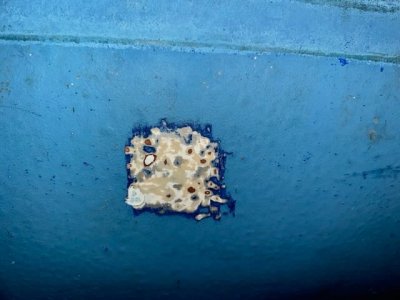
Can't really work out the blisters on the photo. You able to post a picture showing a smaller area ?
 
Can't really work out the blisters on the photo. You able to post a picture showing a smaller area ?
sure - they are all quite small but there are a lot of them. This is an area stripped back to take a reading. Several popped with the vinegar smelling fluid in them
 

Attachments

  • IMG_3755.jpeg
    IMG_3755.jpeg
    66.6 KB · Views: 70
Top