Cat advice

stevefisher

New Member
Joined
11 Aug 2018
Messages
10
Visit site
We are looking at getting a sports cruiser and the full compliment of crew will include a small child and a rather clumsy cat. I am not bothered about the child--they are easy to hose down. My question is : when the said cat falls into the drink what is the best method of retrieving her (i.e. the one that will involve the least injury to me). Also, what is the best way to 'desalinate' her? What do other people do with their cats when they fall into the sea? Your collective wisdom would be appreciated--as well as any other tips and tricks on looking after our feline companions on board [I have already worked out the litter tray will need to be secured in some way!]

Thanks

Steve
 
I have never tried taking a cat to sea but I have tried to wash them in a bathtub - and they hate it. Not even sure cats can swim or even stay afloat so if you think it is a real possibility perhaps do a experiment in controlled conditions.
Really wanted to take our two cats on the boat with us but decided that they would not enjoy it - perhaps because they are territorial and whenever we took them out on 'outings' they seemed rather fearful. Hope your cats are different.
Actually I now remember a You Tube video of a livaboard couple in Thailand who when they woke one morning (in an anchorage) the puss was gone - luckily for them all the cat was found by another cruising couple some distance off so it shows they can at least stay afloat.
Perhaps some of sort electronic collar is on the market which sounds an alarm if the wearer goes in the drink?
Good luck
 
Well, our ship's cat can swim well and will climb out if he has something to climb - an old towel tied to a swim-platform cleat is the answer. If the weather is at all bad or if we are moored up in a strong current, he wears a lifejacket which makes recovery easy - a handle on the back. When he was younger, we used the smallest size of dog lifejacket - there were no alternatives. Now, Baltic make purpose built cat lifejackets in the Maja range. They are a better fit on cats - they hold their heads lower than dogs and a small canine lifejacket is not very comfortable for a cat.

If he/she falls in, just help him/her get out, towel off the worst of the water and let them sort themselves out. Cats have very strong kidneys and can drink sea water if there is no fresh water available - provided he/she has not got oily in the water, they can safely lick themselves dry.

Cats do need some exercise and you'll need to work out how to give him/her a walk without losing them. I recommend getting a Loc8tor (https://mytabcat.com/) to go on his collar - it will help find him if/when he wanders off. They love to explore small, dark places and you will certainly lose him into the bilges or engine bay from time to time. Ours disappeared and the loc8tor tracked him down to the steering gear bay in the transom. Another reason for putting a lifejacket on him/her is as a harness to take him walking under control. Get the jacket onto him in your house and practice walking him on a leash in the garden and the neighbouring streets - that way, if he gets free, he will be near home and will come back for supper. Don't test him on a leash for the first time around a marina that is a hundred miles from home - that is a good way to lose him for ever.

They do get sea-sick - break him/her in gently - potter round the harbour for ten minutes rather than setting straight out on a ten hour passage. We did try motion sickness tablets (intended for animals) on ours, but it was not very successful - cats are very difficult to prescribe for and the dosage is very unpredictable. Our poor moggy was spaced out for more than a day after the tablet whereas he generally gets over sea-sickness within half an hour of arriving at the destination. Let him find a position where he is comfortable, then make up a safe bed for him there and encourage him to settle there when you set out. Until he proves you wrong, assume that he is going to be sick and, potentially, pee where he is sleeping - protect your bed and other upholstery!

Our cat has spent most of his life afloat - and we know several other ship's cats that are perfectly happy at sea. He's fine around the marina and expects to go out for his evening walk on his leash about 9pm every night. He enjoys going for a walk along the beach and pokes around in the sand looking for things that crawl out from under rocks. He used to dive in off the boat after ducks, but he's come to understand now that they can always out-swim him. When we are under way, he usually goes to bed, but there was a very amusing moment a few years ago when we were cruising across the Thames Estuary and he came out to doze on the transom. A seal suddenly popped up just behind the boat and I'm not sure which was more surprised - the cat or the seal.

Do prepare for difficulties. Practice walking on a leash near home before going away, and have a small pet carrier onboard just in case you need to abandon ship - you don't want to be taken onto a lifeboat with a terrified cat loose in your arms!
 
Cats have no problem swimming , they just need something to help the, climb out , as already said a tower , ours have a rope ladder .
We always give our a good showering if he falls in to get all the salt off , he don't like it but it's has to be done , them licking them self clean will do them plenty of harm .
Our get sea sick the first time out each season after we been in the marina for a few months , then he fine , mostly sleep all day while out sailing but as soon as he smell land he up .
Winter time we just let him off the boat , in the summer we mostly anchor but now and then we do go onto a quay , then it depend where we are , if there no cars he goes off never goes far.
Make a scatching pole out of the mast support by putting a rope around it .
 
Last edited:
Get in contact with a Jamie and Liz from Follow the Boat; they’ve had a cat on board for a long time (it’s a mono but suspect most of the issues are the same)
 
Get in contact with a Jamie and Liz from Follow the Boat; they’ve had a cat on board for a long time (it’s a mono but suspect most of the issues are the same)

Indeed! It was after watching this video (https://youtu.be/iLOLWY9RDxE) that we decided to try taking our moggy to sea. He was young - about a year old - and adjusted quickly. But we have met other sailors who managed to introduce middle-aged cats to the sea.
 
Our have been on board full time for nine years now , what the op needs to be awhere of is not everyone is a cat lover and cats love to explore so when in a marina or near other boats you really got to make an effort to stop them going onto other people boats , and anyone who as a cat knows that's not easy .
We unusual tell people not to encourage our cat to comes aboard please but no matter what cat lovers who ant got one will . Others who don't like cats we tell to just throw water over him , we won't get up set and he won't come back .
In nine years we had one big row with one cruiser over the cat in a winter marina ,
they kept birds in cages and would go off for days leaving them on deck , knowing very well three boats away was a cat .. After months of keeping him away one day like a flash he was on boats luckily all he did was play with them , but it did cause a big row , although everyone else in the marina tho it was funny , the general feeling was , birds shouldn't be kept in cages and cats wil be cats .
More time then not people are ok with a cat , it's not the first time someone have moved to a berth near us knowing that if there a cat about there not going to be any mices or rats .
 
Last edited:
Some heart warming stories posted in this thread (but probably only for the cat lovers).

Our story is somewhat different. Our cat was about 4 when she abandoned her previous slaves and adopted us. We live about 2 hours from the marina and trying to introduce her to the boat didn’t work. We are weekenders, not liveaboarders. The car journey for her was not a pleasant experience and she screamed all the way. We had discussed our plans with the Vet and we’re given tranquillisers but we decided against using them, for reasons as already posted. We were at the boat for a week and she hid for most of that time. She refused to eat and was not sociable at all. At home, we tried to introduce her to a lead/tether in preparation but that didn’t end well, either.

Needless to say, the homeward bound car journey was also very vocal. Once home, she stretched and rolled, clearly happy to be “home” but with one of her amusing facial expressions to let us know to “not do that again”.

While crusing we’ve seen a few cats living contentedly aboard. We always speak to the owners and their common theme seems to be introducing them from a young age. No doubt it can be done for an older cat but they have very strong wills and let you know when they’re not happy.

Much as we would both love to have our cat with us we’ve concluded that she is happier and it’s safer to leave her alone at home. For a weekend, we use clockwork feeders, for longer periods we employ a cat sitting service who visits twice per day.

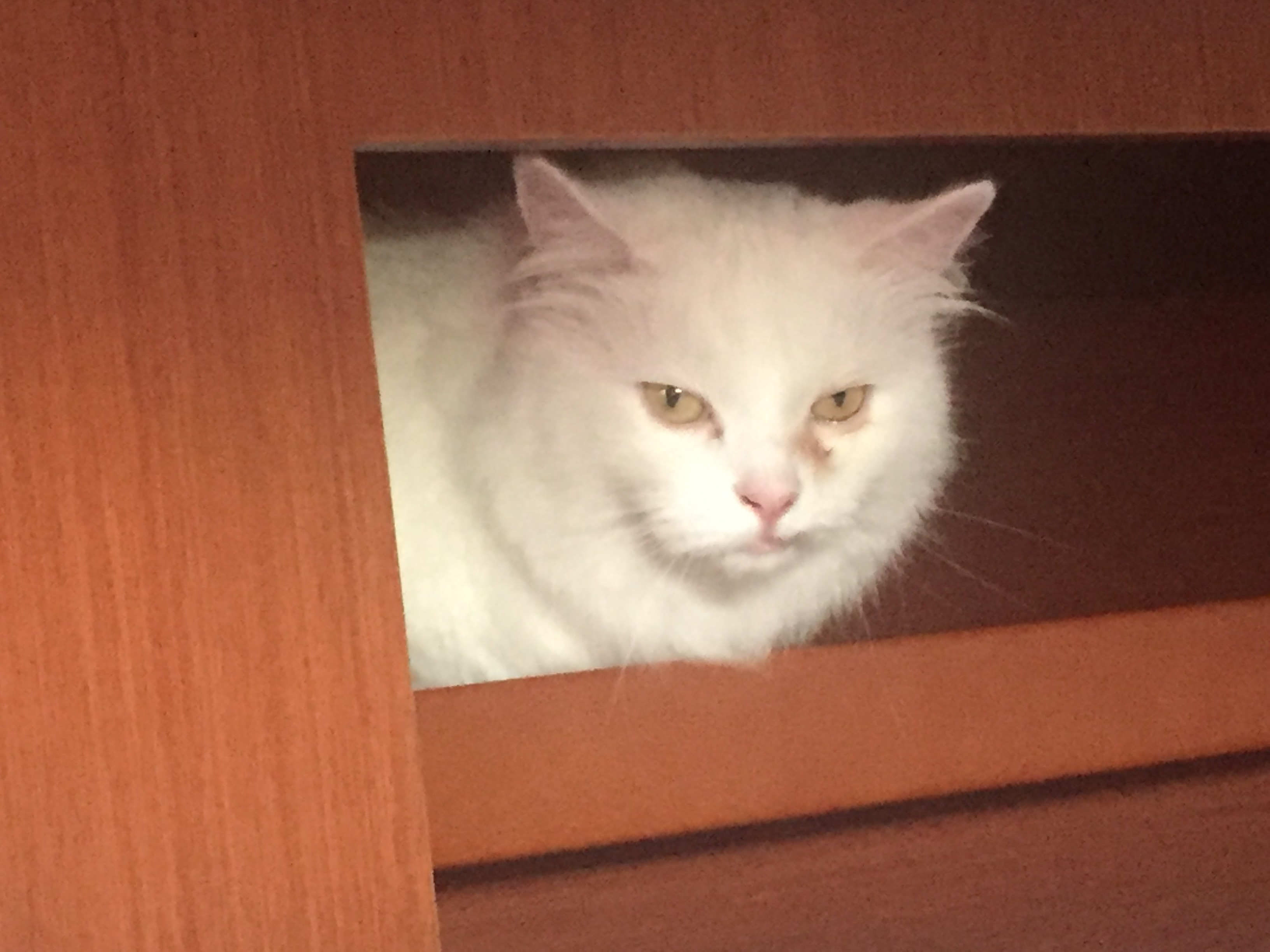
Here's a picture; she was not happy to be aboard!
iPhone%20to%20Aug%202017%20196%20%281%29.JPG
 
Last edited:
Thanks. She's an indoor cat so I am hopeful... Some great advice and caveats here. We will just be doing days/weekends and the occasional week I imagine. If she takes to it we will be delighted, but if not, she can always stay at home and sulk!!!
 
Last edited:
Thanks. She's an indoor cat so I am hopeful... Some great advice and caveats here. We will just be doing days/weekends and the occasional week I imagine. If she takes to it we will be delighted, but if not, she can always stay at home and sulk!!!

Break her in gently and be prepared for some histrionics to start with. It would certainly be wrong to claim that they all take to it, but a surprising number do. As far as traveling is concerned, try different times of the day. We live about two hours from the boat and ours will grizzle and moan all the way in the morning, but simply curls up on my wife's lap and sleeps through the journey in the evening. It is absolutely repeatable - week after week. Again, if you have any significant journey between the house and the boat, get her used to traveling in the car first with short trips round the streets near the house first. For most cats, the only times they go in a car is on the way to the vet - let her learn that going in it does not automatically mean that she is going somewhere frightening. Assume that she'll need to be in a pet carrier in the car, but experiment with her free close to your house. Ours always travels free - sitting on my wife's lap and looking out at the world around him. He would be very distressed locked up in a small box for the journey. make sure you have the pet carrier readily available in the car - to lock her up safely if you have a breakdown or accident.

There are pheromone sprays that you can buy from good pet shops that can help to calm a nervous cat - we find that they are quite useful to help get a good night's sleep while on the boat - without them, he tends to wake up at 3am, bored and wanting to play.
 
Thanks. Madam does have a habit of being a complete lunatic in the middle of the night.IMG_20160809_080715.jpg
 

Attachments

  • fullsizeoutput_895.jpg
    fullsizeoutput_895.jpg
    320.8 KB · Views: 0
P.S. If you have any length of journey between the house and the boat, then disposable nappies are your friend! Line the pet carrier with several to catch any "accidents". If she prefers to travel free on someone's lap, then wrap several disposable nappies in an old pillow case and use it as a pad under her.
 
We took our fairly elderly cat from Caernarfon to Howth before we set off on our travels. He was headed to Dublin to live with our daughter as we felt he was too old to adapt to life aboard. He really didn’t like the trip; spent most of his time in the saloon by the mast post. Didn’t eat, drank only a small amount and generally made sure we understood that this sort of thing was beyond the pale.
If he’d been much younger it would have been worth spending time with a slow introduction to the boat and perhaps all would have been well but with a cat the wrong side of 12 years old, it was just too big an ask. There was also the concern about what would happen if we needed to park the boat and return home in a hurry, as we were living aboard full time. So, all in all, the best option was the one we took, which gave him another 4 years of quality time in congenial surroundings.
Circumstances have now changed. The chances of being called home in a hurry have largely disappeared and were now on the lookout for a suitable kitten to start the ball rolling again...
 
Most cats do well on board although older cats may take a while to get used to a waterborne life. I am a full time liveaboard usually anchored out so I do not have a problem of my cat going walkabout. Marina bound cats frequently explore other boats on the dock.

As others have said cats are good swimmers and can get back onboard themselves using a piece of rough rope or net.

I have been told that cat's kidneys are fairly fragile and that kidney failure is a common cause of cat death so I have always given my cat a freshwater shower after he goes for a salt water swim. He is OK about this until I do his head. My current boat cat has only fallen in three times in 8 years but a previous boat cat used to run off the side deck every couple of weeks and would climb back onboard and come looking for me to get his shower. He was called Random Numbers No Brain or Rumba for short. He lived to 18 on board a variety of boats.

View attachment 72950View attachment 72951
 
To quote Wikipedia :

" Cats' feces are comparatively dry and their urine is highly concentrated, both of which are adaptations to allow cats to retain as much water as possible.[31] Their kidneys are so efficient, they can survive on a diet consisting only of meat, with no additional water,[79] and can even rehydrate by drinking seawater."
 
Top