Cast iron keel fitting adaptor

fisherman

Well-Known Member
Joined
2 Dec 2005
Messages
19,675
Location
Far S. Cornwall
Visit site
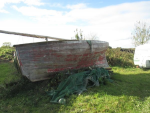
One problem with my old boat is fitting a cast iron keel, if I can find one, bolts will not align with current holes. What if I make an adaptor plate? Say, 12mm steel, bolts up into the boat and down into the keel?
I have yet to get a quote from Irons Bros, but am told to expect expensive and difficult to fit.
 
I thought you were going to have one cut from solid steel? Did that turn out too expensive?

However, you could consider making a wooden pattern and getting it cast in iron for you - must be at least one foundry left in Cornwall? I would have thought making the pattern should be fairly straightforward with your carpentry skills - just need the correct allowance for shrinkage factor (foundry should be able to advise - or maybe Google?).
 
Any reason you don't want to plug the old holes and drill new?
No not really. I'm sure I can make a wood blank and drill the exising holes down through. First step is to find where the old keel went. I spoke to a shipwright yesterday and his prognosis was not encouraging, given the hull work, no keel, no spars no sails......but I'll soldier on for a bit. Douglas fir for a mast, £900.
He had a 35ft or so in the shed, the lead keel, 5.5tons, was £22k, but the hull was a complex shape, mine is flat straight and parallel. Yes, Mike, steel may be the answer.
He said the numbers don't add up unless you have a client with deep pockets, which is not my case, not looking for profit, but not wanting to spend a pile either.
I may end up offering it at a few hundred pounds, inc engine seen running and limited delivery, or do the minimum work to complete the hull. It has all new planks but two missing, frames all good, no deck or topsides.
 
Not sure how long you plan on owning her but steel bolts will cause iron sickness in the wooden keel. Event it will need replacing.
 
A nice old boat, here is my cheap and dirty solution: How about fabricating a hollow keel in mild steel, and filling it with concrete and scrap metal?
You should get the box galvanised first, if affordable.. then fill it with scrap steel punchings, sash weights, fishplates etc.
You could use galvanised keel bolts through the original holes in the wood.
( Concrete and scrap iron are used in some quite respectable MAB's with encapsulated keels...)

Zinc won't do any galvanic damage I believe.
 
Just speculating but I find it odd that a boat of that vintage and size with a straight keel should have an iron keel of any sort. I would have thought a centre plate or perhaps lee boards for getting lateral resistance and internal ballast for stability. Is OP expecting to find a fin keel? I would not think so. Is he expecting to find a very long shallow keel of steel. Perhaps. Are there any drawings of the design? ol'will
 
I have a photo of her dried out, I extrapolated the size of the, evidently cast iron, keel: about 3m long, 300mm deep and 65mm wide, hence about 450kg....if it was cast iron. I can see the rust so yes. Lead would have been 726kg by the same calculation.
I don't think she would like drying out with that much internal ballast. Frames are very light, planks are 20mm pitchpine.
I wonder what a slab of mild steel, shot blasted, primed and two pot epoxy, which I can get done locally, would be like, density slightly more. Sacrificial piece on the btm for grounding....? There is laser and waterjet cutting here also, can do up to 9in thick. Have to remember if Ferris had modern methods to hand he would have used them.
Just had an email from the previous owner, he got the boat without any keel, so thinks it had been sold. This means the holes he drilled in the new keel are more in hope than expectation.
 
Just had an email from the previous owner, he got the boat without any keel, so thinks it had been sold. This means the holes he drilled in the new keel are more in hope than expectation.
He's made work for you for sure. No reason a laser/jet cut slab of dead mild won't work, although I'd be surprised if they can pierce 9" for keelbolts and in any case pierced holes would be tapered, so drilling conventionally is more sensible. Might look quite 'square' unless they can chamfer it at the same time, doing it afterward with powertools would be quite wearing. If you're intent on it being on a drying mooring getting the keel galvanised would be better for rust prevention,
 
He's made work for you for sure. No reason a laser/jet cut slab of dead mild won't work, although I'd be surprised if they can pierce 9" for keelbolts and in any case pierced holes would be tapered, so drilling conventionally is more sensible. Might look quite 'square' unless they can chamfer it at the same time, doing it afterward with powertools would be quite wearing. If you're intent on it being on a drying mooring getting the keel galvanised would be better for rust prevention,
Sorry, forgot, the treatment includes zinc spray. I have used it on steel superstructure, 'A' frame and mast, it looks really good topsides. They treat the local navigational buoys this way. Last time it was £65 per m sq, shot blast, zinc, two primers, two pot finish.
The old keel had a rocker in it, was half jointed with wood fairing fore and aft, not too difficult with water jet cutting.
Steel 65mm thick could have a square slot cut through from the side to accomodate a nut on a bolt, so only a short hole to be drilled from the top. Could also be tapped. or I could fabricate it from two pieces, the top with captive bolts (stainless?) upward, drilled down through the boat in situ, the bottom bolted to it similarly downwards, the whole then sprayed and painted as above. Two bits easier to handle. This job is growing arms and legs.
 
...on the downside the engine is seized. Although the piston is free, I lifted the barrel, the rusty flywheel which incorporates the generator seems to be, as they say, stuck. I can't pull the gearbox off as evidently the splines are stuck in the drive plate, I can see it pulling apart through the starter motor hole.
I can salvage the starter motor which spins and solenoid works, and the gearbox, Hurth HBW 50 must be worth the extraction, it operates. I'll have to destroy the bell housing to detach the drive plate from the flywheel.
I don't expect many people will be running an 8hp BMW so other spares not wanted. I'll salvage the raw water pump, not much else on it......unless you know better, free to good home.
 
They're not that bad, just like every other orphan leisure marine engine something of a liability in terms of parts availability, on the wet side at least.
 
Top