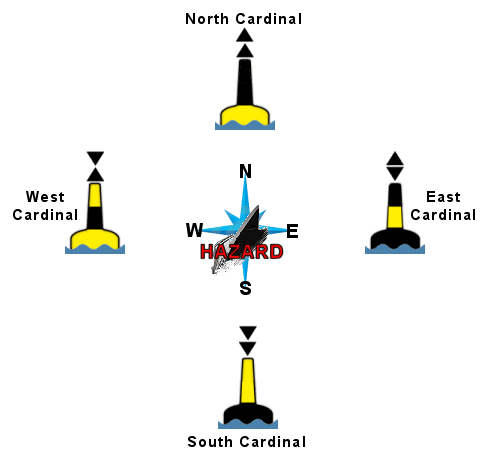
Cardinal Buoy System

I think I can see the thrust of your question, I also find it difficult to tranpose "hazard" and "safe water" points of view, so I stick to one:
Personally I tend to think of a north mark as "hazard to the south" etc in the hope that this reinforces the significance of the mark.
I usually end up mentally visualising any given cardinal mark as if it is round a small island, two up-arrows at the north end, two down at the south end. Apexes towards... vaguely like a "W" on its side for west. That way I can plot myself on my mental map. (It's a very limited mental map! we are talking about pilotage here, not passage making).
 
As a few others have pointed out, you must look at buoyage in conjunction with the chart. Buoys are not like traffic signs which must be obeyed. In isolation, they do not usually convey enough information for safe navigation.

Buoys are often located where they are of interest only to relatively deep draught vessels. Nobody is going to mind if you look at your chart and having correctly identified the buoy decide that it's safe to pass it on the "wrong" side.
 
All I'd add is that your 'need to look at the chart' is what I'd do every time I approached a cardinal I was not familiar with.
I haven't heard anyone propose a better alternative to the current system but I'll give an example of an odd one to look out for.

The East cardinal at the entrance to the Hamble marks the southern extremity of a spit. I guess the reason may be due to the fact there is a South Cardinal a little further south and a need to avoid confusion.
Or maybe to indicate the presence of the bank to big stuff going up the channel, but it is only a small beacon.

When approaching this East cardinal from the south, it was the source of a debate between myself and an experienced skipper/owner. My plan was to pass it to port (east) since that was where the chart said there was more water and no potential obstruction. The skipper insisted on rounding the mark to starboard as he always did.
There was no problem since we were at high water and we followed his route without incident.

It was however a discussion point and one reason I always check the chart when rounding an unusual cardinal.
 
They are supposed to be positioned so that the majority of vessels will approach them from the 'safe' direction. Consequently, you come across them before encountering the danger. If you then follow the meaning of the mark, such as 'safe water to the south' you will avoid the danger.

If you have a large shoal area you could not mark its southern end with a cardinal mark on the north end saying 'danger to the south' or vice versa. You would be on top of the shoal by the time you could see the mark.
 
If you sail in the Baltic the safe channels amidst the 80000 islands and rocks of the Finnish/Swedish Archipelago are marked using cardinals made from vertical pillars in black/white white/black white/black/white or black/white/black ie NSEW. These may cross like roads between islands, so having laterals would fail utterly. There is a logic to it, usually the channel markers are either NS or EW but at first it seems crazy. You get used to looking for the monochrome sticks where usually you would look for red/green or cones and cans. After a while it all seems quite normal!
 
Don't worry - it seemed like that to me at first and it was only once I got used to using the system it seemed a bit more logical. On the subject of recognition, I was taught that the arrows point up for north and down for south, but that the east pattern was the shape of an egg (e for egg, geddit) and the west pattern was the shape of a wineglass ( w for .......).
 
[ QUOTE ]


Best understood if you view buoyage as having two categories.

1 - Red/Green channel markers = stay within the safe zone marked by an outer boundary.
2 - Cardinal buoys = stay outside the danger area marked by one or more cardinals.

Both systems tell you the navigator how to act, not the reason why the buoy exists.

[/ QUOTE ]

A visual approach
 
No waste of time, but if you had seen what we had to contend with before this system then you would appreciate how easy and efficient it is.

Then in the early 70's you had to know the direction of the main flood stream around the UK which changed at the Thames Estuary.

Going from, say, Dover to Hull you would have the buoys going with you for most of the way and then reversed. The same with the IALA system now but there were things called Middle Ground Buoys which had inner and outer markers and could really confuse. I had the 'pleasure' of watching a refrigerated ship run aground at about 24 knots at the Haisboro Gap as he got the buoys wrong. I went to port, he went to starboard, for the Middle Ground Inner End. Scared the s1t out of me. Didn't do him much good as he had to go straight to dry dock.

The new system says simply, if you see a single cardinal ahead (unlikley as they are laid for a purpose) then treat it as though it were a head of land; so with a south cardinal you would treat it like Beachy Head and go well south of it.

All the other answers are right in saying refer to the chart etc.,
 
[ QUOTE ]


Then in the early 70's you had to know the direction of the main flood stream around the UK which changed at the Thames Estuary.


[/ QUOTE ]

Didnt know the change was as recent as that. Would be interested in knowing more about how the old system worked.
 
Best way would be to get the following book from your local library. "Nicholl's Seamanship and Nautical Knowledge - All Grades" by Charles H Brown 22nd Edition 1966 revised 1968. Has a very good section on the old system (which was then the current system /forums/images/graemlins/smile.gif)

I seem to recall that the new system came in during the late 70's seems so long ago now.....
 
but would it not be more logical to have "hazard to the south" etc?
========================================

Yes, there is one - its called a North Cardinal mark.
 
A Cardinal if it is 'Isolated' ie nothing marking anything else in proximity suggests You do what it says and that's it.
------------------------------------------------------------------------

If its isolated, it usually is an 'isolated danger mark'!

Also known as 'Dennis the Menace', due to black/red horizontal stripes. Has 2 black ball top marks & 2 white flashes at night.
 
I think the original point is to ask why has a system been adopted where the cardinals are labelled by their relationship to the hazard rather than by the hazard's relationship to the cardinal.

So, we have a north cardinal which stands to the north of a hazard rather than calling the same thing a south cardinal in order to denote that the hazard is to the south of the mark.

I can think of two reasons for the current system:

1 North Cardinal - pass to the north, and so on.

2 If the cardinals are depicted together on a diagram the north cardinal is in the nroth, the south in the south. If the system were to be reversed the same diagram would show the south cardinal in the north and the north cardinal in the south.

None of this would be impossible but I think it would be less intuitive and would produce more quiz questions like:

"In which city is the south north?"


Answer: Oxford (There are two streets called respectively South Parade and North Parade. During the Civil War when Charles I was besieged by Oliver Cromwell at Oxford, South Parade was the Roundhead southern front, while North Parade was the location of the Royalist northern frontline.)
 
[ QUOTE ]
If you sail in the Baltic the safe channels amidst the 80000 islands and rocks of the Finnish/Swedish Archipelago are marked using cardinals made from vertical pillars in black/white white/black white/black/white or black/white/black ie NSEW. These may cross like roads between islands, so having laterals would fail utterly. There is a logic to it, usually the channel markers are either NS or EW but at first it seems crazy. You get used to looking for the monochrome sticks where usually you would look for red/green or cones and cans. After a while it all seems quite normal!

[/ QUOTE ]
The system makes perfect sense to me. Cant see the problem making sense of it.

However, picking out the black and white sticks can be hard against the sea and sky. Red and green can be easier. I notice that they seem to be using a more yellow colour here instead of white.
 
[ QUOTE ]
2 If the cardinals are depicted together on a diagram the north cardinal is in the nroth, the south in the south. If the system were to be reversed the same diagram would show the south cardinal in the north and the north cardinal in the south.

[/ QUOTE ]

cardinalmarks.gif


- W
 
Top