
Carbine Hook question

AlexKT7

Well-Known Member
Joined
2 Apr 2019
Messages
83
Visit site
Sorry for what may sound as a stupid question.

Hello everyone, I just got Carbine Hook 200mm ( Kong Carbine Hook Carabiner Asymmetric with Eye - 6 Sizes ) which I intend to use for our summer mooring setup. Our boat is around 8000kg and this product has a breaking load of 2400 kg. We have moored up the Beaulieu River. Is this going to be sufficient or it make break under strong winds and I better have some secondary lines?

regards, Alex
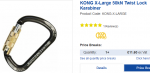
 
A few problems with that setup.
Chain is better than rope as it does not fray on the fairleads or bow fitting.
It can be difficult to reach down and hook it onto the buoy. Picking up a rope or chain already attached to the buoy is much easier.
That type of carabiner can self open if it swings around the eye on the buoy. At least use a locking one like this.
1619780849535.png
 
You did not give the length or breadth of the boat (just as important as weight for determining wind load), but assuming about 35 feet, the ABYC mooring working load recommendation is 2700 pounds working load. Breaking load is about 13,500 pounds (6100 kg or 60 kN). The other problem with carabiners is corrosion.

So yeah, a lot more.
 
Agree as above:

I would add that whilst I would never rely upon a carabiner for a mooring set up I used to have a large scaffolder's type carabiner (large gate) with dyneema attached to it (just over two boat lengths of line).

When picking up my buoy single handedly, the carabiner was in cockpit with me and the line lead along the outside of boat and then over the stem head fitting and back to me in cockpit (with a cleat nearby).

I'd motor up until buoy was at cockpit side, lean over, clip on carabiner and let go, haul in slack, cleat off and I was on mooring.

Walk up to bow and pick up the proper strops. (engine in neutral in case I needed it and sails still ready to haul too).

Saved a lot of hassle with boat hooks etc and worked for me.

I would never rely upon the system for longer than it took to pick up the mooring strops though.
 
And yes, a non-locking carabiner is never used unless very temporary, and generally where rotation and slack (both likely) can occur. Even locking carabiners are vulnerable to gate loading if they get twisted the right way.

Non-locking wire gate carabiners can be used to attach snubbers, because rotation is impossible and because they are always backed up by the main rode. I like that application, because it is so easy. It has never failed me. But that is compelelty different from attaching to a mooring.
 
A few years ago I thought it would be a good idea to attach the painter to my tender with one of those things, and initially it seemed to work well. One day I had just stepped out of the tender on to the shore and was using the painter to pull it a bit further up the beach when, while I watched, the carabiner twisted off the bow ring and I was left holding a painter attached to nothing. Fortunately, I just had to step forward a couple of paces to grab the tender before it floated away, but since then I have never used a caribiner for anything even slightly important.
 
A few years ago I thought it would be a good idea to attach the painter to my tender with one of those things, and initially it seemed to work well. One day I had just stepped out of the tender on to the shore and was using the painter to pull it a bit further up the beach when, while I watched, the carabiner twisted off the bow ring and I was left holding a painter attached to nothing. Fortunately, I just had to step forward a couple of paces to grab the tender before it floated away, but since then I have never used a caribiner for anything even slightly important.

You can use a non-locking carabiner for "important" things. You just have to understand whether twisting is a risk.

unclip from u-bolt

For example, if the dinghy attachment had been extended with a sling it could not have twisted off. I've towed stuff countless miles using carabiners, but they were clipped to bolt hangers, designed for the purpose. All of our painters (kayaks and dinghies) have biners on them, but the crew are all climbers.
 
I have used (substantial) one as a connector on the break-away chain on an unbraked trailer.
Until I reversed the trailer to an almost jack-knife angle to 'just get it into a gateway' and the chain went taut ... and the carbine hook just straightened out, like a paperclip.
Never used one since.
 
I have used (substantial) one as a connector on the break-away chain on an unbraked trailer.
Until I reversed the trailer to an almost jack-knife angle to 'just get it into a gateway' and the chain went taut ... and the carbine hook just straightened out, like a paperclip.
Never used one since.
a. Cris-cross the chains and that won't happen.
b. It might have been substantial, but it may not have been load rated. Tiny climbing carabiners are rated to 20 kN, large steel biners often far less.
c. If the carabiner gate is pressed open the strength is often reduced by many times. cross gate loading can reduce the strength many times.

Climbers learn to always place carabiners so that they will be loaded in line with the gate facing away from the cliff wall. Just having the gate touch something solid can be fatal, since the gate must lock into the nose seat at high load.

I've routinely use climbing carbiners for load testing up to 7 kN. They are convinient. But I have also intentionally broken safety tether carabiners as low as 2 kN by intentional misloading, something people need to know when using safety tethers.

[Bottom image was at less than 2 kN, but with the webbing near the nose. The Kong and Wichard clips can withstand this same test to about 5kN.]

7.%2Bspinlock%2Btests%2BSpeirs%252C%2B122%252C%2B600%252C%2Band%2B350%2Bpounds.jpg
 
Top