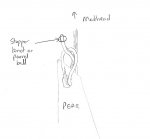
Captive pin shackles vs snap shackles

Bit of 3mm alloy, rounded ends and edges, slot for shackle pins in one end, tongue for opening fuel caps close to the other, hole for a loop of cord, about 1/2 hr work with a bit of scrap metal.
I tried making one from scrap acrylic but the material was too soft but tufnol works.
 
My choice of shackle would be the captive pin type. I've never seen one open accidentally.

I managed to cause this when crewing on a friend's boat once. Not sure how, I probably hadn't turned the pin far enough to click it. Although I thought I had...

Main halyard. Topping lifts make a handy reserve halyard when this occurs.

So they aren't totally numpty proof.
 
I've gone over to swivel jaw snap shackles on main and mizzen halyards to make them easier to connect one handed and both ends of main sheet, so it can be turned around to use the boom out over the side as a hoist. Also on the kicker to use with a snatch block as a barber haul.
 
Bit of 3mm alloy, rounded ends and edges, slot for shackle pins in one end, tongue for opening fuel caps close to the other, hole for a loop of cord, about 1/2 hr work with a bit of scrap metal.
I tried making one from scrap acrylic but the material was too soft but tufnol works.
Never heard of a shackle key?
 
I double the halyard, pass it through the eye of the clew. Then take the free end through the loop. I have a plastic ball on the very end of the halyard so it cannot possibly slip back.
This set up gives me maximum hoist on the sail.
As for mast halyard slap a short line permanently fitted to the shroud is used to pull it away from the mast. Saves the risk of loosing the end of the halyard
That; it's light and there's no shackle to fumble with or lose the pin from and no knot to become bound up. I'm surprised it isn't more commonly used.
 
I double the halyard, pass it through the eye of the clew. Then take the free end through the loop. I have a plastic ball on the very end of the halyard so it cannot possibly slip back.
This set up gives me maximum hoist on the sail.
As for mast halyard slap a short line permanently fitted to the shroud is used to pull it away from the mast. Saves the risk of loosing the end of the halyard
I hope you are not putting the halyard through the clew, or your sail set won’t be optimal :)

That clearly works for you, and is common practice on small sailing dinghies. But not sure I would recommend that technique on larger sails, and dyneema halyards winched bar tight. Like the halyard knot, that loop is likely to go so tight it might need to be cut off - and/or a plastic ball shatter with the forces involved,
 
I hope you are not putting the halyard through the clew, or your sail set won’t be optimal :)

That clearly works for you, and is common practice on small sailing dinghies. But not sure I would recommend that technique on larger sails, and dyneema halyards winched bar tight. Like the halyard knot, that loop is likely to go so tight it might need to be cut off - and/or a plastic ball shatter with the forces involved,
I meant eye in the headboard- thanks for pointing that out
No strain on the ball as it is 20 mm from the fixing which does not slip & easy enough to undo. The ball is really just as a backup. Could just as easily be a knot.
I have 8mm dynema halyard & 28.5m2 laminate sail & adjust it regularly. Gets a lot of pull when reefs set, or cunningham applied
 
I use a snap shackle attached by a halyard knot. Simple and lets me have a bit of adjustment if I find I have any chafe.
 
Thank you all, much appreciated. This forum is great.

(I should I think have been clearer, the height involved means I am working one handed - or at the extreme limit of two hands).

It seems that my choice is
  • struggle on!
  • a snapshackle - with a small risk incurred
  • a captive pin shackle, with an aid to opening - one handed
  • or don't detach the halyard, and arrange a convenient tie away from the mast without disrupting the sailcover
I think I shall try the last option.
Daydream Believer, may I check I have understood your halyard attachment method - I may not have done?

Forum 1.jpg
 
Thank you all, much appreciated. This forum is great.

(I should I think have been clearer, the height involved means I am working one handed - or at the extreme limit of two hands).

It seems that my choice is
  • struggle on!
  • a snapshackle - with a small risk incurred
  • a captive pin shackle, with an aid to opening - one handed
  • or don't detach the halyard, and arrange a convenient tie away from the mast without disrupting the sailcover
I think I shall try the last option.
Daydream Believer, may I check I have understood your halyard attachment method - I may not have done?

View attachment 124404
Yes but the loop pulls tight & jams the tail
 
I had one, it was useless for opening the fuel and water caps and only adequate for some shackles.
i never heard of a shackle key that could open the filler caps. Normally a winch handle does the job. My sailing knife has a normal shackle key and the marlinspike (for taking boyscouts out of horses hooves:) ), will also engage with the eye on the end of the pin on a shackle. I my experience captive-pin shackles can be opened without mechanical assistance if the correct technique is used.
 
Thank you all, much appreciated. This forum is great.

(I should I think have been clearer, the height involved means I am working one handed - or at the extreme limit of two hands).

It seems that my choice is
  • struggle on!
  • a snapshackle - with a small risk incurred
  • a captive pin shackle, with an aid to opening - one handed
  • or don't detach the halyard, and arrange a convenient tie away from the mast without disrupting the sailcover
I think I shall try the last option.
Daydream Believer, may I check I have understood your halyard attachment method - I may not have done?

View attachment 124404
Not having taken on board the suggestions re mast steps, you could improvise with a loop of rope tied over the boom or on the rams horn, that hangs down to within a foot of the deck, to give you a foothold to gain an extra foot of altitude.
 
Not having taken on board the suggestions re mast steps, you could improvise with a loop of rope tied over the boom or on the rams horn, that hangs down to within a foot of the deck, to give you a foothold to gain an extra foot of altitude.

Apologies, apologies.
I should have said, I have mast steps, but still find I need one hand for holding on.
 
Top