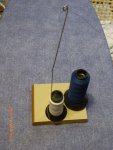
Canvas for a "stack-pack" repair ?

This is all really fascinating. Thanks for the tension tips and the sock idea ! I will certainly buy some V69 thread too. I am using an Alfa machine which is a bit heavier than my mother's 1938 hand Singer (though that has done some great jobs in the past) but this one has zigzag, backwards and is electric - how modern is that ?!

I will report back and doubtless ask more questions. At the moment I need to do that lovely cleaning job to get all the green muck off !
 
Top tension needs adjusting more frequently, especially when changing fabric and thread. The crossover point of the top and bottom threads should be buried in the fabric. If the top thread goes through small loops of the bottom thread pulled through to be above the fabric then top tension is too high.
 
The needle also needs to be sized for the thread.

The thread should sit nicely in the groove and lie slightly proud.

If the thread is too fine for the needle then the hole the needle makes in the fabric will be too loose for the thread, the loop won't form underneath and you can get dropped stitches.

If you do have zig zag, then incorrect thread tensions become even more obvious.

This is digressing from the original question. I hope the original poster doesn't mind but it's all useful ideas.. and as justanothersailboat mentioned, get that little brush out and defluff all the working parts under and around the feed dogs and bobbin area. Whilst you're at it, drop a smidgen of light machine oil onto all the moving parts that are in contact with each other.
 
Link below to a previous thread where I linked to a couple of videos I found showing the formation of the loop that's formed in the thread, which the rotating hook then picks up.

Sewing machine problem

Another reason for dropped stitches is timing that's a bit off... To verify that you'd need to check that the needle is coming up the required 3mm (approx.) before the tip of the hook passes by and that the hook is close enough to the needle (i.e. within the scarf).
 
I think the 'sock' idea was one of Dad's from about sixty years ago.. (another of his ideas from seventy years ago was to use webbing instead of rope when parachuting into Malaya and having to lower themselves down to the ground if they got caught up in the tree canopy - but that's a story for another day - suffice to say it was easier to direct a roll of webbing down through tree branches than a 300ft bundle of rope)..

If you're not into socks then 'bought' versions are available and known as spool net savers or 'thread net sock'.. (Video and pictures below - in case my instructions for socks was hard to fathom).


Thread net spool saver.PNG
 
The needle also needs to be sized for the thread.

The thread should sit nicely in the groove and lie slightly proud.

If the thread is too fine for the needle then the hole the needle makes in the fabric will be too loose for the thread, the loop won't form underneath and you can get dropped stitches.

If you do have zig zag, then incorrect thread tensions become even more obvious.

This is digressing from the original question. I hope the original poster doesn't mind but it's all useful ideas.. and as justanothersailboat mentioned, get that little brush out and defluff all the working parts under and around the feed dogs and bobbin area. Whilst you're at it, drop a smidgen of light machine oil onto all the moving parts that are in contact with each other.

The "digressions" are most welcome. Anything to make it easier and get a better result. I have now dug through my existing stuff and found Serabond 40/V69 and Serabond 30 (both Amman Group). I would like to sew at least 2 layers of canvas for repairs on the body of the canvas but where there is wear on the edging I might be up to, say, 4 layers. I can, if necessary, hand sew.

I should say I haven't had need to do this since I refurbished the complete hood and canvas cover for our Rival 41 so I am very rusty (and I wasn't a good sewer in the first place !) The pack of machine needles I have to hand is SCHMETZ UNIVERSAL 130/705H 15x1H 90/14. I have a recollection of buying Jean needles for the last project.

So what thread and needles would you recommend ? All advice most welcome ! And I shall get my small brush out preparing for a good clean of any fluff that dares to hide ...
 
"Universal" needles try to be halfway between a "sharp" and a "ball" (jersey) needle and I suspect you may be happier with a sharp for this job, but "90/14" needles are relatively heavy needles by ordinary domestic machine standards (though on the light end for heavy canvas work), so I would give them a try before buying any more needles. Jeans needles would be heavier and sharper and perhaps a bit better for this work, but if you don't have any left, the spec for Serabond 40 says it should just about be in range of a 90/14. (I just searched that, I don't really know & could be wrong). If your machine is reasonably robust it should cope with four layers of canvas so long as they're flat and smooth. What it really won't like is if there's a thicker lump (eg a folded seam crossing inside another) and you let it run off the end of the thicker lump too quickly, avoid this or go carefully and ease it over if you really must. In my experience the old cast iron, hand crank machines can punch through more than most ordinary modern electrics and I still keep one around just in case, and for leather.

With a 90 needle and thread that fits in it, you may not need to change the bobbin case tension at all - see if you can get correctly formed stitches just by adjusting the top tension first. Treat the lower tension (on the bobbin case) as a last resort.
 
$10.99 seems a bit steep. It looks like the stuff they put around duty free bottles to stop them clashing. I have lots on the boat to stop wine and beer bottles from rattling. You can get it from here Net sleeving . Unfortunately a minimum of 10m but you could use the rest to protect your valuable beer bottles.
I don't seem to have a problem with the feed from a spool when using my home made stand but I'm still very much a beginner at sewing.
1678821125369.jpeg
 
$10.99 seems a bit steep. It looks like the stuff they put around duty free bottles to stop them clashing.

That was only an example as the first photo I found on the Internet... Time to start selling the freebie bottle protector nets then!

Some threads don't spring off the spools... other thread just seems to try and escape from them, hence the nets.

Wrapping them does keep the thread on the spool though if you have lots in your sewing bag.
 
Our current canvas project is in Sauleda acrylic canvas. We are using Serabond V69 thread and a heavy 100/16 Jeans needle running through a 1970's Jones 942 metal bodied sewing machine. It seems to be coping with at least 5 layers of canvas at some points and a canvas/webbing bit too. Needles are Hemline off Amazon if that helps.
 
Ideally use the largest thread size V92 to sew acrylic canvas . Minimum Needle size 100 /18 or 110 to 120 / 19 .
Also acrylic canvas can be heat sealed for patching to avoid extra layers .Sew smaller patch on inside to cover damage ,then larger patch say 10mm all round then sew that on out side the smaller one .
 
Ideally use the largest thread size V92 to sew acrylic canvas . Minimum Needle size 100 /18 or 110 to 120 / 19 .
Also acrylic canvas can be heat sealed for patching to avoid extra layers .Sew smaller patch on inside to cover damage ,then larger patch say 10mm all round then sew that on out side the smaller one .
Many thanks for that. And a huge THANK YOU for the bundle of navy canvas you so kindly sent me. What a star !
 
Top