
You are using an out of date browser. It may not display this or other websites correctly.
You should upgrade or use an alternative browser.
You should upgrade or use an alternative browser.
Canbus Electrics
- Thread starter pmagowan
- Start date
Graham_Wright
Well-Known Member
Canbus on a boat - excellent idea. Of course you will need emergency backup with separate switches and feeds and local operation plus all the cabling when it (all) fails at the wrong moment.
Um.:nonchalance:
Um.:nonchalance:
prv
Well-Known Member
excellent idea. Of course you will need emergency backup with separate switches and feeds and local operation plus all the cabling when it (all) fails at the wrong moment.
Do you have dual-redundant wiring currently?
I'd have more faith in a sturdy DeviceNet cable with overmoulded connectors than the typical yottie mess of individual wires and choc-blocks squeezed into crevices in the furniture.
Pete

vas
Well-Known Member
Do you have dual-redundant wiring currently?
I'd have more faith in a sturdy DeviceNet cable with overmoulded connectors than the typical yottie mess of individual wires and choc-blocks squeezed into crevices in the furniture.
Pete
+1
fwiw, all important bits of switching is done via the helm el.panel, and I can operate these BMS 20A relays manually by simply opening a cabinet.
V.
derekm32
New Member
i2C can be made to run up 10m but you need to be careful about termination,I2C is an 'Inter IC' bus. It's intended for connecting a bunch of chips on a PCB, or at most across a backplane.
It could be a very poor choice for comms over any distance.
It's not really a bus that you'd choose for devices powered from different fuses for instance.
I think you need to be clear about your aims, and also the 'ground rules'.
In my view, the ground rules for designing systems in a typical cruiser-racer amateur yacht might include:
1) must keep various systems working when other sub-systems fail
2) should not introduce new single points of failure that take out multiple functions
3) the environment is damp on a good day and the possibility of two feet of water in the cabin should be considered....
I wonder what others would add to that?
I do agree with the sentiment that yachts these days have far too much spaghetti shoved behind a panel near the chart table.
On one of my boats, I called a halt to that, instead of adding yet another breaker for the Eberspacher, I decided that didn't need to be switched from the chart table. So I added a secondary switch and breaker panel in the aft cabin for a few functions. That saved a lot of work and a few metres of fat wire.
I've been on yachts when a fault in one instrument locks up the whole instrument bus. That was fraught, and made me wish for the nice simple standalone Nasa depthsounder my own boat had at the time.
Apart from a few cabin lights and the stereo, there is not much on a yacht which doesn't have potential safety implications if it won't work.
As an aside, my mate had some issues with his BMW late last year. Odd things happening, random tailights coming on and tailgate window popping open while driving.
I thought this was going to be some scary-complex CANbus issue, but actualy it was plain old multiple wires. The only canbus involved runs from the dash to a box of nonsense in the passenger footwell, from there it's old skool copper spaghetti. Something like 22 wires alongside the tailgate hinge? That's an 08 plate car.
st599
Well-Known Member
Yes, NMEA 2000 is based on CanBUSI am revamping the electrics on a Sweden 41 and was wondering if anyone else had canbus based electrics. It seems ideal for a boat that rather than have all the wires trailing back to the one panel at the chart table you only need a reasonable sized +ve and -ve and a signal wire going round the boat.
Has anyone done this?

geem
Well-Known Member
Super yachts take the canbus approach. The few Captains I know tell me how problematic these systems are. The engineers that design these systems love them. Those that have to operate the system don't have the same affection. Some of the gremlins on fly by wire throttles and gear selection have had serious failures when the throttle/gear position says forward and the engines are going full astern. The nunber of faults on the canbus system on a couple of superyachts we know was worrying. Give me a decent hard wired system any dayI am revamping the electrics on a Sweden 41 and was wondering if anyone else had canbus based electrics. It seems ideal for a boat that rather than have all the wires trailing back to the one panel at the chart table you only need a reasonable sized +ve and -ve and a signal wire going round the boat. Then you can have a series of switching nodes at convenient locations. Microcontrollers, like the arduino, can also control RGB LEDs and so you can have adjustable lighting. You can also reprogram any of the switches to other functions as necessary e.g press switch to turn light off/on, press and hold for 2 seconds to turn all cabin lights off/on.
Has anyone done this?
Graham_Wright
Well-Known Member
Yes I do - where it matters.Do you have dual-redundant wiring currently?
I'd have more faith in a sturdy DeviceNet cable with overmoulded connectors than the typical yottie mess of individual wires and choc-blocks squeezed into crevices in the furniture.
Pete
vas
Well-Known Member
with due respect Geem, if you read behind the lines, it's NOT the CANBUS that fails, it's the bloody hardware that hooks there which is crap and fails.Super yachts take the canbus approach. The few Captains I know tell me how problematic these systems are. The engineers that design these systems love them. Those that have to operate the system don't have the same affection. Some of the gremlins on fly by wire throttles and gear selection have had serious failures when the throttle/gear position says forward and the engines are going full astern. The nunber of faults on the canbus system on a couple of superyachts we know was worrying. Give me a decent hard wired system any day
CANBUS is a rather robust protocol running on v.many things from cars to airplanes and most domotic systems in houses/hotels/factories.
so yes, can be a pain but not the CANBUS to blame ;-)
cheers
V.

westernman
Well-Known Member
NMEA 2000 is CAN + specification of connectors and cabling.Yes, NMEA 2000 is based on CanBUS

Baggywrinkle
Well-Known Member
CANbus is decades old and has been in cars since the late 80s. With a transceiver connected to a tablet, laptop or RPi and a bit of software to read out the bus traffic, (plus a copy of the message catalogue), you can see exactly what is going on. Including tracing traffic and injecting messages.
NMEA 2000 connects devices using Controller Area Network (CAN). NMEA 2000 is based on the SAE J1939 high-level protocol, but defines its own messages. NMEA 2000 devices and J1939 devices can be made to co-exist on the same physical network.
CAN functions like this ...
Functionality - EMS Dr. Thomas Wünsche
... all in all, very reliable but when the backbone goes down, everything goes with it.
If you want redundancy, segregate the backbone with gateways or think about separate backbones for specific functions.
Most modern boats already have a NMEA2000 backbone out of the factory which is used for the instrumentation.
Mads from SailLife did it on his boat with these Products
... and if I remember correctly, when it all stops working, you can bypass all the electrickery in the switch modules and control the outputs directly giving backup functionality.
NMEA 2000 connects devices using Controller Area Network (CAN). NMEA 2000 is based on the SAE J1939 high-level protocol, but defines its own messages. NMEA 2000 devices and J1939 devices can be made to co-exist on the same physical network.
CAN functions like this ...
Functionality - EMS Dr. Thomas Wünsche
... all in all, very reliable but when the backbone goes down, everything goes with it.
If you want redundancy, segregate the backbone with gateways or think about separate backbones for specific functions.
Most modern boats already have a NMEA2000 backbone out of the factory which is used for the instrumentation.
Mads from SailLife did it on his boat with these Products
... and if I remember correctly, when it all stops working, you can bypass all the electrickery in the switch modules and control the outputs directly giving backup functionality.
Last edited:
st599
Well-Known Member
Not sure I'd be looking at 2000 now though. The new NMEA OneNet protocol looks more promising.
Baggywrinkle
Well-Known Member
Not sure I'd be looking at 2000 now though. The new NMEA OneNet protocol looks more promising.
I think OneNet is based on ethernet which means everything will get more expensive. The huge advantage of CAN is that it is very cheap. We've moved our in-vehicle bus to ethernet and getting the old CAN world, particularly switch packs and actuators to move to Ethernet is proving somewhat difficult due to the oncost of supporting an IP stack and an ethernet physical layer.
The other issue with ethernet is that it is no longer a shared medium like it used to be, rather a point to point system supported by switches (NMEA OneNet Switches). They are also expensive compared to the CAN network topology which only needs two terminators.
geem
Well-Known Member
I am no expert, i just listen to my Captain friends tales of woe. They hate the systems installed on their boats.with due respect Geem, if you read behind the lines, it's NOT the CANBUS that fails, it's the bloody hardware that hooks there which is crap and fails.
CANBUS is a rather robust protocol running on v.many things from cars to airplanes and most domotic systems in houses/hotels/factories.
so yes, can be a pain but not the CANBUS to blame ;-)
cheers
V.
I think part of the problem is that all these superyachts are one offs. They all get a bespoke design. Very different to cars that go through rigorous testing. Anybody converting a small yacht would likely have less issues simply because a small yacht will be way less complex.
I have a .raymarine nmea2000 backbone in my boat. I just traced a power spike problem on a wind speed repeater to a faulty 24/12v dropper. It must have an internal short as it was super hot to the touch. It dragged the system voltage down. New dropper and we are back in business. It took a day to find the problem. It would be way simpler with hard wired system in my view. When canbus works it great. Can be hard to trace faults though
Baggywrinkle
Well-Known Member
I am no expert, i just listen to my Captain friends tales of woe. They hate the systems installed on their boats.
I think part of the problem is that all these superyachts are one offs. They all get a bespoke design. Very different to cars that go through rigorous testing. Anybody converting a small yacht would likely have less issues simply because a small yacht will be way less complex.
I have a .raymarine nmea2000 backbone in my boat. I just traced a power spike problem on a wind speed repeater to a faulty 24/12v dropper. It must have an internal short as it was super hot to the touch. It dragged the system voltage down. New dropper and we are back in business. It took a day to find the problem. It would be way simpler with hard wired system in my view. When canbus works it great. Can be hard to trace faults though
It's more a problem of coping with paradigm shifts and putting the effort in to get over the learning curve ... I have no problem diagnosing bus systems but they are much more complex than basic 12v electrical circuits.
Most of the functions available on modern plotters, repeaters and multi-function displays are only possible with bus systems ... just you need someone who knows what they are doing to fix them.
Give it a generation and everyone will be fine with bus systems but it will be the next tech advance that they will all hate.
geem
Well-Known Member
Yep, just upgraded to a Raymarine axiom+ 12" RV, ACU400 autopilot, and a pair of p70s control heads. All this trying to intergrate with existing seven St 60/70 items and keeping the existing seatalk network for ST60s. I extended the backbone through the engine room to pick up the ACU400. I spent the last 2 days trying to integrate everything and fault finding. Turns out the 24/12v dropper powering the backbone was faulty. I suspect a short. I think it was dragging the voltage down. The wind speed would spike every 10 seconds. A whole new level of pain in fault finding compared so hard wired electrical items.It's more a problem of coping with paradigm shifts and putting the effort in to get over the learning curve ... I have no problem diagnosing bus systems but they are much more complex than basic 12v electrical circuits.
Most of the functions available on modern plotters, repeaters and multi-function displays are only possible with bus systems ... just you need someone who knows what they are doing to fix them.
Give it a generation and everyone will be fine with bus systems but it will be the next tech advance that they will all hate.
A new dropper sorted it. Now trying to get the AIS with nmea0183 to integrate through an Actisense converter. Just ordered the cable to allow me to access the converter and reprogrammed the baud rate. I am no expert at this so feeling my way a long.
vas
Well-Known Member
a mix and match system where you want to keep some old and still performing kit and integrate it with N2K is more of a pain, true.
Re debugging my boat was a great example of complication and in some terms how not to do things! Further I built my own N2K black boxes using Timo Lappalainen arduino libs (have five onboard atm).
The only problems I ever had was when my black boxes at the beginning were doing silly things and NOT joining / be accepted/communicated with the bus - these were coding errors which you wont find on a compliant N2K certified device of course!
Yes, power supply is pretty essential, any small 4-5in N2K gauge (that is powered exclusively from the bus) would show it immediately (by not firing up ) Mind if the bus is big, you can (should!) have a second power supply for redundancy - try it, a dropper is 30-40 euro.
FWIW, my bus is on 24/7 for the last 8yrs, a VenusOS (Victron opensource s/w) device gives me enough info on the el. of the whole boat when there, but most importantly send via the boat router data to an influx database every 30secs: that data are harvested from the N2K bus, so I get water depth (and speed for the week after launch that it works...), cabin temps, outside wind/temp, humidity, tank levels, engine/geny state, you name it. All that is due to having the N2K bus powered and a tiny 20euro device reading all "messages" converting them and pumping them to the web.
TBH, compared to the mess of tiny fcking cables joined together with wherever fills suit (invariably some will be simply twisted and taped over, others with gnd, others free floating, etc is not something I'm keen on dealing with. Yes, I know it (generally) works but that's not sleek nor smart.
I know each to their own and all that!
V.
Re debugging my boat was a great example of complication
and in some terms how not to do things! Further I built my own N2K black boxes using Timo Lappalainen arduino libs (have five onboard atm).The only problems I ever had was when my black boxes at the beginning were doing silly things and NOT joining / be accepted/communicated with the bus - these were coding errors which you wont find on a compliant N2K certified device of course!
Yes, power supply is pretty essential, any small 4-5in N2K gauge (that is powered exclusively from the bus) would show it immediately (by not firing up
) Mind if the bus is big, you can (should!) have a second power supply for redundancy - try it, a dropper is 30-40 euro.FWIW, my bus is on 24/7 for the last 8yrs, a VenusOS (Victron opensource s/w) device gives me enough info on the el. of the whole boat when there, but most importantly send via the boat router data to an influx database every 30secs: that data are harvested from the N2K bus, so I get water depth (and speed for the week after launch that it works...), cabin temps, outside wind/temp, humidity, tank levels, engine/geny state, you name it. All that is due to having the N2K bus powered and a tiny 20euro device reading all "messages" converting them and pumping them to the web.
TBH, compared to the mess of tiny fcking cables joined together with wherever fills suit (invariably some will be simply twisted and taped over, others with gnd, others free floating, etc is not something I'm keen on dealing with. Yes, I know it (generally) works but that's not sleek nor smart.
I know each to their own and all that!
V.
Baggywrinkle
Well-Known Member
This is what my electrical system evolved into ...
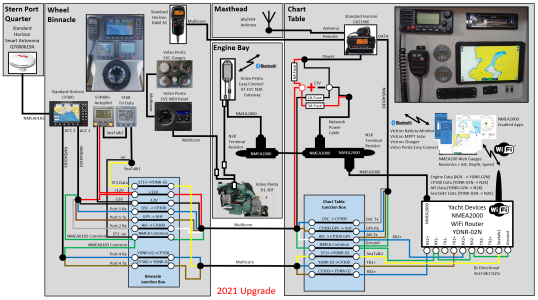
... the only issue I had was that the NMEA2000 WiFi router was routing too much data onto the Seatalk1 network which caused the Raymarine Autopilot to malfunction ... it exhibited heading drift. Once the routing table was modified from its default settings to limit what went to the Seatalk1 bus everything was fine.
Basically a weird failure mode from the autopilot.
... the only issue I had was that the NMEA2000 WiFi router was routing too much data onto the Seatalk1 network which caused the Raymarine Autopilot to malfunction ... it exhibited heading drift. Once the routing table was modified from its default settings to limit what went to the Seatalk1 bus everything was fine.
Basically a weird failure mode from the autopilot.
geem
Well-Known Member
I think these weird failure modes are way more likely with Cambus systems. That's why my Captain friends on Cambus based superyachts detest them so much. We have pretty tiny systems and it's apparent that it's not just me having issues. Can you imagine the potential failure issues on a 100 metre superyacht.This is what my electrical system evolved into ...
View attachment 170977
... the only issue I had was that the NMEA2000 WiFi router was routing too much data onto the Seatalk1 network which caused the Raymarine Autopilot to malfunction ... it exhibited heading drift. Once the routing table was modified from its default settings to limit what went to the Seatalk1 bus everything was fine.
Basically a weird failure mode from the autopilot.
I found the problem with my dropper (I have two on the system) because when I turned on the Autopilot ( it has a 24v supply) the problem of irratic spiking in the wind speed display stopped. This suggested that the system was getting power from the autopilot even though there were two droppers supplying the network, one at each end. Removing the super hot dropper and replacing it cured the fault. I didn't know it was faulty until I put my hand on it and I couldn't leave it there.a mix and match system where you want to keep some old and still performing kit and integrate it with N2K is more of a pain, true.
Re debugging my boat was a great example of complication
The only problems I ever had was when my black boxes at the beginning were doing silly things and NOT joining / be accepted/communicated with the bus - these were coding errors which you wont find on a compliant N2K certified device of course!
Yes, power supply is pretty essential, any small 4-5in N2K gauge (that is powered exclusively from the bus) would show it immediately (by not firing up
FWIW, my bus is on 24/7 for the last 8yrs, a VenusOS (Victron opensource s/w) device gives me enough info on the el. of the whole boat when there, but most importantly send via the boat router data to an influx database every 30secs: that data are harvested from the N2K bus, so I get water depth (and speed for the week after launch that it works...), cabin temps, outside wind/temp, humidity, tank levels, engine/geny state, you name it. All that is due to having the N2K bus powered and a tiny 20euro device reading all "messages" converting them and pumping them to the web.
TBH, compared to the mess of tiny fcking cables joined together with wherever fills suit (invariably some will be simply twisted and taped over, others with gnd, others free floating, etc is not something I'm keen on dealing with. Yes, I know it (generally) works but that's not sleek nor smart.
I know each to their own and all that!
V.
vas
Well-Known Member
I think it has been asked before, what s/w did you use for the dia, may have to do one like that (but it's going to be a bit larger I'm afraid with just one N0183 branch/deviceThis is what my electrical system evolved into ...
View attachment 170977
... the only issue I had was that the NMEA2000 WiFi router was routing too much data onto the Seatalk1 network which caused the Raymarine Autopilot to malfunction ... it exhibited heading drift. Once the routing table was modified from its default settings to limit what went to the Seatalk1 bus everything was fine.
Basically a weird failure mode from the autopilot.
Would be good to have such a graph for others (or me with memory failing as time passes!)